Jake Galstad/Motorsport Images
PRUETT: Our safety heroes in Nomex
The fears expressed upon the aeroscreen’s introduction in 2020 involved overturned cars, trapped drivers, and the worst-case scenario of our heroes being entombed in flames within a cockpit that offers no exit.
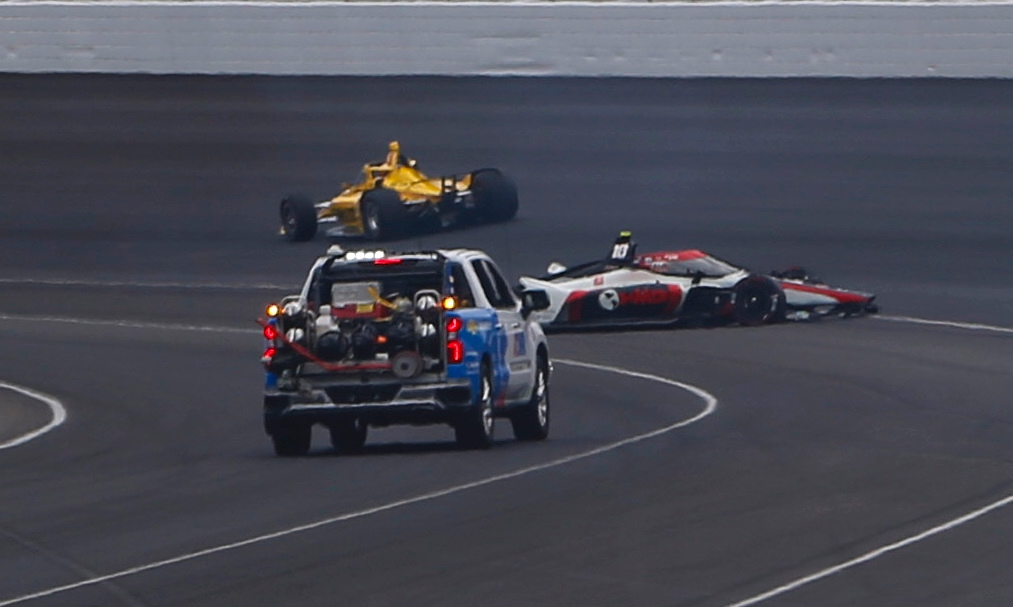
Tim Baughman’s IndyCar Safety Team has trained for this outcome on multiple occasions. On Friday, as Colton Herta flew and flipped through Indianapolis Motor Speedway’s Turn 1 during final practice for the Indy 500, his AMR-sponsored crew were rolling hard in their custom emergency response trucks while the Andretti Autosport driver’s was sliding and scraping the last of its speed down to a spark-filled stop. They reached Herta within eight seconds of his car coming to rest.
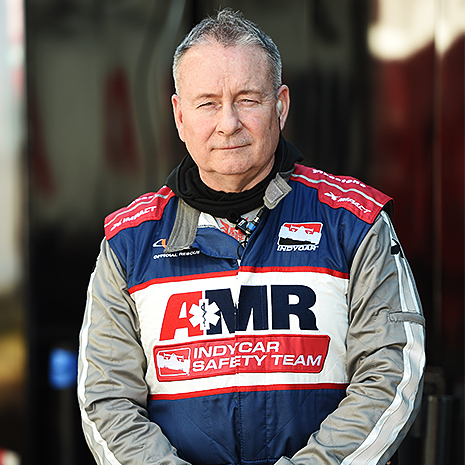
Tim Baughman. IndyCar photo
"You've got to understand and respect that an IndyCar traveling 220 miles an hour is going to football field a second,” Baughman told RACER. “And when it hits something, our accident scenes are like a plane crash. There's 1000 feet covered from the time they hit to the time they come to a rest. While they are sliding, they're dissipating energy, and that's part of it.
“But that’s also when our guys drop it into gear and they're moving before the car has finished wrecking and that's why we can catch the car. We're going faster than it is by the time it slides to the stop. We roll immediately as soon as the hit happens and call ‘yellow, yellow, yellow’ -- that's our dispatch on ovals. We drop the hammer on all three trucks, regardless.”
The swift and balletic maneuvers amid an emergency response are a gift to the NTT IndyCar Series and its drivers.
“We can be aggressive in our response because everything is about getting to that driver,” Baughman said. “If you look at that video really closely, you'll see one of our guys coming down, it was eight seconds after the sparks stopped flying. He’s sliding in there, he's on his back, looking at Colton and saying, ‘Hey, we're here, we're gonna get you out, stay put.’ And then he reports back using the radio. We have a code system: Code 01 means the driver’s OK, uninjured. In this case, it was, Car 26, Code 01.
“And as everybody was pulling up to the scene, the first thing we have is radio silence and rapid initial dispatch, until the crew leader comes back and says Code 01, or Code 02 means the drivers awake but has some kind of injury, or Code 03 means the drivers had their bell rang and they're possibly unconscious and then Code 05 is multiple systems trauma. We don't say ‘fatality’ over the radio.
“Depending on the code called over the radio, it changes the whole game plan like a Code 01 stands down all the doctors in the trauma center all the medical staff. But if it's anything escalated to a Code 03 or Code 05, everybody goes on a higher alert. The pilots head towards the helicopter to prepare for transport to the hospital. All the doctors start forming in the driver trauma room at the Health Care Center. So all those things are part of those systems and they all hear that and they all understand what our codes are. We added a new code we developed after the James Hinchcliffe crash. It's a Code H and it's not for ‘Hinchcliffe’ it's for drivers that have a hemorrhage.”
In unison, the AMR team lifted Herta’s tattered car until it was resting at 90 degrees and then progressed to lay the car flat.
“Our drill is getting to the car and get it on its side at 90,” Baughman said. “At 90, things happen where you can better protect a driver from the flame. “We’ll put extinguishing agents on it immediately while its upside down, but get it to 90, and you give the driver a way to get out now that it's wide open and they're awake like Colton was. He climbed right out. So that process is a minor change that we made with the aeroscreen, because we’ve had cars upside down for a long time and believe better things happen at 90 degrees.”
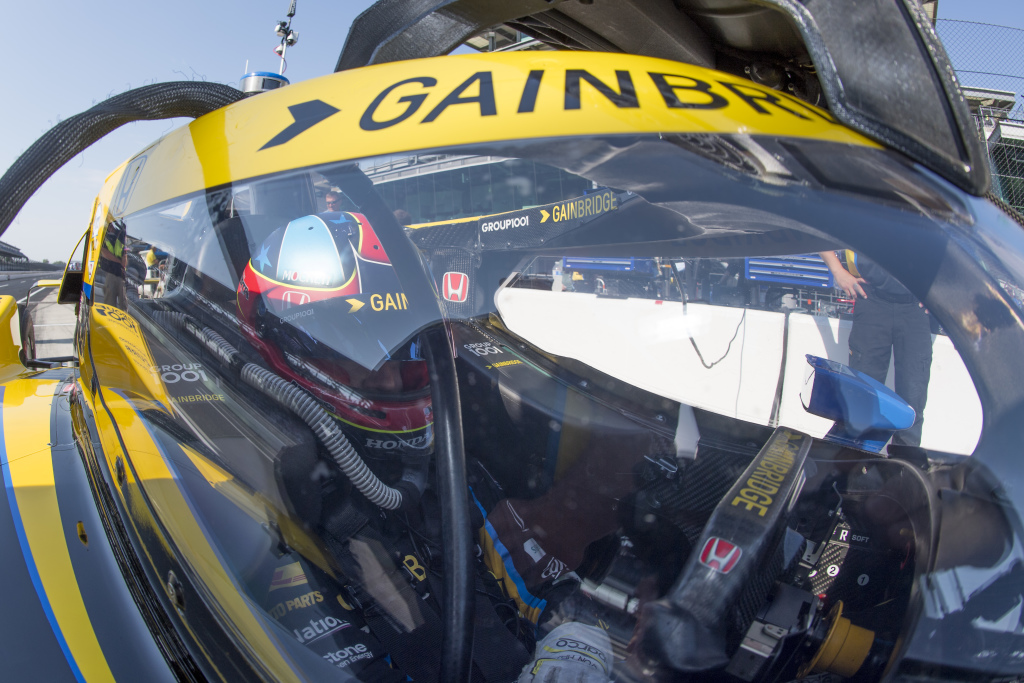
The aeroscreen has changed some of the Safety Team's practices, but not the speed or precision of their extractions. Motorsport Images
Thankfully, there was no fire to contain as the inverted No. 26 Dallara DW12-Honda provided all of the impact countermeasures it was designed to offer; the E85 fuel in the 18.5-gallon cell behind Herta maintained its integrity. All of the seals and hoses carrying the fuel were unbroken. The crushable front, side, and rear structures dissipated energy; Herta’s custom seat, made from compressed foam beads, protected the Californian’s spine; the dense cockpit head surround and HANS device managed the immense whipping forces experienced by his head.
And the aeroscreen and roll hoop kept Herta safe from the ground below and any debris that might have made its way into the driver safety cell.
https://twitter.com/IndyCar/status/1530269985624543238
Although the opportunity has yet to present itself, Baughman’s hardcore team of EMTs, firefighters, medical specialists, trauma specialists, and coordinators are ready for the day when the first driver inversion -- with fire in the cockpit -- of the aeroscreen era happens.
“The first objective is to make sure that driver is the start of everything we do in a worst-case scenario where it's upside down, on fire, and the driver’s unconscious or can’t help themselves,” Baughman said. “Five weeks before Romain Grosjean has his fire in Formula 1, I took my crew up to the north end of the Speedway with 50 gallons of fuel, took our training tub, put it upside down with the dummy in it. I dumped fuel all the way around it. And I had our guys suited up like normal and I had them go into the fire to get the dummy driver out. I didn't want the first time that they'd ever done a rescue with a driver who was upside down and on fire to be at a race.
“You know most of us have seen all kinds of stuff, but it’s not common when a race car is upside down and burning; you don’t get that a lot in the races. So we practice going right into the fire, lift the car on fire 90 degrees, and all that. My team are already trained firefighters, they've already been in heat, they already know what fire is. Now it's just a matter of trusting your team, understanding how our extinguishing agents work. We drill like this so the AMR Safety Team understand that heat, knows that their equipment works and the processes behind it.”
Some might not know AMR Safety Team was involved from the aeroscreen’s first conceptual stages. The width and height of the aeroscreen was dictated by the dimensions of the backboard needed to extricate an injured driver. Fastening methods between the aeroscreen and chassis were changed at Baughman’s request to make the unbolting process faster.
Ongoing development of cutting tools to open portals in the polycarbonate screen and the titanium halo, if necessary, feature in the handheld equipment that could be put to use in today’s race. Beyond the immediate response they offer to IndyCar drivers, the team keeps busy behind the scenes looking for advancements in the same way teams are constantly searching for an edge to make the cars faster and more efficient.
“They gave me samples of the titanium -- we cut it with our hydraulic cutters from Holmatro, and I'm telling you, it's the toughest mother out there,” Baughman said. "Trying to cut through that halo material actually helped Holmatro to design their next line of tools that we have on our trucks. Everything was hydraulic tools, but now, we're switching to batteries. They're hydraulic, but they're battery-driven. So you don't have a pump and all those hoses and everything to drag around.
“These are all self-contained, a battery unit and a pump -- you can just walk away and go to go to work with it. You're not carrying all the other equipment that we've had to for all these years anyway. But with the introduction of electricity to the unit, they're able to put sensors in the blades. Those sensors can actually sense the cutting force and actually decrease it or increase the speed based on what it's sensing. So in those first titanium tests, we destroyed the blades and it took about 11 seconds to make a cut. We tested cutting about four months ago with this new tool, same blade, same hydraulic cylinder, but now with electronic components and sensors, and it cut it in eight seconds. And it didn't damage the blades like it did before. That's all because racing helped to develop better rescue stuff.
“PPG gave us a bunch of the screen blanks so that we could practice cutting and making sure we had the right blade and we've trained on them, making thousands of cuts.”
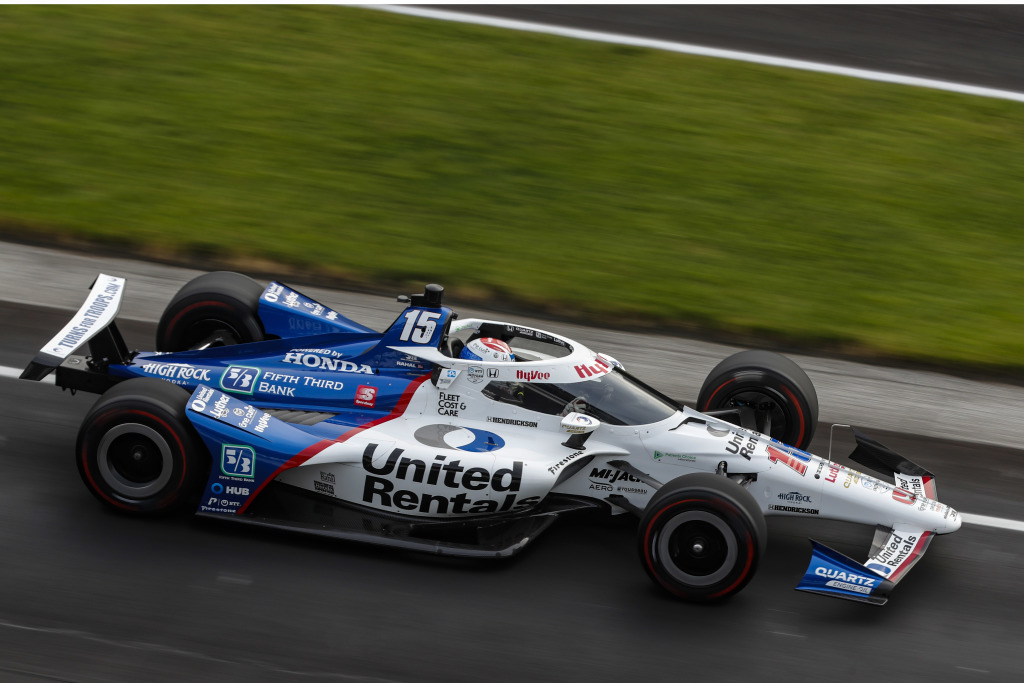
Along with its protection from debris, the Safety Team's testing has shown the aero screen to offer an effective fire barrier. Phillip Abbott/Motorsport Images
Through the use of a blowtorch and an infrared camera, IndyCar’s curious safety group learned PPG’s thick screen has the ability to act as a barrier for an external fire.
“As a firefighter, I wanted to find out how long it would take to melt with a direct torch on it,” Baughman said. “We got to over 1000 degrees. It took almost a minute for the direct torch over 1000 degrees to melt a hole in the polycarbonate screen. We saw how being on the other side of the fire with the screen there helped.”
These are our safety heroes in Nomex. They excel at their craft, amid danger, amid near fatalities and even when the saddest outcomes are laid bare in front of their eyes, because they hold each other to meet an unwavering level of excellence.
The 106th running of the Indianapolis 500 will feature 22 men and women on pit lane, in race control, and mostly in those safety trucks. One truck’s even painted in honor of Carl Horton, the founder of IndyCar’s first traveling safety team who recently passed. As you cheer our 33 brave drivers on Sunday, please share the same energy and love for our specialized first responders. They always deserve it, yet rarely receive it. They are the drivers’ heroes, and if we’re fortunate, they’ll have nothing more than Code 01s to handle.
Presented by:

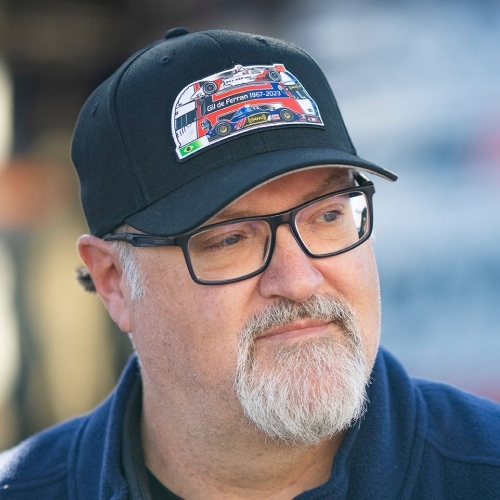
Marshall Pruett
The 2026 season marks Marshall Pruett's 40th year working in the sport. In his role today for RACER, Pruett covers open-wheel and sports car racing as a writer, reporter, photographer, and filmmaker. In his previous career, he served as a mechanic, engineer, and team manager in a variety of series, including IndyCar, IMSA, and World Challenge.
Read Marshall Pruett's articles
Latest News
Comments
Comments are disabled until you accept Social Networking Cookies. Update cookie preferences
If the dialog doesn't appear, ad-blockers are often the cause; try disabling yours or see our Social Features Support.