Motorsport Images
SPECIAL: Won and done – the Brabham BT46B 'Fan Car'
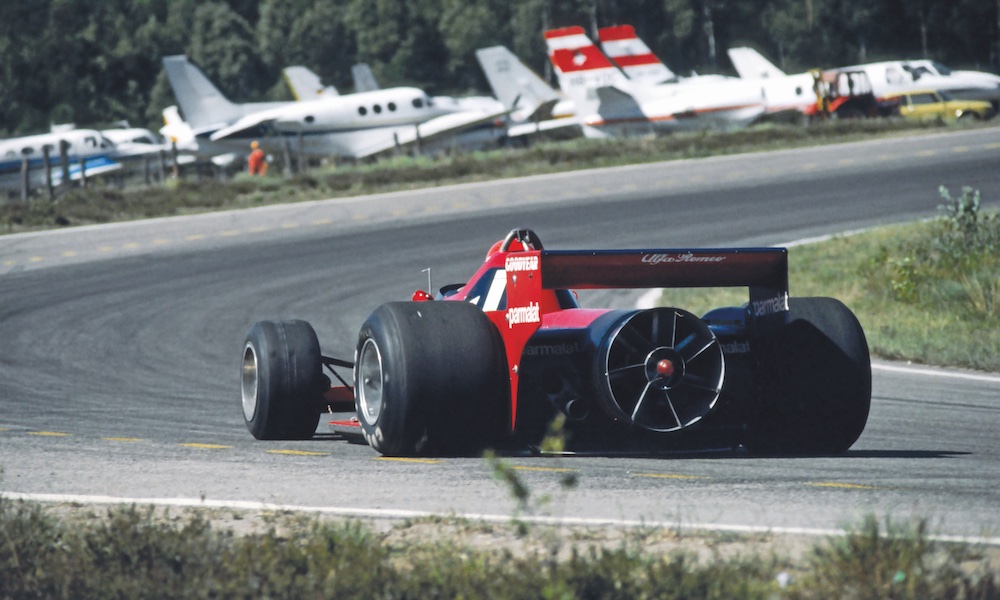
In 1978, Brabham’s Gordon Murray needed something big to beat the Lotus 79. His eureka moment came with the BT46B “Fan Car,” a Formula 1 legend that raced – and won – just once.
This story appears in the Oct./July 2021 ‘Great Cars Issue’ of RACER magazine alongside other great features including an interview with 2021 NTT IndyCar Series champ Alex Palou and a look back on the short, but memorable exploits of cars such as the Indy 500’s whispering turbines and Bentley’s Le Mans-winning Speed 8.
print or digital subscription
.Desperation. That’s what drove Gordon Murray to the most infamous eureka moment of his envelope-pushing career.
In early 1978, the South African designer was feeling the heat – much like his angular Brabham BT46. Its novel surface cooling that promised to do away with conventional radiators was an unmitigated flop, replaced by conventional radiators.
To make matters worse, as Brabham scrabbled to save its season, Lotus was sucking, too… in a far more effective sense. “Black Beauty,” the Type 79, was threatening to gallop away with the Formula 1 season thanks to the low-pressure alchemy brewing beneath its elegant full-length, sealed-skirt sidepods.
The “wing car” had landed, but Murray found himself grounded with little room for maneuver.
His problem was Carlo Chiti’s flat-12 Alfa Romeo, which was bigger and wider than the almost ubiquitous Cosworth DFV V8 and a hindrance in regard to the venturi tunnels he needed to generate ground-effect downforce. His first solution was a twin-monocoque design – a precursor to Colin Chapman’s 1981 Type 88, perhaps? – but the added weight and complexity made it a non-starter. Back to square one. Or at least the FIA rulebook.
Murray paused over the article on aerodynamics that would prove key: “Any device whose primary function is to have an aerodynamic influence on the performance of the car has to be firmly attached to the sprung mass.” There it was. Eureka! The key words were “primary function,” so Murray devised a plan: mount a conventional radiator horizontally over the engine and cool it with a fan hung out the back, driven via engine speed through the gearbox. The story he’d peddle was that a fortuitous side-effect created by fitting flexible skirts to seal the underfloor meant the fan also sucked the car to the ground.
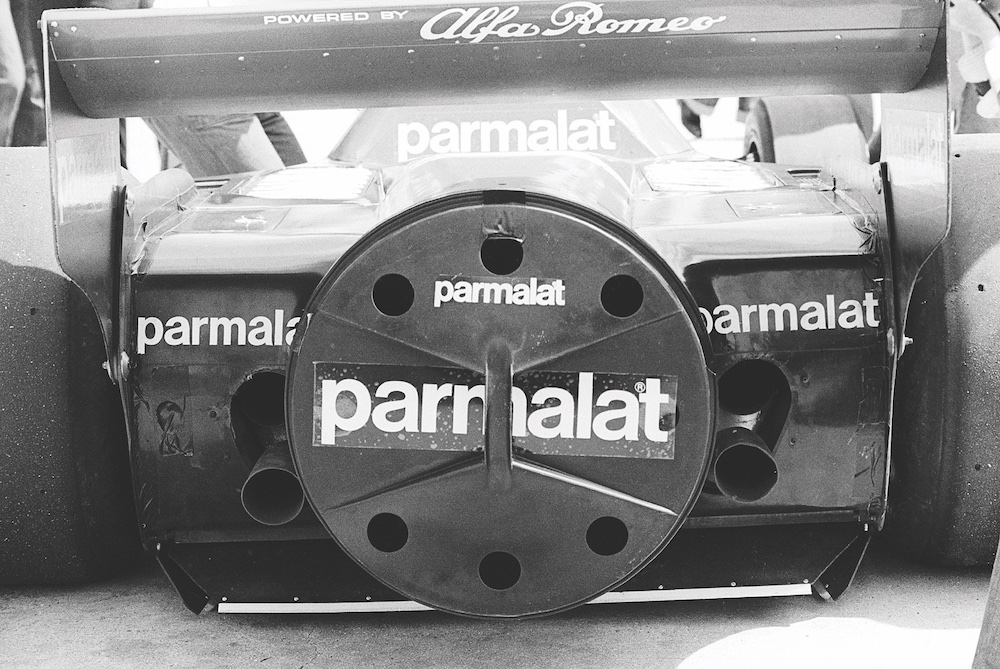
After two private tests, the Brabham fan car went public at a Goodyear tire test at Brands Hatch. Not wishing to give away too many of the BT46B’s secrets, the car’s fan – key to producing suction – was covered with the lid of a trash can in the pits. Sutton/Motorsport Images
Even today, Murray still emphasizes the Brabham BT46 “Fan Car” was entirely legal, to the letter of the rulebook, because the primary function was cooling, not aerodynamic benefit. As he recently noted: “When the FIA measured the flow of air through the fan and through the radiator, they found that 60 percent of the air was for cooling and 40 percent for downforce, meaning that aerodynamics was not the primary function.”
Niki Lauda, the reigning world champion who’d quit Ferrari for Brabham in 1978, spelt out the reality in typically pithy terms. He nicknamed the car “the vacuum cleaner.”
The BT46B ran initially at Alfa’s Balocco test track in Italy, before Brabham boss Bernie Ecclestone booked a strictly private session back in England at Brands Hatch. The track was like Fort Knox according to those who got a whiff – but naturally a scoop photo was captured of the car with its giant fan standing proud below the rear wing.
Brabham then went public at a Brands F1 tire test, although every time the BT46B pitted it was wheeled into a garage and the shutter was pulled down. Still, prying eyes got a closer look when the car stopped out on the circuit. Brabham’s mechanics rushed to hide the device with the aid of a trash-can lid, the diameter of which happened to be a perfect fit.
Lauda’s teammate, John Watson, had his first taste at Brands. “My first thought was it’s a complicated bit of kit,” he tells RACER. “Is it going to work, or is it another surface cooling dream that Gordon’s come up with?”
In his book “To Hell and Back,” Lauda reckoned the fan car “unpleasant to drive. It understeered massively, all the more so when you took your foot off. The fan was powered by the engine, with the result that the suction effect fell off when the revs dropped.”
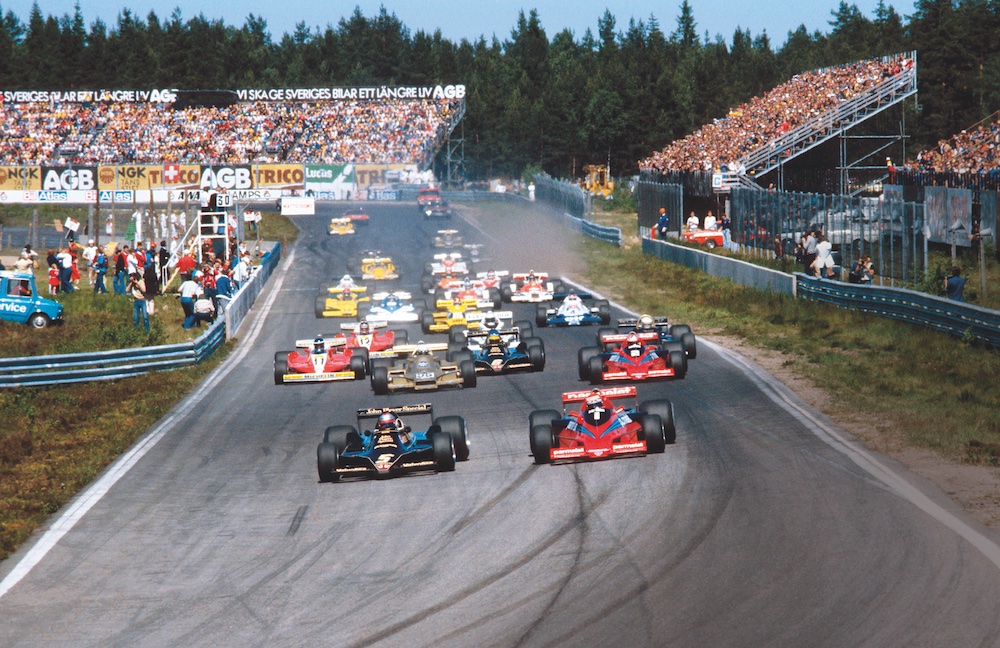
With Brabham careful not to show its full hand pre-race, Mario Andretti’s Lotus 79 started the Swedish GP from the pole. Niki Lauda’s BT46B (No. 1) tailed the Lotus in the early laps, before a small error by Mario was Niki’s cue to pass and pull away with “embarrassing ease.” Motorsport Images
Watson is more forgiving: “Downforce was always being generated, plus you still had front and rear wings. On full power in and out of a corner, you had the benefit of low-speed downforce that the Lotus didn’t get.”
All hell broke loose at Anderstorp when the fan car rolled out for its debut at June’s Swedish Grand Prix. According to Lauda, Ecclestone had been mindful to “apply to the sport’s governing body for an affidavit attesting the legality of the new design.” But Chapman immediately recognized the threat it represented, and he wasn’t alone.
“Tyrrell had a spitting fit and couldn’t get his words out,” says Watson. “Gordon needed to develop it and get a more refined sealing system, with Lexan skirting similar to what we used for ground-effect cars. There were still bleeds. Nevertheless, it generated a lot of suction.”
The key now was for Brabham not to give the game away on just how much suction... Lauda and Watson were under strict orders to take it easy in practice, but in the pitlane it was impossible to hide the effect of the fan. Each time the throttle blipped, the suction sank the car, which rose slightly again when the revs died.
“Bernie was leaning into the cockpit: ‘Don’t rev the engine when you’re sitting in the pits!’” recalls Watson. “But you had to keep the engine running and every time you gave it a blip, you could feel the car coming down. ‘Crude’ is an unkind word to use, but it was the first phase of what would have become a phenomenal amount of downforce.”
The campaign against Brabham went into overdrive, Chapman and Andretti stoking the fire on a safety angle. “That thing was an absolute goddam nightmare to follow,” insisted Mario. “You got right up behind it, and you just got showered with stones. Now suppose there was a bolt or something on the road, and that came back through the fan at you. I mean, it would be like a bullet! A visor wouldn’t help you.”
Murray has always dismissed the stone-throwing claims, and Watson does, too – in no uncertain terms.
“Mario and Chapman were a double act par excellence, telling basically a load of lies,” he states. “The pair of them were desperate to get anything to force Brabham not to run in Sweden. They were reading from the same hymn sheet. Unbelievable.”
Chapman’s other quarrel perhaps held more water. “Fan cars were nothing new,” he said. “Jim Hall was running his Chaparral with a fan back in 1970, and they were outlawed then. The reason is very straightforward: with a relatively simple development, you can produce so much downforce that the car’s cornering limitations would really be a matter of what the driver could stand. A 100mph corner would become a flat-in-top corner. And then all the circuits would be obsolete.”
In qualifying, the Brabhams ran on full tanks to hide their potency, but they still lined up second and third on the grid, Watson ahead of Lauda and behind Andretti’s pole-winning Lotus. Come race day, Watson retired after a spin, but Lauda ran second to Andretti in a two-horse contest, Niki admitting he was “playing cat and mouse” with the American.
After Didier Pironi’s Tyrrell dropped oil, Andretti made a small error and Lauda “overtook him without the slightest difficulty and finished with embarrassing ease, being careful not to let my lead appear too great.” The fan car was a winner first time out – in what would be its one and only race.
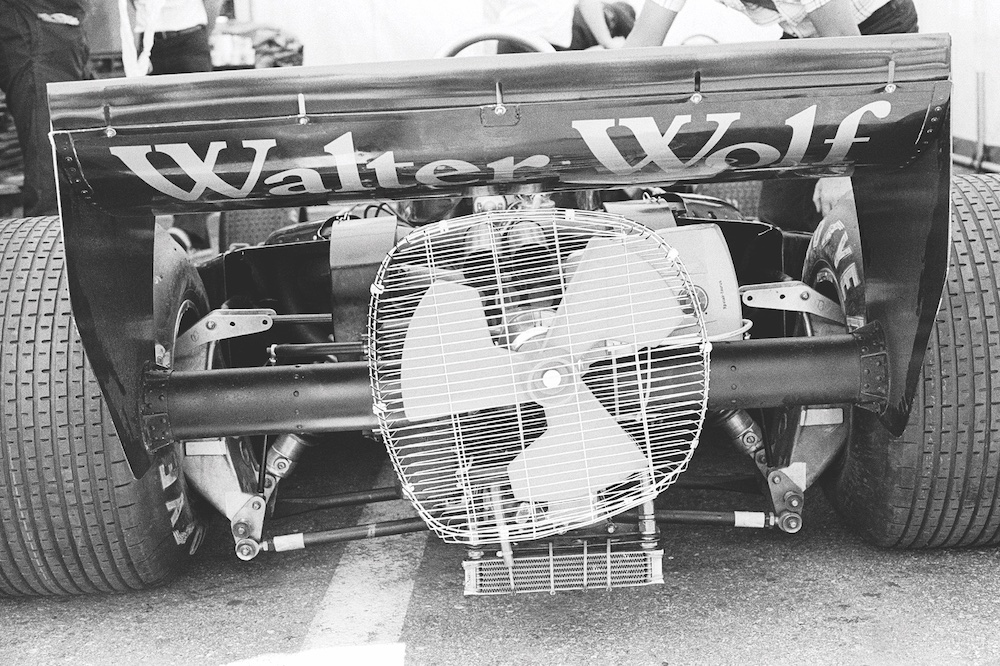
If you can't beat them, join them – sort of. The Wolf team saw the funny side with its own ad hoc solution. Others, including erstwhile dominant Lotus, were more apoplectic than amused by Gordon Murray’s fan-based brainwave. Sutton/Motorsport Images
As Murray insists, the BT46B was never banned. Ecclestone chose to withdraw the car from further action, much to his designer’s frustration, apparently for the greater good and to keep the peace among the increasingly influential Formula One Constructors Association made up mostly by the British garagiste teams. He already had one eye on the bigger picture.
“The fan car was always going to go because Ecclestone was out on a limb,” noted Andretti. “The other constructors were against him, and they are the people who support him in his cause. He wasn’t going to risk breaking up FOCA. No matter how much power he thinks he has, without the Tyrrells and the Chapmans, even Ecclestone is dead. He’s got his priorities.”
The epilogue is one that still gives Watson immense satisfaction. “It’s important to remember Bernie volunteered not to run it again,” he says. “He got his win and kept his word. When I got to the French GP I had a bog-standard BT46, yet I took pole. It gave me enormous pleasure in front of Chapman and that lot.”
So was the Brabham fan car a sliding doors moment for F1? Could it have changed the face of grand prix racing? No, because had Brabham stuck to its guns, the rule-makers would have closed the loophole. Instead, the BT46B represents a beacon for clever F1 thinking, a moment of pure inspiration. That it led to a dead end instead of a wide open, and potentially lethal, highway was probably for the best.
HOW TYRRELL ALMOST GOT THERE FIRST
There’s a good reason why Ken Tyrrell might have been particularly frothy about the Brabham fan car – that’s because his team beat Gordon Murray to the idea. The only problem was, they failed to make it work.
Maurice Philippe, the design great behind the Lotus 72, intended the Tyrrell 008 he created for 1978 to run as a fan car, as John Gentry recalls. The draughtsman arrived at Tyrrell in 1977 after spells at March, Shadow, Fittipaldi and direct from running Chris Amon and Gilles Villeneuve in a Formula 5000-based Can-Am car. He wasn’t exactly made to feel welcome at first as long-time Tyrrell designer Derek Gardner, creator of the outgoing P34 six-wheeler, hadn’t yet left.
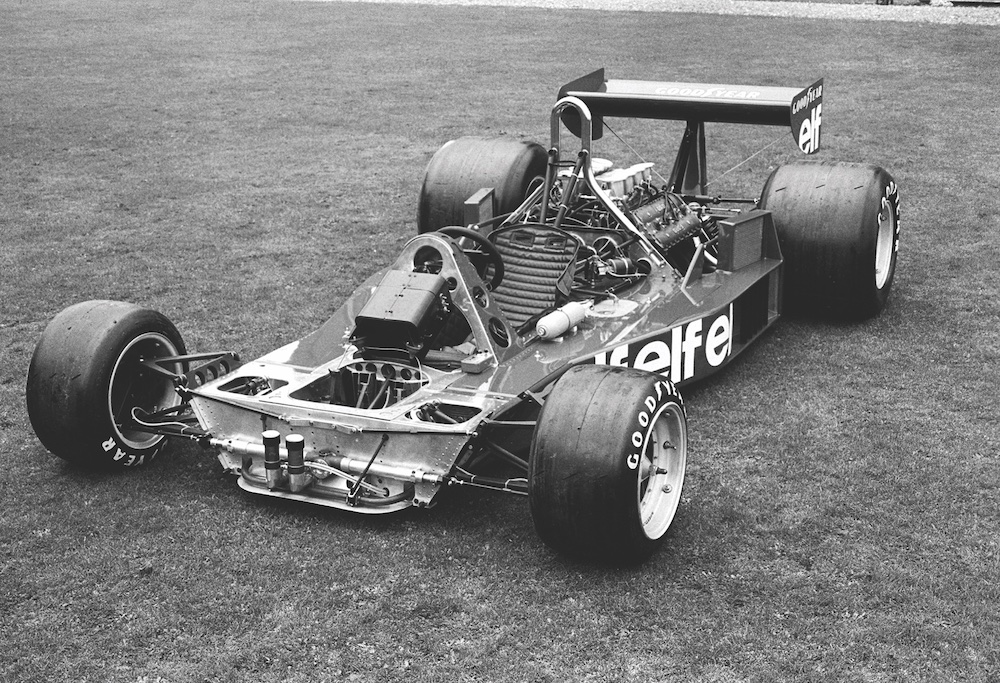
Designer Maurice Philippe created 1978’s Tyrrell 008 (unclothed in pre-season guise) as a fan car. Sutton/Motorsport Images
“Maurice needed help on the detail stuff of 008,” says Gentry. “Derek Gardner was still there and he didn’t allow us into the drawing office! There was a double garage down the bottom of Ken’s woodyard, and Maurice and I had our drawing boards in there. When Derek left we joined the main office – there was only one other guy in there.”
The Tyrrell fan car worked on a similar premise to the Brabham BT46B, but with a significantly different layout.
“Maurice wanted to hide the radiators, so he put one lying flat underneath the car where the fuel tank would be, and there was a fan driven off the crankshaft to suck the air through,” explains Gentry. “We went through a lot of designs of the fan and we were restricted for size, plus we had to make the vanes ourselves. The guy in the workshop on a milling machine was incredible.”
The idea was dropped after temperatures proved too hard to control, and 008 ran as a conventional pre-ground effect F1 car, Patrick Depailler claiming a win at Monaco. “We went testing at Paul Ricard and it just got too hot,” recalls Gentry. “So in the end the radiators sat on top of the bodywork, as an afterthought. But Maurice was an amazing guy.”
Gentry has one other big memory from his short spell at Tyrrell, before he made an ill-judged move to ATS: “At Christmas time Tyrrell always had a big Christmas do. You’d bring your wife and it was like a family. They had a guy to come along as Father Christmas to give presents to the wives. Who do you think it was? Bernie Ecclestone!”

Damien Smith
Damien Smith is a freelance journalist who has worked in the motorsport arena for more than 25 years. He joined the staff at Autosport in September 1996 and reported on most codes of the sport, but especially enjoyed Formula 3000, sportscar racing and Formula 1. He eventually served as editor-in-chief of Autosport, but is most proud of his two stints spanning 10 years as editor of Motor Sport. Still a special contributor to the magazine and website, he also writes a weekly motorsport column for Autocar while making regular contributions to his favorite U.S. title. He's also living proof that it's possible to (almost) love The Stones as much as The Beatles.
Read Damien Smith's articles
Latest News
Comments
Comments are disabled until you accept Social Networking Cookies. Update cookie preferences
If the dialog doesn't appear, ad-blockers are often the cause; try disabling yours or see our Social Features Support.