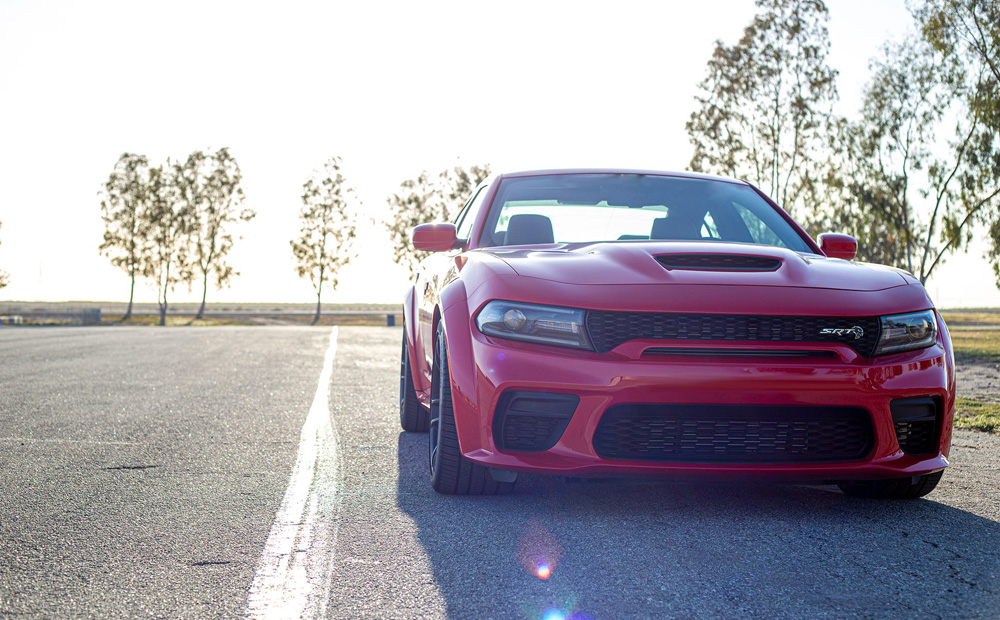
Dodge Charger SRT Hellcat Redeye Widebody track test: Red key vs black key
The words “living legend” first come to mind. “Badass” follows. Plus “overkill,” and dare I say “collectable.” But of the all superlatives that pop into my head, “last hurrah” are the saddest of the bunch when gathering my thoughts about the week I spent with the 797hp 2021 Dodge Charger SRT Hellcat Redeye Widebody.
Yet this isn’t a story about how ever-tightening emissions standards are strangling the future of outrageous performance or that EVs are marching in to replace the beloved roar of internal combustion engines. Nope. By all rights, the Hellcat variants of the Charger and Challenger should probably never have made it to production in the first place, so the fact that the Redeyes exist is extraordinary and something to be celebrated.
So being that this is RACER, we did exactly what you would do when handed the infamous SRT “red key” that unlocks all 797 ponies, and we hit the racetrack. But this wasn’t all for fun; rather, our specific data goal revolved around road course performance potential between that notorious red key and the lower powered, 500hp black key.
But first, the basics...
In both Charger and Challenger forms, the Redeye is quite literally a boosted version of -- if you can call it this -- the run-of-the-mill 717hp Hellcat, pumping an extra 80hp out of the 6.2-liter supercharged V8 motor. The 2021 Dodge Charger SRT Hellcat Redeye Widebody we tested sported a Hellcat Redeye base price of $78,440 optioned with goodies, which included a bevy of Hellcat signage (some wearing the telltale red jewel in the eye of the beast), as well as a 220mph speedometer, navigation, a Harmon Kardon audio system, sunroof, 305/35-20 Pirelli PZero all-season tires and an awesome carbon fiber and suede interior. All in, the four-door sedan we were testing rang up at $90,060. It’s notable that the price includes the $1,495 destination charge and $2,100 gas-guzzler tax (12 mpg city, 21 highway and 15 mpg combined, if you care, with those numbers largely aligning with our experience).
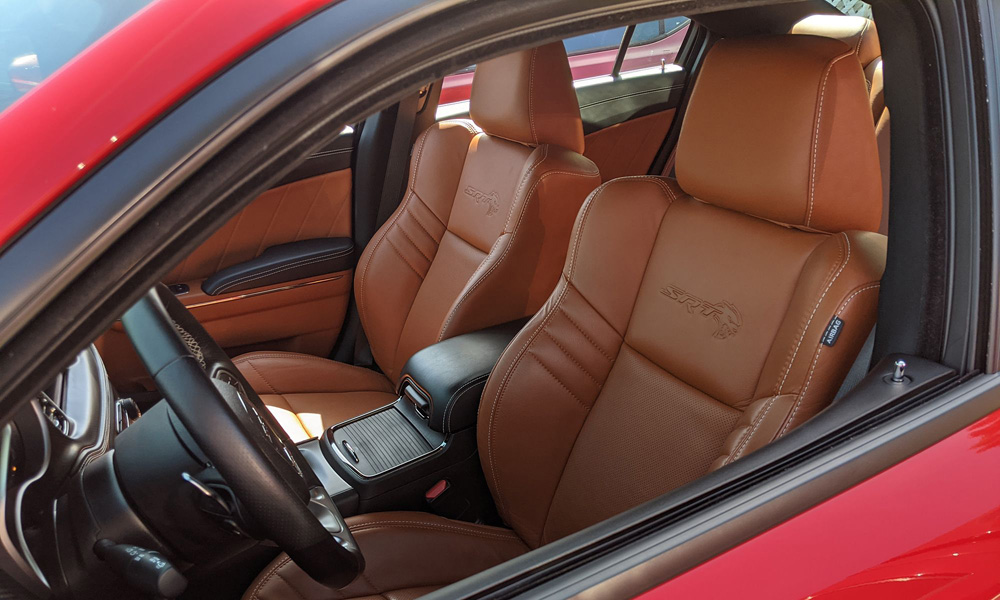
First glance inside tells you this is no rental car Charger...
Behind the illuminated SRT steering wheel badge, it’s easy to sink comfortably into the bolstered leather. In fact, while this $90,000 Charger shares its bones with a $29,995 version, outside of some hard plastics on the door and dash, it’s difficult to spot this car’s humble roots. Granted, BMW M5 or Mercedes-Benz AMG E63 this is not, but neither of those have 797hp nor drip with the enviable image of American overindulgence. They’re also far more expensive.
Something neither BMW nor Mercedes will get you is the attention from those in the know. My first outing in an unavoidably bright “TorRed” painted Charger SRT Hellcat Redeye involved someone going out of their way to complement the car; and this occurrence was far from isolated.
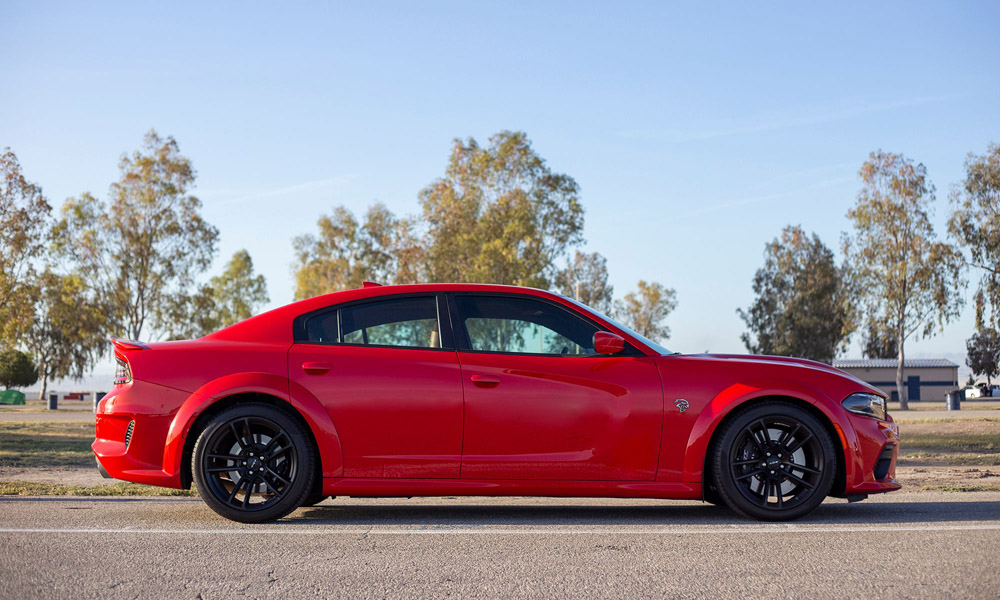
Another thing the BMW and Mercedes aren’t are 4,600lbs, like the Charger SRT Hellcat Redeye Widebody. Yet, it should be said, they’re not far off, either. Regardless, the Charger is more content cruising the boulevard than being pushed to the limit on a racetrack road course. But even on the racing circuit, I found a simple trick to bettering the car’s cornering dynamics was only a button push away.
Setting the stage
Hellcats offer a “red key” that unlocks full power; meanwhile, the Hemi will also output a measly 500hp with the black key (or via a tap of the finger on the center display menu while using the red key), dropping some 300hp from the Redeye’s full capabilities. And there is where our challenge arose: How far off the pace would a Charger SRT Hellcat Redeye Widebody be lapping a racetrack in 500hp mode vs. with 797hp?
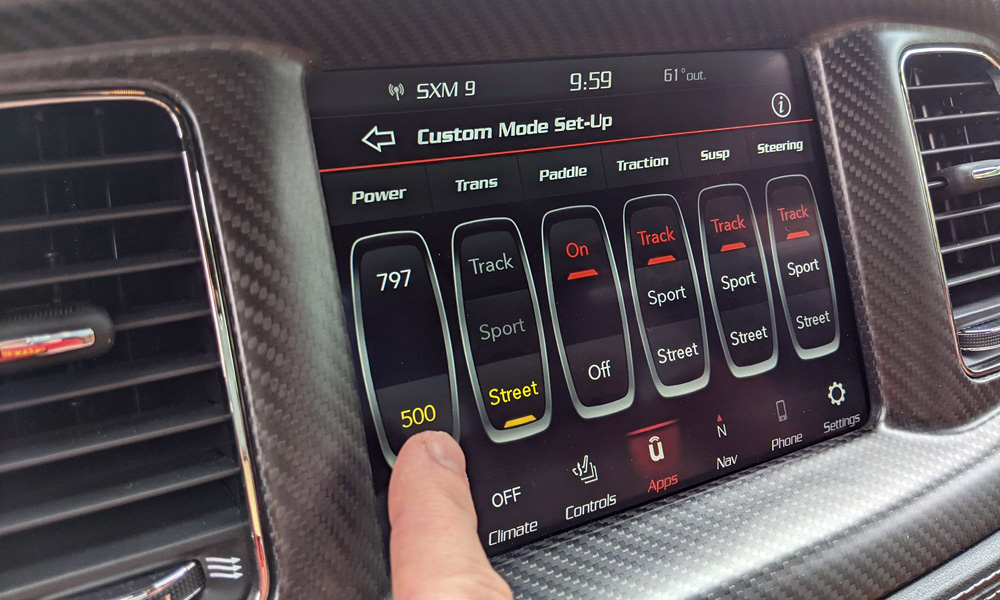
Decisions, decisions...
We needn’t say, 797hp on the street is ridiculous. Pressing the gas with any zest unleashes burned rubber from the back tires and giddy laughter from within the cabin. There’s no trick to it, either. Don’t bother turning off traction control or defeating stability -- the car simply wants to burn tires. At the same time, it features three sets of LATCH mounts in the rear for children’s seats -- not a common occurrence even in vehicles claiming to be family friendly. So with my three young kids securely mounted, we cruised the town far under the speed limit with no bucking or tire chirps. Remove the pleasant sounds of the 6.2-liter Hemi and Redeye’s 2.7-liter twin-screw supercharger (0.3L more than the standard Hellcat’s supercharger) and you’d never know this easy driver was capable of massive tire shredding.
On the racetrack, that 797hp is still a handful. Our test version came equipped with 305mm width Pirelli PZero all-season tires sporting a 500 UTQG rating. The tires are designed to handle all but snowy conditions, thus they struggle at the track with power application and lugging the sedan’s weight through the turns. Can’t blame the tires or car on this one -- physics are physics.
My time at the track took place in pleasant temperatures in the mid- to high 70s F. Also, all track time was completed with no traction algorithm or stability as a backup -- my hands and right foot controlled all.
Speaking of feet, all Redeyes come equipped with the 8-speed TorqueFlite HP90 automatic transmission and paddle shifters, which is probably for the best since it allows both hands to remain on the steering wheel at all times, tapping paddle shifters when needed. If a manual transmission is on your wish list, you’re out of luck matching that to a Charger chassis. For a third pedal and 700-plus horsepower, you’ll be buying a Challenger SRT Hellcat to get the Tremec 6-speed.
On track
After familiarizing myself with an absolutely ridiculous amount of power, I managed a 2m05.258s lap around the popular 13CW configuration at Buttonwillow Raceway Park in Central California with the Charger in full 797hp song. In fairness to the car, earlier in the morning I had clicked off a 2m04.4s, but I opted to discount that session due to the cooler temperatures of both the air and track surface. You can choose to count this lap time if it helps to prove your point.
Obtaining the “official” 797hp lap time of 2m05.2s was rough, though. Every corner was a lesson in throttle control and patience. In fact, if a corner seemed like it was perfect for fourth gear, I was forced to take it in fifth -- and even then, there was wheelspin aplenty. Getting on the gas a hair too early mid-turn often resulted in miniature tank-slappers and lifting from the throttle, making consistent laps a challenge.
The massive 15.7-inch vented front Brembo rotors with six-piston calipers and rear 13.8-inch rotors with four-piston calipers worked admirably the entire time with minimal fade -- something I didn’t expect. But with physics rearing its head again, braking points were moved well back from what I was used to thanks to the car’s weight and speed.
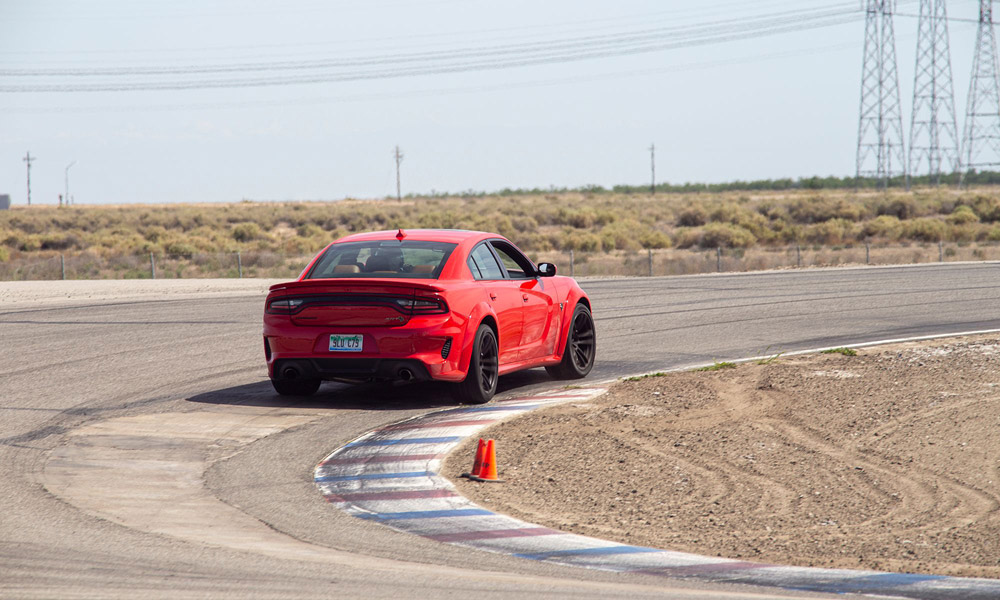
Comparison laps in “red key” and “black key” modes made for some interesting number crunching.
Dodge’s adaptive Bilstein dampers, meanwhile, absorbed track imperfections and small curbs like a champ, be it in a straight line or under hard lateral load. Then once steering angle had been given, on-throttle rotation to point the vented hood in the desired direction was not only easy, but fun.
To say the track test between “red key” and “black key” modes was apple to apples would be misleading. The 797hp laps involved the car being placed in full “race” mode with stability controls defeated. To enter 500hp mode using the red key, “race” settings could be had for all available virtual toggle switches on the center display (like suspension and steering) with the exception of the transmission, which insisted on being in the “street” setting. Therein, presumably the transmission shifts marginally slower than the 160 millisecond shifts that come with race mode.
On track with “only” 500hp, the Charger felt surprisingly better balanced. Easing on the throttle was far easier than before, and I found I could drop the hammer significantly earlier exiting a corner than with 797hp. Also, mid-turn throttle corrections were downright easy and resulted in far less weight transfer compared to full power bucking the car. Also, because less speed had been built on the straights, braking points changed to significantly closer to the corners, resulting in more sustained speed on the straights.
With the weather about 5 degrees F hotter than before, a 500hp time of 2m05.835s was logged, just 0.577s off our comparable 797hp session. Had the test begun with 500hp mode, the results could have swapped.
Data deep dive
Data captured with an AiM MXm data system reveals the nuance. With 797hp, the Hellcat’s top speed was 121mph, while the fastest 500hp lap showed a top speed of 116.5mph. But zeroing in on segments is where things truly get interesting.
The top speed on the front straight was 118mph with 797hp vs. 113.1mph with 500hp. Yet due to top speed and stopping distance, I was able to stay on the throttle 0.47s longer, translating to roughly 77.4 feet deeper with 500hp. A short chute later, 797hp mode reached 107mph with 500hp hitting 97.1mph, yet with 500hp I could carry that speed for an additional 0.59s, or 82.9 feet, before transitioning to the left pedal.
Braking traces never showed fade, but with 500hp, I found I was squeezing the gas earlier and more confidently through each corner.
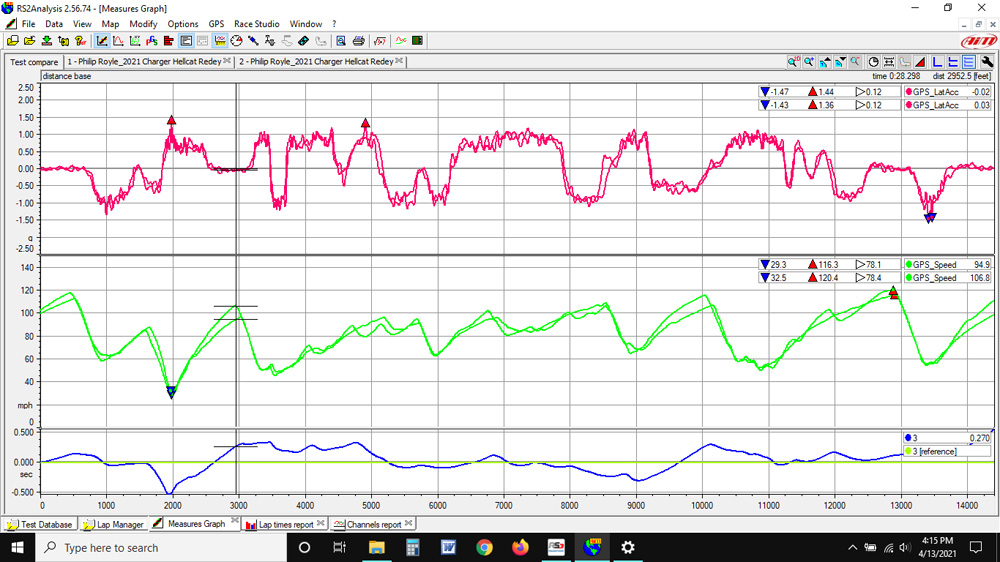
Click on the graph to view a larger version.
Here’s a fascinating example: Exiting the last turn, I was on the gas a seemingly inconsequential four feet earlier with 500hp vs. 797, yet I chased the throttle for so long on corner exit with 797hp that it took 3.6 seconds and 330 feet before I caught up to the 500hp corner exit data trace.
And another one: Entering an extended right-hand high-speed sweeper that leads to a near-100mph left-hand kink, I found I was slowing too much for both in “red key” mode, utterly negating the acceleration advantage in the adjoining straight. Compounding the issue was during the sweeper, I could sustain a speed upwards of 7mph higher with the “black key,” likely a result of 500hp offering a smoother application of power.
Speed data traces also show that while the additional horsepower was an advantage under acceleration, it really wasn’t until 70-80mph that it truly showed its colors, at which point the speed curves separated exponentially. It was quite impressive to see that rate of acceleration come to life through the data of one botched 797hp lap where I had to let off the gas in the esses in fear of looping the car. While I had loosened my throttle application early in that acceleration segment, by the upcoming turn, the car in 797hp mode was still up 2mph over the fastest 500hp lap.
Lessons learned
Prior to hitting the track, there had been thoughts that the Redeye in 500hp mode might be faster around the track given the preposterous nature of applying 797hp to the ground via two tires. This test didn’t prove that to be the case, but that doesn’t mean there’s no truth to it.
A set of 200 treadwear tires or R-compounds would undoubtedly bring the Redeye to life in full 797hp mode, leaving the 500hp mode in the dust around the road course. Given more traction, 797 horses could take advantage of the situation exponentially more than 500. The problem would be longevity, as a few on-track sessions showed that this beefy sedan is no friend to tires.
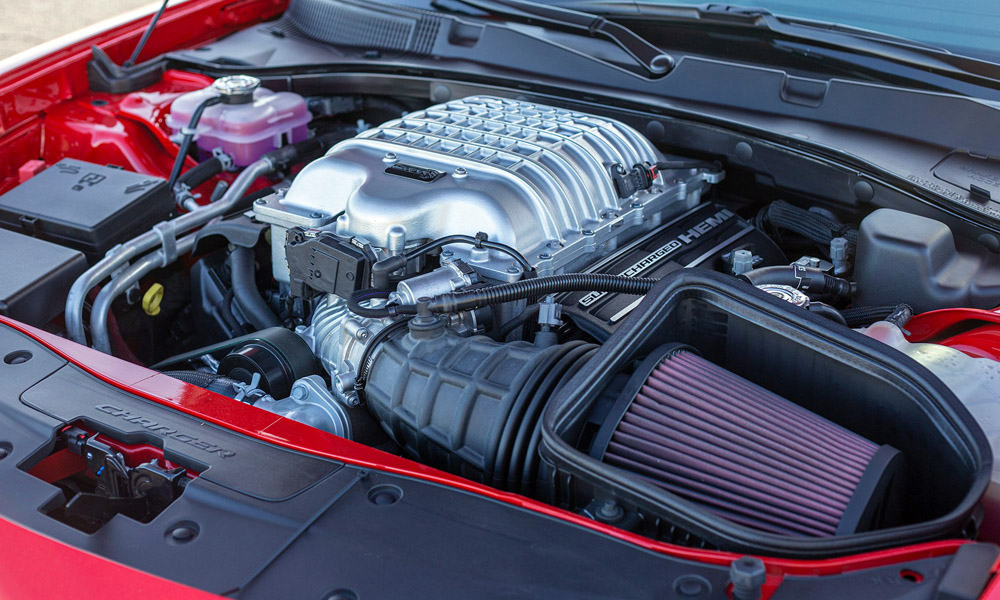
At the center of the storm...
Price no object, the 2021 Dodge Charger SRT Hellcat Redeye Widebody is breathtaking, inspiring and a dream car. Its 0-60mph time might be in the four-second arena, but you’ll never achieve it because traction off the line is impossible. In fact, traction at any legal speed is almost impossible if you mash the throttle. But that’s not the point of this car.
You could say the Hellcat Redeye Widebody cars are giants among peers, but I prefer what I’ve already said: it’s overkill and badass. It’s also more akin to an awesome cruiser than something you’d want to take to the road course.
I also believe that if any current automotive models are future classics, it’s the widebody variants of the Redeye Challenger and Charger. I will likely look on with disbelief in 20 years when one sells at auction for hundreds of thousands of dollars and I think about how I carelessly pummeled the car to complete this performance curiosity test.
Yes, Dodge’s Hellcat and Redeye line-ups are ones that likely never should have happened, but that doesn’t make them any less of living legends. And if $90,000 is in your pocket and you’re considering this or something like a comparable BMW or Mercedes, you should exchange your cash for a Redeye while you can -- even if it is just as fast on the road course with 500hp.

Philip Royle
Read Philip Royle's articles
Latest News
Comments
Comments are disabled until you accept Social Networking Cookies. Update cookie preferences
If the dialog doesn't appear, ad-blockers are often the cause; try disabling yours or see our Social Features Support.