Robin Miller's Mailbag for November 25, presented by Honda Racing / HPD
hpd.honda.com
and on social media at@HondaRacing_HPD
and https://www.facebook.com/HondaRacingHPD.Questions for Robin can be sent to millersmailbag@racer.com. Due to the high volume of questions received, we can’t always guarantee that your letter will be printed, but Robin will get to as many as he can. Published questions have been edited for clarity. Views expressed do not necessarily reflect those of RACER or Honda/HPD.
Q: As a fan of all forms of major motorsports, I end up reading and listening to a variety of different sources of information (with RACER.com being my No.1!). With that said, I saw a confusing (to me) video today about another ‘new’ IndyCar team -- and it seemed extremely preposterous. So, I have to go the best source in all of motorsports. Is there anything to NASCAR team Rick Ware Racing expanding into IndyCar?
Sean Simpson
RM: Ware Racing competed in this year’s Indy 500 with James Davison, and partner David Byrd and Rick Ware also ran Davison with Byrd in 13 Cup races in 2020. The trio plans to run more NASCAR in 2021, but not sure RWR has any Indy plans.
Q: Is Rick Ware Racing going to join IndyCar? His social media shows him taking delivery of and housing a 2020 spec Honda IndyCar at his race shop.
Rob Peterson, Rochester, NY
RM: Please read my answer above your question. All I know is that I emailed him and asked if he had any plans to run the 2021 Indy 500, and I’m waiting on a response. He’s a NASCAR regular but was evidently blown away by the whole Indy 500 experience. Just think if 250,000 people had been there.
Q: I'm sure that all the Jimmie Johnson questions must seem kinda repetitive at this point, so I'll attempt to make this one somewhat different. We've seen what feels like a full heat race worth of IndyCar and open-wheel drivers switching to NASCAR full-time. Between Tony Stewart, Robby Gordon, Sam Hornish Jr., John Andretti, Danica, JPM, hell I think Dario even made the switch briefly, it feels like this has always been a one-way street. Who was the last person to go the opposite way -- into IndyCar -- for more than just a one-off race? Could this be seen as an indication that IndyCar is catching back up to NASCAR in terms of nationwide popularity, or do you view this to be a one-off?
Michael in Brownsburg
RM: I guess we’d have to go all the way back to 1971, when Cale Yarborough ran the USAC championship trail full-time with Gene White and Lloyd Ruby as his teammate. Cale finished fifth at Trenton and Michigan and wound up 16th in the point standings and drew rave reviews. “Put that boy in a good car and he’d be right up there,” said 'ol Rube. Donnie Allison also ran four times for A.J. Foyt that season and scored a sixth at Indianapolis. Lee Roy Yarbrough damn near won the inaugural California 500 in 1970, finished third at Trenton in 1971 and was a two-time Indy 500 starter -- qualifying eighth in 1969 – as just a part-timer. But J.J.’s move doesn’t signal anything except a stock-car champion who wants to try something else and has the financial security, savvy and balls to step outside his comfort zone.
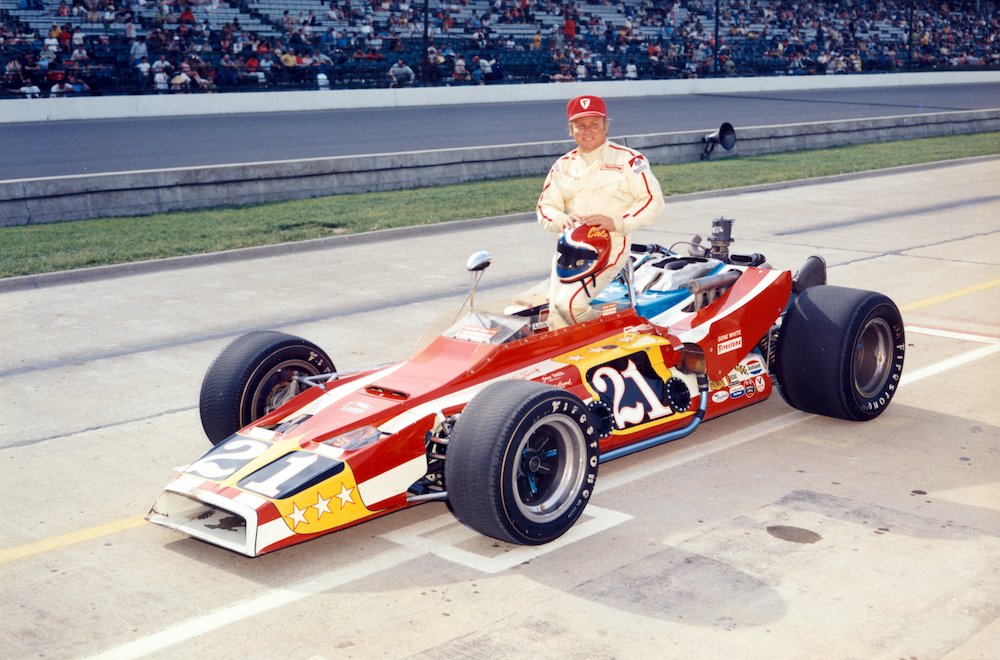
A few drivers have made the full-time jump from Indianapolis to Daytona, but it's almost half a century since Cale Yarborough went in the other direction. Image by IMS
Q: Been a big fan of your Mailbag for many years, and a huge fan of IndyCar since the late '90s over in the UK. I was wondering about your thoughts on driver age? Over here in Europe, any racer over 35 is repeatedly asked about retirement plans, but in the U.S. it’s all about performance and not age. With a lot of the top names in IndyCar (Power, RHR, Bourdais, Dixon, Sato) in the 39-43 age range, how long do you see them continuing? I recall Emmo winning Indy at 46 (should have at 47, too), being on the front row at Nazareth ’96 at 49, Mario leading the most laps at Indy at 53, and finishing second at Le Mans at 55. I’d love to see the top guys keep going as long as they are fast. Who from the current crop do you see driving successfully into their late 40s in IndyCar?
Julian Collie
RM: I don’t know about late 40s in IndyCar -- that trend went away with A.J., Mario, Rutherford, Johncock and the Unser brothers, and the youth movement is in full swing today. But the guys you mentioned could certainly drive sports cars until they’re 50 if they so desire, and there never seems to be an age limit for Indianapolis success, so I imagine if they had a good ride that running IMS in their late 40s isn’t out of the question.
Q: Your ‘What's the point of points’ article was spot-on! I tip my hat to you for writing what I have believed since I became a race fan 60+ years ago. The champion is the driver who wins the most races in a season. Period. No stages, no most laps led, no lead a lap, no fastest race lap, no qualifying, no double (have I missed any?) points allowed. Al Davis (Oakland Raiders former head coach) said it best: "Just win, baby!" All the rest of the schemes are BS. There can be just one winner.
If a point system must be used, I thought the best one was F1's 1991-2002, 10-6-4-3-2-1 system. It put the most emphasis on winning. One of the worst, as you wrote, was NASCAR's 175, 170, 165, etc., with a five-point bonus for leading the most laps in a race. Do you know it would have been mathematically possible for a driver to win all the races in a season but one, and finish second in that one race, and not be the champion? Absolutely ridiculous. The criteria that should be used to determine a champion are: 1) most wins, and, 2) if tied in wins, any points system you desire. Also, divide the prize money any way you wish.
I understand, as you do, the need for a points system to keep casual fans interested to the end of the season. A playoff system allows for a ‘random’ champion. But to purists like you and I, we can derive much pleasure from watching one driver dominate over the others because of his mastery of the skills that all the other drivers in the races also supposedly possess. A driver should not be punished by a point system because of his success. Will IndyCar maintain its philosophy?
Bill B.
RM: Thanks Bill. I don’t think Jay Frye is a big fan of double points in the season finale so maybe he can convince R.P. to leave it in the trash can, and I think the current point system works just fine and will stay in place.
Q: I saw your response a few months back to the idea of a roval at IMS. Though I agree with you that the traditional road course has some good racing, would a roval race, in a doubleheader weekend (one road course race and one short oval/roval), not be a cool way to add another oval to the schedule? The audience is captive, the audience seeks an oval, and it might be a cool race. When you look at a Google Earth image of IMS, not many modifications to the road course would be needed. All we hear in these responses is "we need more ovals!" Would it ever even be considered?
Tim Gleason, Chicago
RM: I can’t speak for R.P. but I think he’s in favor of having one oval race a year at IMS because it’s special and that’s why 250,000 people come to the track. But I suppose anything is possible next year depending on the COVID situation and if tracks are needed.
Q: I've had this idea bouncing around my head for a while. I propose to IndyCar go annually slot in a one-off traveling race each season -- a floating race that goes to a different track that isn't on the usual IndyCar schedule. For example: one year go to Kentucky, the next year The Glen, the next Chicago, Michigan, Mosport, Sonoma, Richmond, New Hampshire, etc. That would give promoters the opportunity to try holding an IndyCar race to test the waters, so to say, and would give IndyCar the opportunity to grow the season and possibly add the ‘floating’ track to the schedule if it was successful. I think promoters would get behind this idea and try to bring IndyCar to their tracks at least once. Gotta think outside the box these days.
Dave Sutton
RM: I think it’s an interesting idea, but just not sure how many promoters would buy into it because it’s risky, so it would probably require a break from IndyCar on the sanction fee front. But I’ll send your suggestion to R.P.
Q: Just watched the Next Gen NASCAR night testing in Charlotte on the road course, and realized the track is fully lighted. It would be nice for IndyCar to have a Saturday night race there. The track is perfectly located to cater the many frustrated East Coast race fans. For me it's a no-brainer. Your thoughts?
Phildawg
RM: When three spectators were killed by debris from a crash in an IRL race at Charlotte in 1998, it was a given there would be no more IndyCars on the oval. But Josef Newgarden drove an IndyCar on the Charlotte roval in 2019, so I imagine that layout remains a possibility down the road.
Q: I find it interesting and somewhat amusing to read about F1 drivers considering coming to IndyCar. Where do they think they will go? I don't see a lot of cars available. I think their egos are getting in the way of reality.
John, Seville, Ohio
RM: So do I. First off, unless it was Hamilton, Verstappen or Leclerc, none of those other guys would excite fans, but if they brought $4 million it would excite owners and they could find a ride. But nobody is knocking down the door to sign Grosjean. Sometimes when you’re out of work it’s good to make up your own news, and this falls into that category.
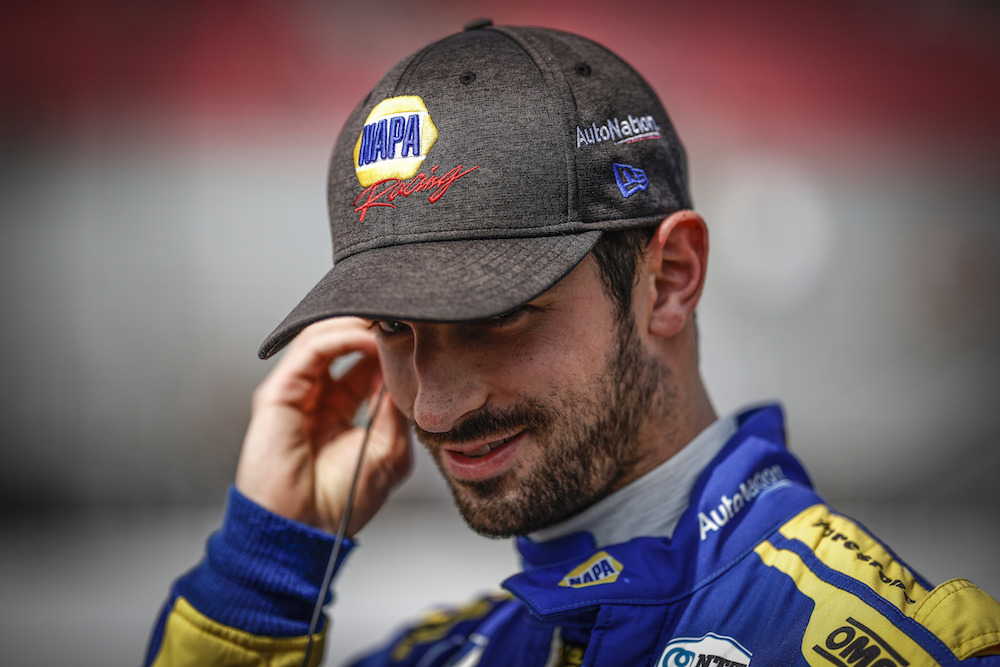
Sometimes, the 'F1 driver to IndyCar' thing actually works out pretty well. Michael Levitt/Motorsport Images
Q: Did you expect Marco to challenge for the win after qualifying on the pole at Indy? For whatever reason I had a strong hunch he would finish 13th. If I were able, I would have put money on it. Conversely, I have no idea what to expect from Jimmie J. next season, but I'll certainly be keeping an eye on him.
John Luther, Hakalau, HI
RM: I didn’t think he’d win, but I did think he’d be in the top 10 and maybe the top five. As for J.J., it’s going to be a very steep learning curve and tough year to be a rookie.
Q: With Jimmie Johnson slated to compete on road courses and street courses for the next two seasons (and hopefully an Indianapolis 500 or two), it got me wondering, if there was any Cup Series driver you would want to see run road courses, or street courses in IndyCar, who would that be? I would take my favorite current driver, Chase Elliott. Six of his 19 lifetime NASCAR national series wins have came on road courses, and he has a road course win in what used to be called the K&N Pro Series West. So it wouldn’t hurt in my opinion to see what Chase could do in an IndyCar at somewhere like Mid Ohio, or Road America or Barber.
Kevin, North Carolina
RM: Love to see Kyle Busch, Kyle Larson and Elliott give it a go on a road course as well as the Indianapolis 500. They’d need a proper test program, but all three could handle it, and I imagine they’d fare better at IMS than Mid-Ohio.
Q: NASCAR Cup Series does the Busch Clash and the All-Star Race each year. Will the IndyCar series ever do a non-points, money-only race?
Chris Fiegler, Latham, NY
RM: CART had the Marlboro Challenge from 1987-92 at Miami, Laguna Seca and Nazareth and the winners were Michael Andretti (twice), Rick Mears, Bobby Rahal, Al Unser Jr. and Emerson Fittipaldi.
Q: How good and cost-effective was the Panoz DP01? It only had one season to shine. Do you think that we are years behind where we could be with IndyCar technology because after the unification, IndyCar kept the old Dallara for another three years before developing the DW12?
Matthew Fornaro, Parkland, FL
RM: The Panoz was a racy car but no less affordable than anything else as I recall, and when Tony George spent all that money putting the two series back together he wasn’t going to dump Dallara. But the economy made spec cars a necessity, and I’m not sure how much technology would have been gained. I’m not smart enough to answer that.
Q: Hi from an old guy. I wanted to thank you for your article about Bill Marvel. I did not know he was gravely ill, but you explained that kindly. What I am thrilled about and for which I am thanking you is the welcomed recognition you gave this great human being. I loved that guy. He was a workman among workers. And he was one of the most unassuming and humble people I have ever met. Thanks, Robin.
Dan Cotter
RM: You are a successful and racy old guy who used to field cars at the Indy 500 and on the CART circuit, and I appreciate your note. ‘Marvelous’ was something else, and should have run USAC because he would have taken it to the top. I spoke to Bill yesterday and he sounded weak, but still had that amazing spirit. He was thrilled that A.J., Mario and Uncle Bobby had all called him. Hope things are good with you, Dan.
Q: In your article regarding Bill Marvel, there's a photo of the Andretti brothers and Foyt at the 1966 Hoosier race. Mario won after Foyt's brake pedal broke after leading 90 laps or so. The Andrettis are smiling whereas Foyt seems ready to fight, but as noted in the comments section, a hand is on Foyt's arm looking like an attempt to calm Foyt down. Do you have any knowledge of what is transpiring in that photo? Regarding respect or lack of pertaining to Andretti and Foyt, how do they view each other?
I saw an interview years ago in which Mario was asked whether he and Foyt would ever have dinner together, and Andretti said while smiling, "Yes, but A.J. would make me pay for it." I've also heard and read that if A.J. is asked to sign something, and Mario has already signed it, that A.J. won't sign it. Tony Stewart confirmed this during his Dinner with Racers podcast – true or false? What is the scoop between these two GOATs?
Alfred N, Northern, CA
RM: No drama after that 1966 Hoosier Hundred between the two to my knowledge. As for their relationship, it’s much better than people think. They call each other on their birthdays and they had a great breakfast at Daytona a few years ago that Mario called “one of the best meals of his life.” Sure, sometimes Tex gets a little surly about signing a photo if Andretti signed it first, but that’s all for show. They respect the hell out of each other, as they should, and they’re forever locked together in history.
Q: I was very surprised at your response to the question, ‘Who was the best all-time technically/mechanically savvy driver?’ Why did you choose to leave Dan Gurney off your list of A.J., Mario and Uncle Bobby from the glory days?
Michael Aldea, Hawthorne, NJ
RM: Because sometimes I am a moron. OK, the question was about the best IndyCar drivers and I always consider Gurney as F1/IndyCar/Trans Am/Can-Am, but obviously he left his mark at Indianapolis and was one of the sharpest chassis men ever. Good call though, The Big Eagle should have been at the top.
Q: I just drove by the Indianapolis Motor Speedway and noticed that the home by Turn 2 that Mari Hulman-George used has been demolished. It must have happened recently, because the bulldozer and dumpsters are still there. A sign of progress in one way, but also sad! Any stories you can print about the history in that old home? I hear it was a fun place to be back in the day...
Scott A.
RM: I was only in the “Mouse House” once and I don’t know any stories, to be honest. I am a little surprised it came down but not sure what purpose it served anymore since I don’t think anyone had stayed there for years.
Q: I recall watching the Daytona 500 in 1972 on ABC's Wide World of Sports (delayed coverage) when Foyt won driving the Wood Brothers 1971 Mercury. I believe he was so far ahead that late in the race Foyt made a surprise pit stop. He stormed into his pit box, rolled down the window and hollered, "How am I doing, boys!" Then roared off and went on to win by more than a lap.
Ron Rose
RM: Called Super Tex to get the scoop: “It’s kinda true, I was just having some fun with the boys and made an extra stop and told them to say hi to that pretty girl standing in our pits. They didn’t think it was too funny, but we won so I enjoyed it.”
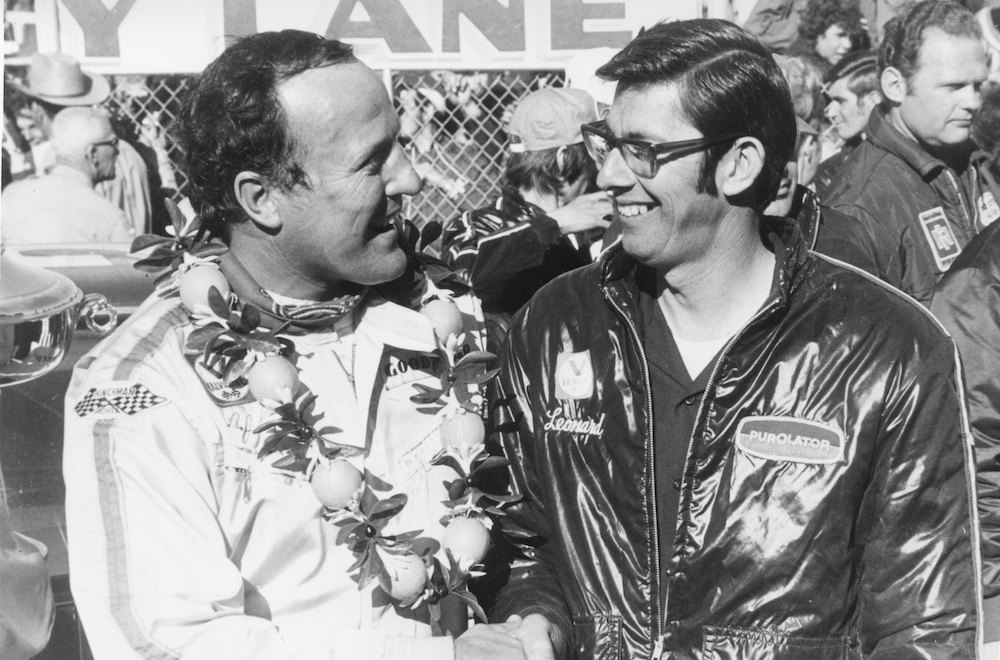
It was probably easier for Leonard Wood to see the funny side of A.J.'s extra pit stop at Daytona '71 once he'd won the race. Image via NASCAR
road course
.My question is, with the loss of any real race in the Northeast, what would it take for a track like this to be available to IndyCar? I know the track lacks grandstands and possible parking for fans but it could potentially be a great addition to the calendar and point on the map for the reach of IndyCar in the United States.
Joe K.
RM: Probably require lots of money to make it FIA and IndyCar ready, and not sure the owner wants to do anything but let enthusiasts have fun at speed. I’ll send this to Jay Frye though, thanks.
Q: I'm a first-time writer, long-time reader of the Mailbag. I look forward to reading it every week on Wednesday, and love your 'Indy Tough Guys' video series, too. I know that you've been meeting with some of the guys who used to run Indy on Fridays for lunch for a while. As a diehard IndyCar and USAC fan, do you all ever chat about the current crop of USAC drivers? If so, are there any drivers who impress the old guard nowadays? Bacon, Grant, Courtney, Windom, Darland, etc.?
Matt Krimmel, Prague, Czech Republic
RM: The Friday lunch gang is Lee Kunzman, Johnny Parsons, Merle Bettenhausen, Jerry Weeks, Gary Irvin and sometimes Pancho Carter and Lightin’ Larry Dickson, but we’ve had Justin Grant as our guest along with Brian Gerster. Not sure too many of the old-timers keep up with USAC but I know J.P. goes to Indiana midget and sprint week. They’re all big Kyle Larson fans and I think they appreciate those five guys you mentioned.
Q: I was wondering if you have heard any news regarding Alex Zanardi? Last I heard he was transferred to a rehab.
John Furnis
here
.Q: I never heard the term 'Brody Knob' before. I’ve always called it a Necker’s Knob myself. However, it occurs to me that it would facilitate spinning the steering wheel to allow quick U-turns, J-turns, or “Brodies.” I’m referring the maneuver popularized by Broderick Crawford in the "Highway Patrol" TV series from the '50s. Given the size of steering wheels and the slowness of the steering boxes in those days, a knob on the wheel would make it a lot easier to quickly spin the car around. I’ve probably only seen a couple episodes of that series and don’t remember if he had that knob installed in his police car.
I did a ride-along at an autocross a few years back with a paraplegic driving his RX-8. He used a knob on the steering wheel. That allowed him to steer with his left hand and operate the gas/brake control with his right. The knob looked fairly incongruous in a sports car like the RX-8. It sure worked for him, though. Really enjoy reading the RM Mailbag, and any opportunity to see your commentary on TV.
Russell B., Bedford
RM: Thanks for that history lesson Russell, and thanks for reading the Mailbag.
Q: Grew up in SoCal in the 1950s and '60s. Never heard of a Brody Knob. We had bench seats and no power steering, so the knob came in very handy and was known as a Necker’s Knob. You can imagine it not being popular with some parents, so the version that flipped down out of the way and out of plain sight was my favorite. Bucket seats may be cool, but not romantic.
Steve in Vancouver, Washington
RM: More good knowledge, thanks Steve. Did you turn into the drive-in with your Necker’s Knob to get your girlfriend closer? I would guess yes.
Q: According to my dad, after the war, these became popular in many areas of the country for using when you drove with your girlfriend. The term Necker’s Knob was kind of disdained by many females, so it evolved onto a Broady Knob (driving with your broad), and then morphed into Brody Knob.
Michael Danks, Dallas
RM: Awesome. The final and definitive word on a great part of American tradition in the bobby sox days.
Q: I recently finished the book Black Noon by Art Garner based on your recommendation. Besides being a great read about the 1964 race and the Sachs/MacDonald accident, I actually got more enjoyment reading about the state of racing and the drivers of that era, which was plentiful and that I did not know as much about. It also prompted me to go down the rabbit hole online to seek out more historical material, and I stumbled on one of the best first-person accounts I've ever read on being a racing driver by Patrick Bedard: The Anatomy of a Crackup in the May 1985 issue of Esquire that I’d recommend to the Mailbag readers. I have some of the other racing books you previously suggested on my Christmas list, but any others that you can add?
David Cubine
RM: Go to Coastal181.com and get Vukovich, Beast, Troy Ruttman, Foyt/Andretti/Petty, Lone Wolf and Second To One and then watch my annual Xmas video in a couple weeks and there are several new books coming out you’ll enjoy.
Q: Recently watched the 2000 Toronto race on YouTube. With 900-horsepower cars and 75,000 fans in attendance, it was a sight to behold. It also reminded me of owner Pat Patrick and the success he had in CART. I always got a kick out of him because of his no-nonsense and grouchy demeanor. Could you provide some background on Patrick and pass on any interesting stories or tidbits about him?
Miles, California
RM: Pat worked for the Michner family and they had Indy cars, so he got started with his own in 1970 (and Johnny Rutherford damn near stole the pole). Patrick won Indy with Johncock in 1973 and again with Emmo in 1989 before he and Penske funded CART’s beginnings. He enjoyed drinking -- during the race when he was on the timing stand -- so it was always an adventure when a pit reporter asked a question. But he spent a lot of his own money on Indy cars and deservedly got into the Hall of Fame.
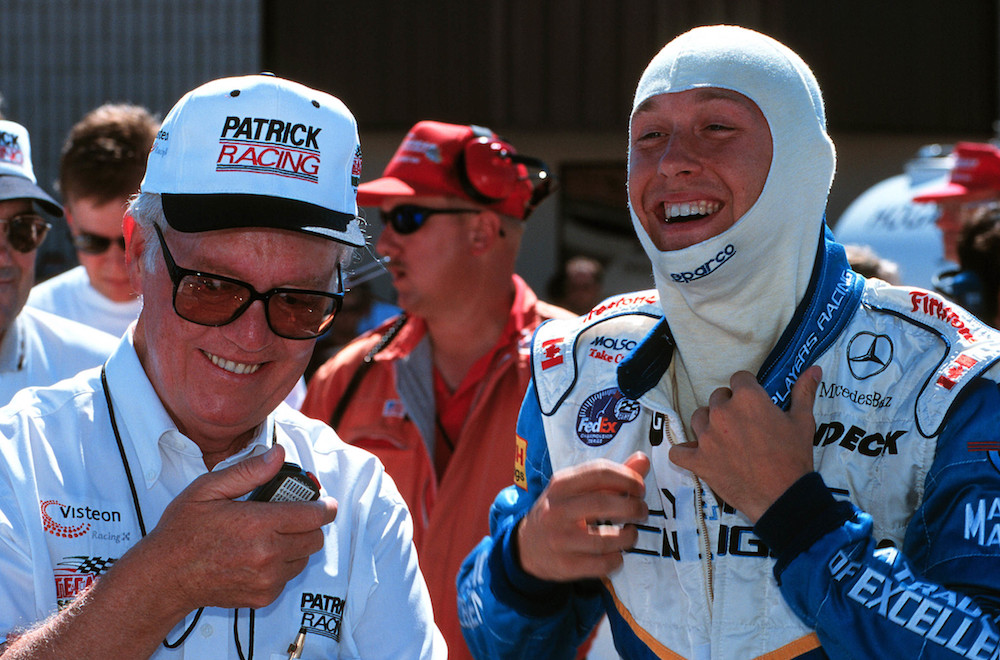
Greg Moore certainly managed to find Patrick's lighter side. Michael Levitt/Motorsport Images
Q: Seen any episodes of this very intriguing and interesting show produced by Dale Jr.? I find it fascinating. Perhaps he will move toward Midwest venues in future episodes.
Tom Fitzgerald
RM: Well I like his podcast but you are probably talking about his Lost Speedways series on NBCSN and Peacock, which is also very entertaining. I’ll try to get him to Jungle Park.
Q: Could someone estimate how fast a really fast road car (e.g., a Ferrari 488 GTB or one of the McLarens) could lap Indianapolis? Would they have to brake for the corners, or with the banking would they just ease off the throttle? It would be interesting to see the comparison both to modern IndyCars and the historic ones. For example, what is the last year that the 488 GTB would have sat on pole?
Michael Sturm
RM: Michael Cannon, the championship-winning engineer for Scott Dixon and old friend, was kind enough to answer your question, but it’s all guesswork:
“Taking a wild-ass guess... Well, a qual lap for a NASCAR is around 185mph. This is a proper race car -- 1000+lbs of downforce, big horsepower and racing tires. A stock Ferrari 488 GTB is about 200lbs lighter but several hundred horsepower shy of a Cup car. And much lower on downforce, too. So, without going into an in-depth sim, you can guess that the 488 won’t come close to a current Cup car’s performance, and certainly wouldn’t be flat around Indy. (Yeah, it looks easy on TV -- kinda like the 4” beam looks easy when watching the Olympics.) If I had to guess, maybe around 150mph as an average -- in the early 1960s era of performance. As a general comment, there is nothing sadder than a high-performance road car on a racetrack. Yeah, they’re fast compared to some Oldsmobile/Buick, but can’t put a stripe on a purpose-built race car.”
Q: I'm moving somewhere into Hendricks County soon! I'm looking forward to meeting people who already know and appreciate IndyCar, and experiencing the local short track scene. Just a few questions: Are there any neighborhoods in Hendricks you would recommend I avoid looking for housing (crime and such)? Which Hoosier tracks put on the best show for each of USAC's three national series? And do you, or any locals who read the Mailbag, know which tracks have a solid series for street stocks or late models?
Thanks, Indy-bound Steve
RM: Hendricks County is about as safe and friendly as you could want, and you’ll only be an hour away from Kokomo, Putnamville, Paragon, Bloomington and 90 minutes from Gas City. Lucas Oil Raceway is in your backyard, and everywhere I’ve mentioned puts on good midget and sprint shows, with Lucas hosting Silver Crown again and possibly the Indiana State Fairgrounds if Bob Sargent brings it back again. The street stocks and late models run pavement at The Speedrome on the eastside of Indy, and at all those dirt tracks as well.
Q: A while back, you wrote a piece asking the question, ‘what makes a great race?’ My question today is, ‘what makes a great fan?’ We do gripe about every little thing, do we complain about every racing call, or as fans do we just enjoy the sport as it is?
I grew up in New Mexico and became a fan of Little Al and Galles Racing. In 1994 when Little Al signed with Penske I had a huge problem. Do I stay a fan of Galles, or am I now a Penske fan? Do I still cheer on Little Al? My dad pointed out that you can be fan of a driver no matter what team, you can be a fan of a team, and he also pointed out that you can just be a fan of the sport. And that is what I continue to be: a fan no matter what I think of the race, the drivers the teams. What says you Robin, what makes a great fan?
Horacio, Denver, Colorado
RM: I guess a great fan is one willing to travel to races and buy shirts and hats to support his or her favorite driver, but it could also be someone who doesn’t travel but never misses practice or qualifying on NBC Gold and watches or tapes every race. I think we have a lot of passionate fans that visit RACER.com and they can be very opinionated, but it shows they care. I chased Jim Hurtubise all over the Midwest when I was 15-16-17, and I just hope that kind of passion still exists with young fans.
Presented by:
Robin Miller
Robin Miller flunked out of Ball State after two quarters, but got a job stooging for Jim Hurtubise at the 1968 Indianapolis 500 when Herk's was the last roadster to ever make the race. He got hired at The Indianapolis Star a month later and talked his way into the sports department, where he began covering USAC and IndyCar racing. He got fired at The Star for being anti-Tony George, but ESPN hired him to write and do RPM2Nite. Then he went to SPEED and worked on WIND TUNNEL and SPEED REPORT. He started at RACER when SPEED folded, and went on to write for RACER.com and RACER magazine while also working for NBCSN on IndyCar telecasts.
Read Robin Miller's articles
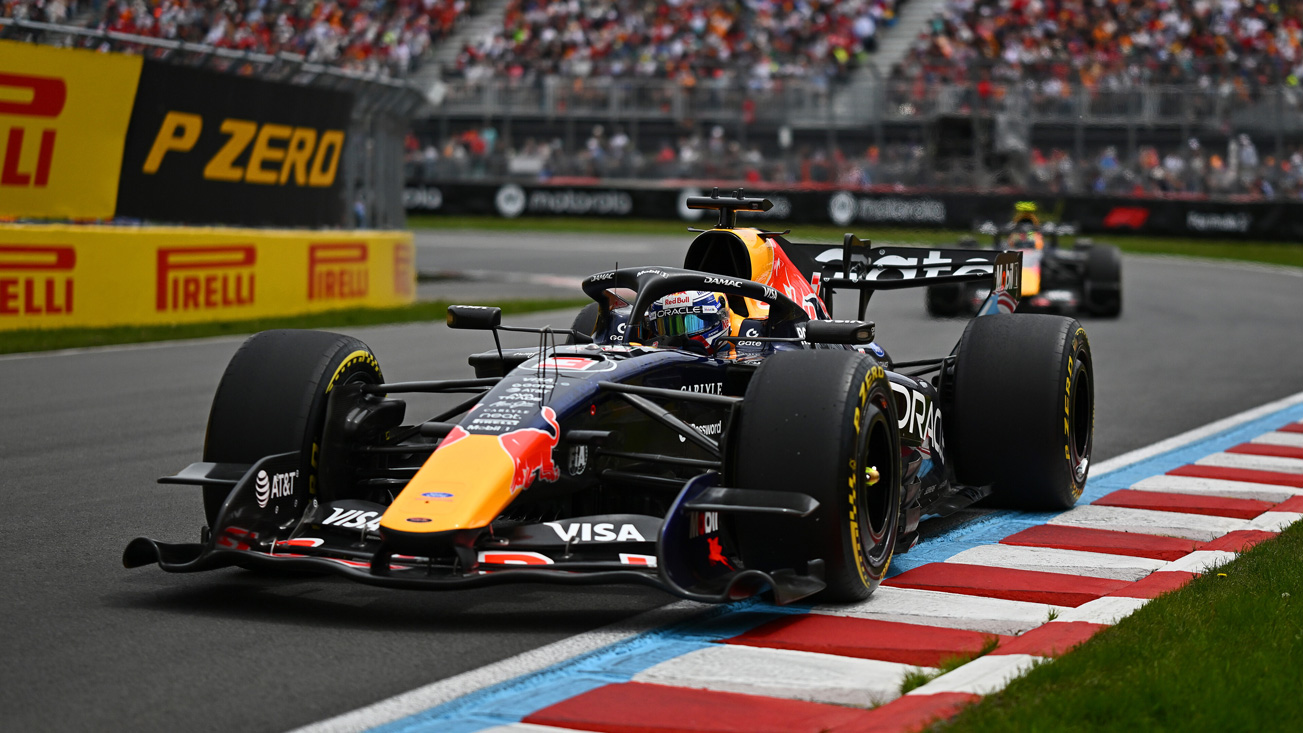
Ford’s Formula 1 return builds momentum and results
Latest News
Comments
Comments are disabled until you accept Social Networking Cookies. Update cookie preferences
If the dialog doesn't appear, ad-blockers are often the cause; try disabling yours or see our Social Features Support.