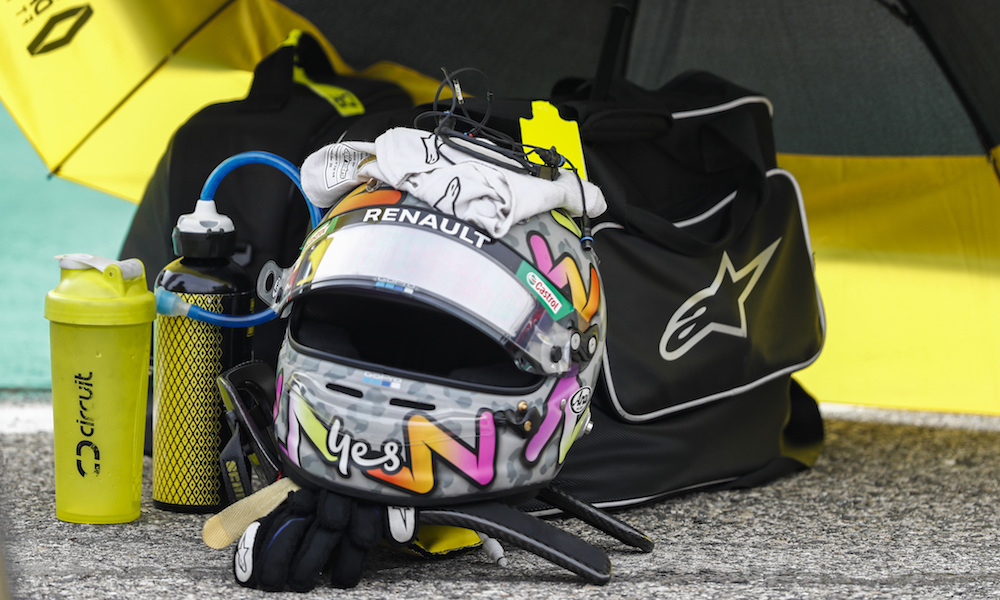
Dunbar/Motorsport Images
STRAW: The strange case of Daniel Ricciardo
No Formula 1 driver’s recent career choices have been questioned as much as those of Daniel Ricciardo, save perhaps for those of the man who takes his place at Renault in 2021 – Fernando Alonso. Having turned his back on Red Bull to join Renault last year, a decision that’s likely cost him a victory or two, he’s three races from walking away from his new team after having contributed significantly to his upward trajectory.
The Australian is swapping like for like by moving to McLaren, given both are in the gaggle of teams at the front of the midfield vying to get to the head of the queue to join the big guns in 2022. While you can argue that Renault, which will be rebranded Alpine next year, has the greater potential thanks to its works status and the question marks over McLaren’s long-term finances, the fact is that both are at a similar level currently. But bouncing around the midfield hasn’t damaged Ricciardo's reputation. In fact, it has arguably been enhanced.
Renault’s sporting director, Alan Permane, suggested in a recent Inside F1 podcast that Ricciardo is up there with Lewis Hamilton, Charles Leclerc and Max Verstappen as the leading group of drivers in F1. While that might seem at odds with the fact he’s frozen out of F1’s ‘big three’ teams and missed out on the Ferrari seat that went to Carlos Sainz, this is not a minority view in the F1 paddock.
And you can see why. Ricciardo’s class shines through whenever he’s had the machinery to get the results. He’s had two seasons where he could have made a convincing case for being the outstanding driver in F1 – 2014 and 2016 – and even when he was shaded by Verstappen at the end of his Red Bull stint, it was by a tiny margin. While Verstappen had gained a slender upper-hand in qualifying, Ricciardo’s all-round excellence meant he was still performing at a similar level. And few doubt Verstappen’s future-champion credentials.
While the 31-year-old is not enjoying his lack of victories, he’s certainly at home with Renault, and the progress made this year appears to have energized him despite his imminent departure. That deal, of course, was agreed during the interregnum between the aborted start of the season in Australia and the real start in Austria in July – before Renault’s improvement had become clear.
What Ricciardo has shown both this year and once settled in last year was the outstanding level of his race performances. In 2019, he had the edge over Nico Hulkenberg in qualifying, but that advantage was bigger on Sundays. This year, he was driven some wonderful grands prix, not just those two podium finishes, and has been a regular points scorer. And despite the fact he hasn’t got a chance of adding to his tally of seven wins, he describes this as his best season since 2016 despite winning races – including the prestigious Monaco Grand Prix – in the two seasons after that.
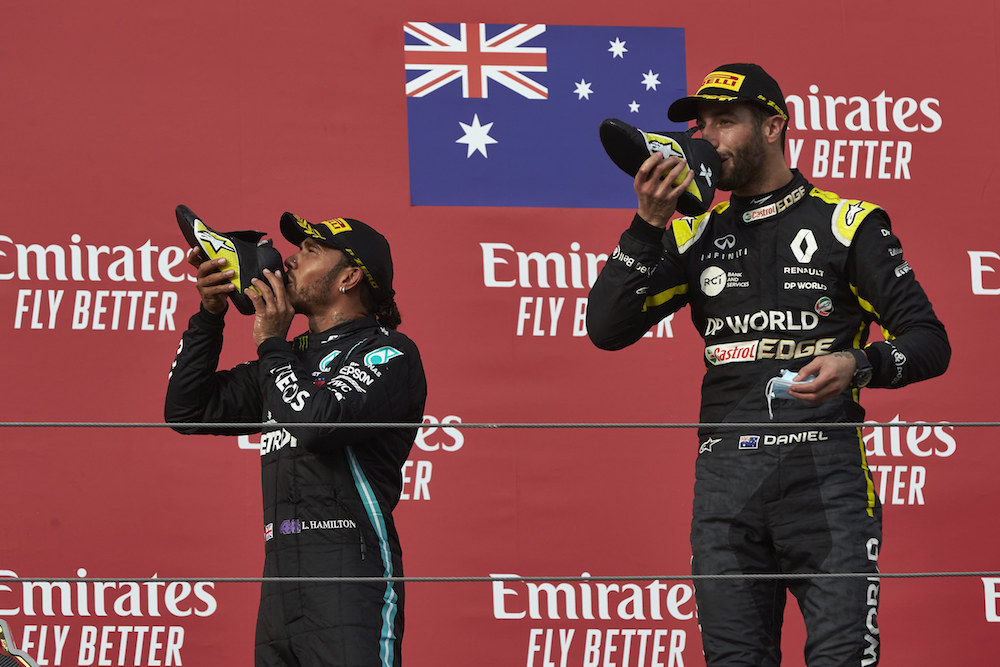
Other seasons have been more statistically impressive, but Ricciardo rates 2020 as his best year since 2016. Etherington/Motorsport Images
“It’s what you make it,” says Ricciardo of scrapping in the midfield. “I don’t think any year is easy, but it’s also what you make of it, how much you put on yourself. Even if you win every race, sometimes it still can be tough on you. It depends how high you set the bar.
“The last year at Red Bull [2018] was probably emotionally the most tough, because at the start of the year it looked like I was maybe competing for a championship, and then mid-year realized that I wanted to move on, and then towards the end of the it was DNF after DNF.
“There were a lot of emotions that year, so I think that was the most tough year for me emotionally and how it played with me a little bit. Last year was still fun, even though we didn’t really get the results we were after initially. It was still fun to try and build with a new team. This year there’s definitely been more fun because that building’s delivered some really good results.”
He's also talked about how the lockdown period has revitalized his appetite for racing. While not a young driver, he’s not exactly an old one either, and just because he’s going to be in a midfield car next year – even with McLaren’s switch to Mercedes engines promising a slight improvement – it doesn’t mean there’s not time to get to the front either with his new team or elsewhere.
Even so, it is unfortunate that he’s ended up feeding on podium scraps, something that he’s likely to have to do for at least another season. While it might seem flippant to throw him into the same category as the recognized gold-standard drivers in F1, it’s absolutely correct to do so. After all, he’s already proved it.
Remember, this is a driver who outperformed the incumbent leader at Red Bull when he lined up alongside Sebastian Vettel in 2014. You might say that campaign was Leclerc-esque. And the problems at Red Bull were a consequence of being crowded out by the team resoundingly pinning its colors to Verstappen. That wasn’t an unreasonable decision perhaps, but resulted in Ricciardo walking away. Sometimes even if you aren’t emphatically the number two driver, you can’t miss that the center of gravity in a team has moved to the other side of the garage.
It wasn’t for want of trying in terms of what Ricciardo was offered. Red Bull was willing to pay Ricciardo very well – not quite matching the $25 million per year Renault have paid him, but in the ballpark – and even went as far as offering a one-year contract at the driver’s request. That reflects the fact that even when it seemed likely he would re-sign for Red Bull, before the moment he realized he did want to go to Renault while flying to the USA in the 2018 summer break, he didn’t see it as ‘his’ team anymore. Red Bull lost Ricciardo because he saw the way the wind was blowing: he was the outsider in Verstappen’s team. And by leaving, he created a problem for Red Bull it has yet to solve, with successors Pierre Gasly and Alex Albon struggling.
With all three of the top teams ending up, by accident or design, in 2021 with an obvious leader and a de facto support act (although Sainz will have something to say about that once at Ferrari), Ricciardo has become the odd-man-out in F1. Yet he is not just another midfield driver.
On track, he has a classical driving style that allows him to carry the speed through the corners but has never been heavily limited by any particular car balance. Yes, he struggled a little on his switch to Renault with the car dynamically on braking and turn-in, but that was largely because he was struggling to get to grips with the limitations of a relatively less competitive car, rather than lacked the ability to do so. Once in tune, he started to perform exceptionally.
And he wasn’t afraid to admit the need to go through that process. As early as the second race in the season, in Bahrain, he was open about the fact that he needed to adjust his approach. Many other drivers would have pointed at the weaknesses of the car first and spent weeks, months even (some never grasp this) pointing the finger at everything other than themselves. But Ricciardo embraced the challenge.
That’s always been a strength. Probably the first time this aspect of his mindset struck me was in Bahrain in 2012. Then at Scuderia Toro Rosso and in his first full season in F1, he qualified a staggering sixth. But that wasn’t the impressive bit. Come the race, he made a poor start and was quickly shuffled back to ninth but he never managed to stem the losses and completed lap one down in 16th.
Shortly afterwards, I spoke with him about the race and he talked through the first lap. Crucially, instead of blaming the circumstances and lamenting the fact that he’d have had a great result without a poor launch or bad luck, he pointed the finger at himself. He recognized that he had reacted badly to losing a few places at the start and made poor racing decisions. But he knew this long before he’d had the chance to look at replays or run through it with the team. He understood what he did wrong, and the next time he was so high on the grid, in China a year later, there was no repeat.
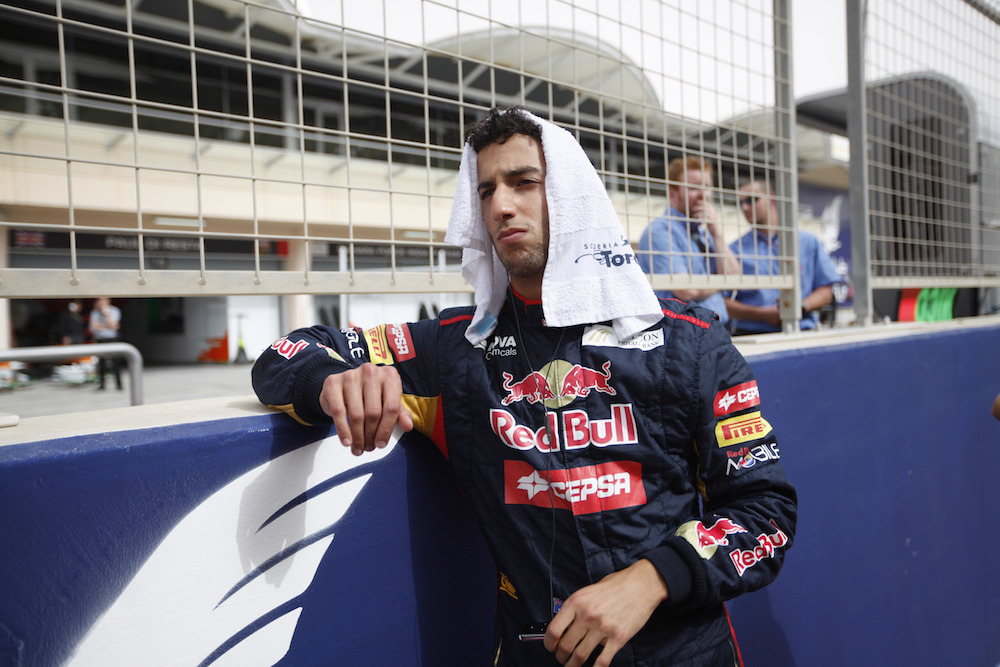
Early signs of Ricciardo's mental game were evident in his response to a disappointing day in Bahrain in 2012. Motorsport Images
Justifiably, there has been much talk recently about the evolution of Lewis Hamilton – a fast driver with a great capacity for self-analysis and self-improvement, which is reflected in his results. Ricciardo has similar qualities, it’s just that he hasn’t had the chance to show them in a genuine championship-challenging car. That’s not to reduce how good Hamilton is, simply to elevate the perception of Ricciardo.
Today, it’s difficult to see where he will get the world championship shot that he deserves so he can prove to all that he is in that elite group rather than just at the top of what might be called the second tier. He’s answered every question asked of him throughout his career, and has shown in fits and starts that he can go up against anyone and come out on top on a given day. What he has never faced is the ultimate challenge of a season-long fight for the title.
Ricciardo’s career trajectory is difficult to predict and largely out of his hands. Assuming he continues to perform, he is at the mercy of where McLaren shakes out when the new technical regulations are introduced in 2022. It’s not inconceivable that it could be able to fight for wins that season, but it is a big ask. Then it comes down to the question of decisions made by the other big-name drivers, and also whether any of the top teams want to have two big-beast drivers at the same time. Ricciardo is perhaps the most well-suited to such a situation given he isn’t a high-friction driver but, as 2018 proved, even then there can be problems.
Whatever happens, he will continue to perform for a good few years yet. Famous for his bold overtaking moves, he’s also an excellent tire manager – crucial in modern F1 – and has proved at Renault that he can be the focal point of a team that needs to make big gains even if he's a more relaxed operator than Alonso is in the way he drives the team.
But whether he is ever able to accumulate the statistical achievements to reflect his quality, who knows. If not, he’s destined to go down in history among the greatest drivers never to win the world championship.
Edd Straw
Edd Straw is a Formula 1 journalist and broadcaster, and regular contributor to RACER magazine. He started his career in motorsport journalism at Autosport in 2002, reporting on a wide range of international motorsport before covering grand prix racing from 2008, as well as putting in stints as editor and editor-in-chief before moving on at the end of 2019. A familiar face both in the F1 paddock, and watching the cars trackside, his analytical approach has become his trademark, having had the privilege of watching all of the great grand prix drivers and teams of the 21st century in action - as well has having a keen interest in the history of motorsport. He was also once a keen amateur racing driver whose achievements are better measured in enjoyment than silverware.
Read Edd Straw's articles
Latest News
Comments
Comments are disabled until you accept Social Networking Cookies. Update cookie preferences
If the dialog doesn't appear, ad-blockers are often the cause; try disabling yours or see our Social Features Support.