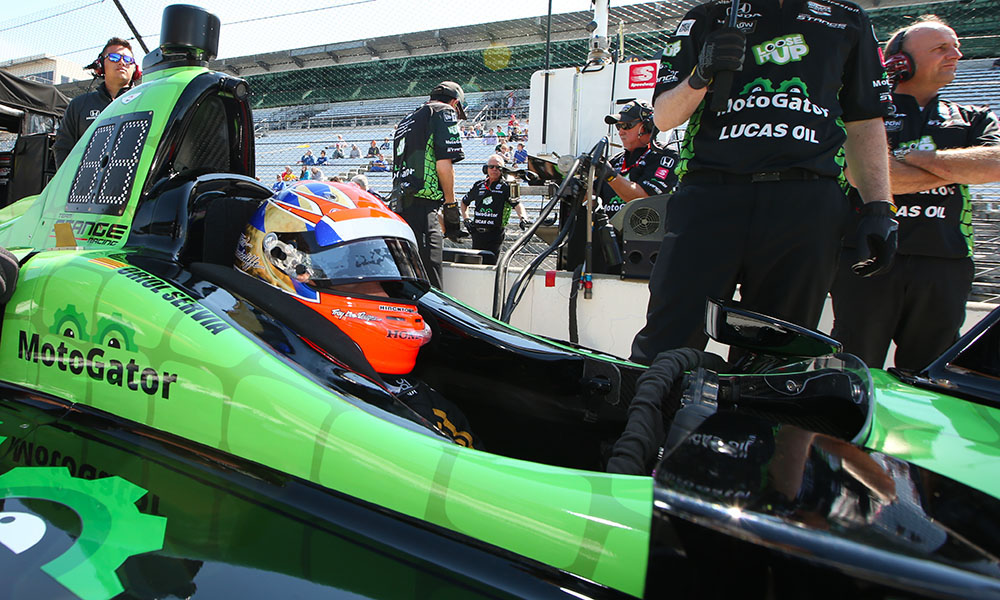
Image by Marshall Pruett
Hinchcliffe drives four different chassis on opening day of Indy practice
James Hinchcliffe couldn’t get enough of the Indianapolis Motor Speedway on the opening day of practice.
The Arrow Schmidt Peterson Motorsports driver owns the rare distinction of seeing his name listed four times on the speed chart, and that comes as a result of driving his No. 5 Honda chassis, the sister No. 7 piloted by Marcus Ericsson, the Indy-only No. 77 assigned to Oriol Servia, and even Jack Harvey’s No. 60 Meyer Shank Racing Honda, which is involved in a technical partnership with Arrow SPM.
Ericsson’s No. 7 Honda was the fastest car from the quartet, albeit with Hinchcliffe behind the wheel, with a best lap speed of 225.498 mph to place 23rd overall. The strange car-hopping exercise, as the Canadian explained, was to benchmark the four cars with a single driver to search for any handling discrepancies.
“Today was solid, and we got through a lot of what was on our test list,” Hinchcliffe told RACER. “The biggest thing obviously being the car swap at the beginning of the day. The reason you do that is, at a track where you're really looking for a thousandth, sometimes even tenths of thousandths of a second, any sort of discrepancy in car build or just the way things fit together, can skew data that you're sharing with your teammates.”
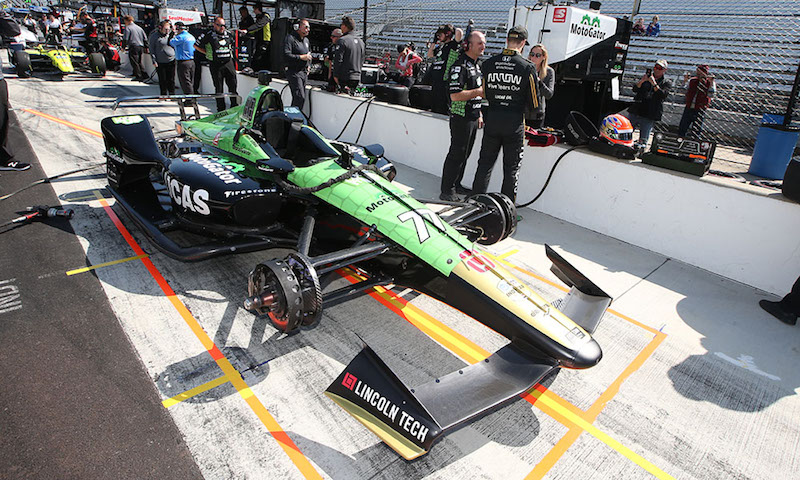
Hinch's nosecone served as a standardization tool as he hopped from car to car. Image by Marshall Pruett
With the MSR team relying on Arrow SPM to prepare its car for the 500, Hinchcliffe was able to take the nose/wings and seat from his No. 5 entry to sample the miniature fleet to ensure repeatable testing conditions.
“So we tried to create a situation where we had four cars built by the same group, set up the same, and we used the same driver with the same set of tires and the same front wing,” he said. “Tried to eliminate as many variables as we could just to make sure that the setups all matched, the feeling in the car was the same, so that when the drivers are talking later in the month, later in the week, we know there's nothing built into a particular chassis that feels a little different. Gives us a bit of a rough idea on relative speeds between the cars. So, there's a lot of reasons to do it, a lot of benefits to do it. I'm glad we got it done.
Even if the reaction to seeing his name listed four times in four different cars was rather odd, he’s appreciated of the efforts by Arrow SPM to build identical machines.
“And I've got to say I've got to give everybody at Arrow SPM a lot of credit because building four cars that closely and having them show up and run similar times and have similar feels like that is not an easy thing to do, but that's how it felt for us,” he added.
“And yeah, happy how we got it done. Did a lot of data collection today, and going to dive into it tonight and come back and try to find some speed tomorrow.”
Presented by:
Marshall Pruett
The 2026 season marks Marshall Pruett's 40th year working in the sport. In his role today for RACER, Pruett covers open-wheel and sports car racing as a writer, reporter, photographer, and filmmaker. In his previous career, he served as a mechanic, engineer, and team manager in a variety of series, including IndyCar, IMSA, and World Challenge.
Read Marshall Pruett's articles
Latest News
Comments
Comments are disabled until you accept Social Networking Cookies. Update cookie preferences
If the dialog doesn't appear, ad-blockers are often the cause; try disabling yours or see our Social Features Support.