NASCAR's O'Donnell on 'rough night' in Richmond
Steve O'Donnell admits Saturday was a "rough night" for NASCAR officiating at Richmond Raceway.
The executive vice president and chief racing development officer spoke at length Monday morning during an appearance on SiriusXM NASCAR Radio about some of the memorable cautions thrown during the regular season finale. O'Donnell vowed the sanctioning body would be reviewing the Federated Auto Parts 400 to avoid the same snafus in the future.
"I think if you look at the year to date we've been really consistent and done a really great job," O'Donnell said. "Unfortunately, that didn't carry through on Saturday night. I think the first one, that was a quick trigger – it was a mistake."
The caution on Lap 88 was listed as "smoke" in the official race report, thrown when leader Matt Kenseth locked the brakes up getting into Turn 3. O'Donnell believes had that been the only incident of the night, it might have been brushed off with everyone moving on.
like Kenseth and Clint Bowyer, damaging their cars in an accordion effect
of drivers slamming on the brakes."We communicated multiple times over the radio to stop, pit road was open and unfortunately where the vehicle chose to stop was in the worst place," said O'Donnell. "We can't go back and fix that [but] we can go back and look at the communication and what are better ways to make sure that doesn't happen, because that could have had a huge impact on the race. It actually did, but even further heading into the playoffs that's not something you ever want to see happen."
Scott Miller, the senior vice president of competition also said Saturday night the ambulance did not follow the directive to stop. When asked to explain the protocol for dispatching the safety crews, O'Donnell said one official handles the directives for opening and closing pit road while another oversees the safety and medical personnel.
Related Stories
"Anytime there is an incident and a vehicle stops, we'll dispatch our chase vehicle, an ambulance and usually a tow truck. In this case, all three of those are dispatched and then if a vehicle ends up rolling off, there's communication to each one of those individually," O'Donnell said. "I think in this case, I want to say the safety truck was a little ahead of the field, and so we asked them to kind of stand on the gas, get ahead of the field. We asked the tow truck and ambulance to stop and that probably would have been about midway through the backstretch. Tow truck did.
"Unfortunately, there were multiple communications with the ambulance and it just didn't happen. It stopped at a really bad place. Ultimately, that is on us. We have a lot of folks who work hard at the racetrack, but we've got to do a better job of communicating. If we go back and look at it, could we have thrown the red light on the pits (to close pit road) or would that even have been worse with cars coming down? That's something we've got to look at.''
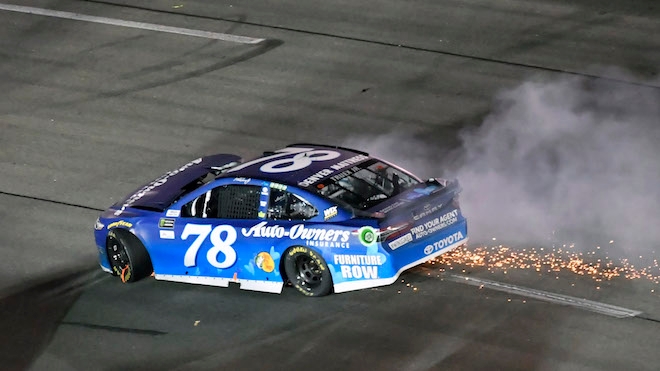
The final caution was also questioned as it thrown on Lap 398 of a scheduled 400 for Derrike Cope scraping the wall. Martin Truex Jr. was leading handily at the time but ended up wrecked on the overtime restart (pictured, top) and openly criticized the decision to call for a caution.
Said O'Donnell, "I've been back and forth with Martin – he's obviously upset and I think that's fair."

Latest News
Comments
Comments are disabled until you accept Social Networking Cookies. Update cookie preferences
If the dialog doesn't appear, ad-blockers are often the cause; try disabling yours or see our Social Features Support.