IMSA 2017 Prototype Tech Profile: Nissan Onroak
• Tech Profile #1: ORECA 07
• Tech Profile #2: Ligier JS P217
• Tech Profile #3: Riley/Multimatic Mk 30
• Tech Profile #4: Cadillac DPi-V.R
ORIGINS AND PERFORMANCE:
Led by the Florida-based Tequila Patron ESM team and its co-owners Ed Brown and Scott Sharp, the Japanese Nissan brand was introduced as the third Daytona Prototype international manufacturer to partake in IMSA’s new formula.
The engagement of Nissan, through its NISMO competition arm, is unique among the three DPi manufacturers as it’s the only arrangement where an automotive company is involved as a service provider, rather than as a full-factory effort like those facilitated by Cadillac and Mazda.
With the dynamics of the three-party union in mind, ESM brought NISMO together with its preferred P2 vendor, France’s Onroak Automotive, and as a team, they have produced the Nissan Onroak DPi. Built upon Onroak’s 2017 WEC-spec Ligier JS P217, the fascinating Nissan version has also earned the honors of being the first DPi model to adopt the use of a GT3-based engine.
Taken from Nissan’s halo car, the beloved twin-turbo V6-powered GT-R, the JS P217 was fitted with the NISMO-built 3.8-liter mill with great precision. For all of the installation issues that could have come from bolting a road-based engine into a spec WEC chassis, the clean and tidy job carried out by Onroak deserves praise.
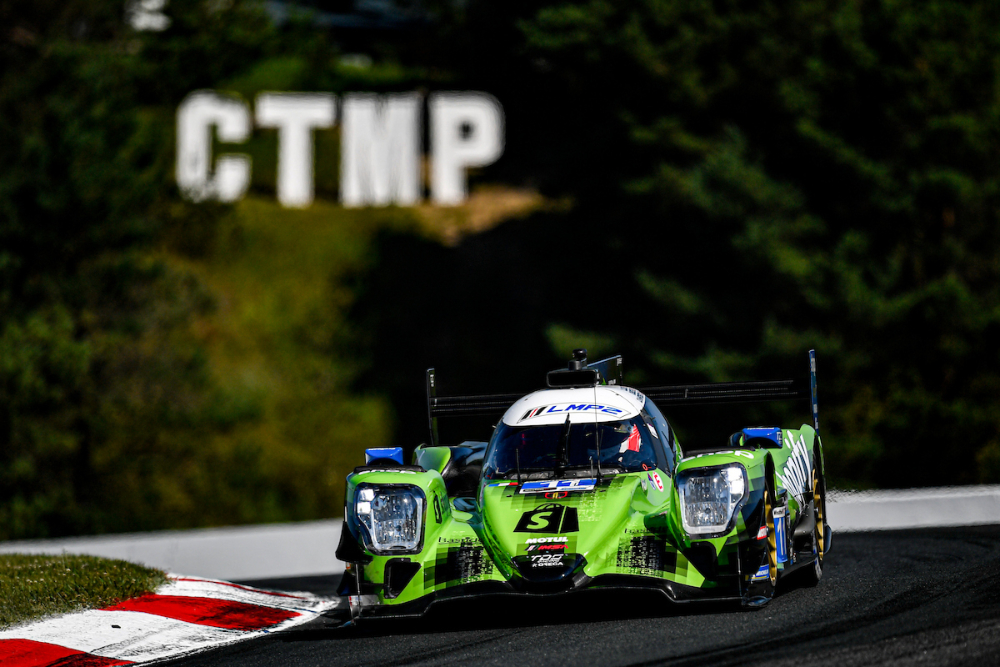
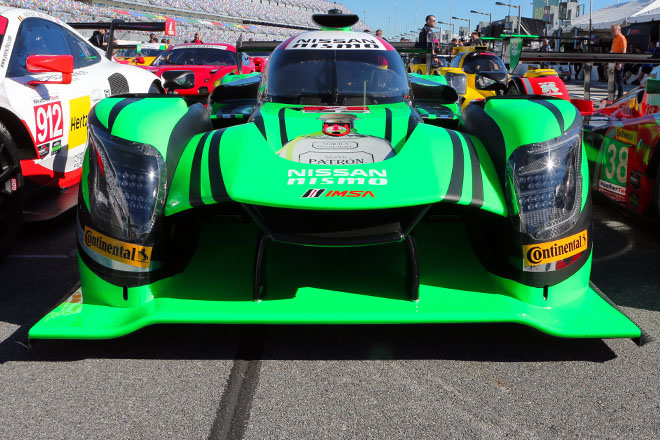
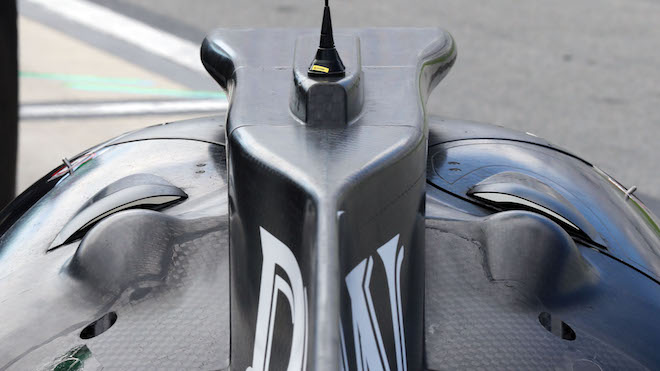
The custom bodywork carried by the Nissan Onroak DPi is a far cry from the visuals presented by the JS P217. With the Ligier already topping the list of radical lines and shapes in the Prototype class, the funky Nissan has taken the bar and moved it beyond reach.
And to think that accomplishment almost didn’t happen. Nissan’s first DPi bodywork submission to IMSA was little more than a light massage of the JS P217, and with some help from the series – including a visit to Nissan’s website to borrow a few styling cues from its road cars – a sketch was returned with strong suggestions of what was expected from the next submission.
With some creative license applied to IMSA’s suggestions, the end result is what we see today.
Although the Nissan Onroak DPi is loaded with potential, it is destined to use the Rolex 24 at Daytona and the month-plus that follows (leading into Sebring) as learning opportunities. The late commissioning of the project has conspired against its immediate success, and with the first car arriving at ESM’s base just days before Christmas, the car’s development calendar is months behind the rest of the field.
The recent Roar Before the 24 test, a three-day affair at Daytona, was akin to a public shakedown for ESM, NISMO and Ligier. It presented the first chance to put the pair of Nissans through a proper testing program, and as expected, a litany of new-car blues were experienced.
An engine failure in one chassis led to losing most of one day with that car, and heat issues – specifically with the Nissan’s turbo intercoolers – sapped power and led to some interesting discovery efforts to identify the problem. In the drivetrain, the car’s asymmetrical differential was locking in specific corners, which caused a handling imbalance.
If those issues come across as worrisome, they aren’t; finding and fixing new-car problems is part of the development process. The only difference here is, due to the late start of the program, the team was unable to encounter these items in private and have them resolved before the cars appeared at the Roar.
The greatest issue for the Nissan Onroak DPis is the same one faced by any and every 2017 P2-based model equipped with Cosworth electronics. Where the WEC P2s are required to use Cosworth’s steering wheel, data system and engine control module, IMSA gave its DPi manufacturers the freedom to choose their own providers. Cadillac, for its DPi-V.Rs, retained Cosworth for its dash and data, but moved to Bosch to control its 6.2-liter V8. Mazda, for its RT24-Ps, cut Cosworth out of the picture altogether by using Motec for its dash/data and Life for its ECU. (Predictable sidebar: Mazda is the only brand so far that has avoided major electronic nightmares).
Nissan, from its familiarity with Cosworth’s products in conjunction with its Nissan GT-R GT3 race car, stuck with the brand as its DPi dash/data/ECU vendor, and the outcome has been far from pleasant. Constant problems with the dash – something the Cadillac teams are also familiar with – slowed the Nissans at the Roar while Cosworth support personnel attempted to trace the issues. Being locked out of accessing the dash through an external laptop was another fun experience by the ESM team.
Accurately and consistently controlling the turbo boost generated by the Nissan engine is another ongoing problem through the ECU, and as a result, using the full complement of boost allowed by the series has not been possible (without risk of overboosts and the penalties that would be applied). The inability to start the cars due to Cosworth-related problems has also been a massive headache that has limited the amount of testing the team has been able to conduct since the Roar.
Combined, the normal mechanical growing pains have been exacerbated by the electronics cluster. It also left the program without the ability to show its full capabilities at the Roar, and barring a barrage of miracles during the race, it’s unlikely we’ll see the Nissan Onroak DPis charge to the front and finish all 24 hours without interruption.
Despite all of the setbacks, and starting off 2.6 seconds behind the leaders, ESM took the gap down to 1.2 seconds by the end of the Roar. Once its cooling and boost control problems are rectified, the car’s limited top speed will certainly improve as well at Daytona.
There’s a lot to come from this program in the future. Getting through Daytona is the first step towards bigger things.
DAYTONA TEST PERFORMANCE NUMBERS
The aforementioned six prototype models were represented by 12 cars entered at the Roar (3 x ORECA 03, 3 x Cadillac DPi.V-R, 2x Mazda RT24-P, 2 x Nissan Onroak DPi, 1 x Ligier JS P217 and 1 x Riley/Multimatic Mk30).
Nissan Onroak DPi’s Fastest Roar Lap: 1m39.608s (P6 among the six models, P11 of the 12 cars, -1.265s to the fastest lap set by the ORECA 07)
Nissan Onroak DPi’s Best Roar Top Speed: P11, 190.6 mph (-6.5 mph to the top 197.1 mph set by Mazda’s RT24-P)
NAMES AND SPECIFIC VEHICLE DATA
Lead Chassis Designer(s):Nicolas Clémençon
Lead Aerodynamicist(s):Nicolas Clémençon (in collaboration withEXA engineers for the CFD and with RUAG engineers for the wind tunnel studies)
Transmission Vendor: Hewland
Brake Package Vendor: Brembo Calipers with carbon AP discs and pads
Data and ECU Electronics Package Vendor: Cosworth
Engine displacement and cylinder count: 3.8-liter Nissan V6
Engine air induction system: Twin turbo
SPEC 2017 P2-BASED DATA FOR EVERY PROTOTYPE MODEL
Minimum Weight: All WEC P2s and DPis have a minimum of 930 kilos (2050 pounds) with no fuel or driver for the Rolex 24. 930 kg is also the minimum in the WEC.
Maximum Length: 4750 mm (7 in.), which is 100 mm/4 in. longer than the previous LMP2 max length.
Maximum/Minimum Width: 1900 mm max (approx. 75 in.) to 1800 mm min (approx. 71 in.), which is narrower than the previous maximum of 2000 mm/75-3/4 in.
Maximum Height: 1050 mm (approx. 41.5 in.), slightly up from the previous 1030 mm (40.5 in.) standard.
Wheel Size: 18x12.5 in. fronts and 18x13 in. rears.
Tires: All supplied by Continental. Unique use of DP-derived Daytona specification for the Rolex 24, only. Brand-new 2017-spec Continental tires will be used from Round 2 at Sebring onward.
Transmissions: Six-speeds are required for every car. In the WEC, P2 teams are severely limited on the number of gear ratios that may be used (three sets), which will compromise the ability to perfect power and torque curves at some tracks. IMSA has removed the restriction for WEC P2s running in the WeatherTech Championship, and there are no limitations for DPis.
FRONT SUSPENSION
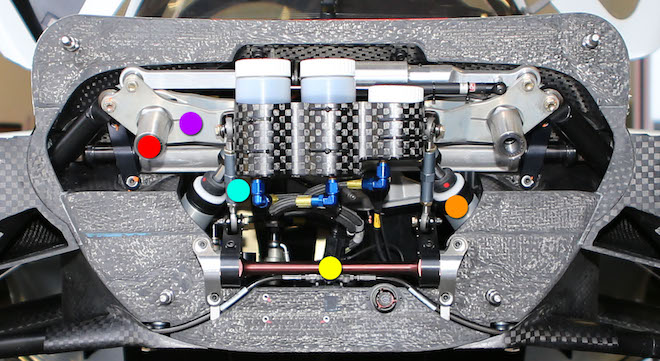
The Nissan Onroak DPi uses the same torsion-bar suspension found on the JS P217.
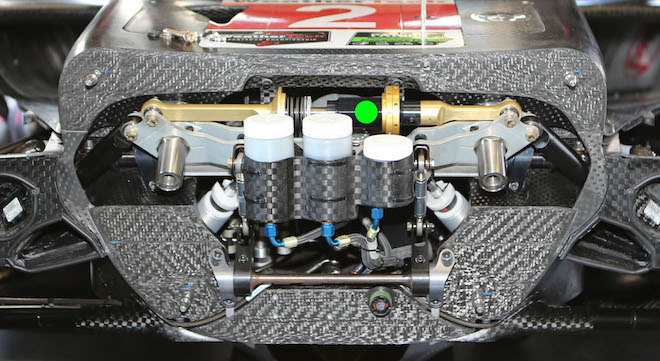
Actuated by pushrods connected to the lower control arms, the torsion bars are twisted by rocker arms that connect to individual dampers. Secondary links that connect the dampers and torsion bars to an anti-roll bar. Finally, a front third spring/damper is connected between the rocker arms that controls chassis pitch and dynamic ride height.
Below: Torsion bars (red, inside their forward housings), rocker arms (purple), dampers (orange), rocker-to-anti-roll bar links (cyan), anti-roll bar (yellow), third spring/damper (below, green).
REAR SUSPENSION
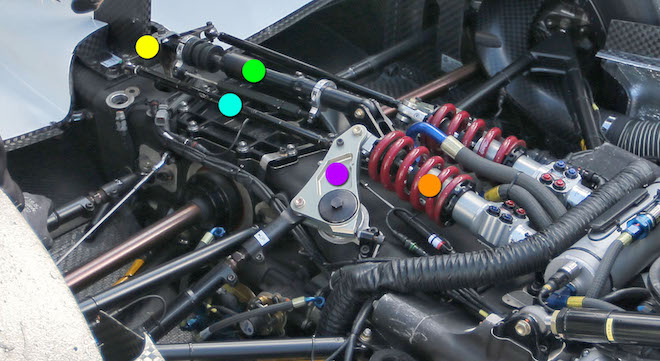
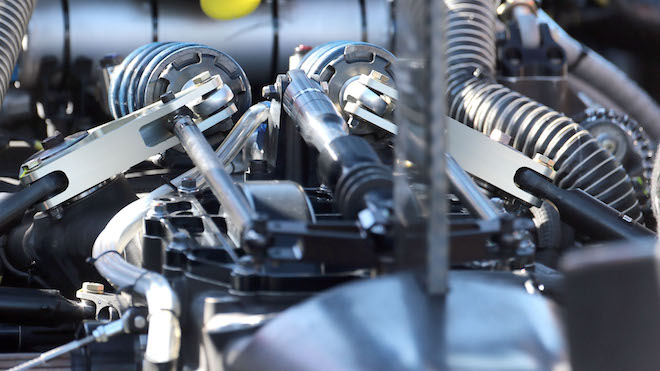
The Nissan Onroak DPi also uses the JS P217’s conventional suspension layout at the rear.
Below: Rocker arms (purple), dampers with coilover springs (orange), rocker-to-anti-roll bar links (cyan), T-style anti-roll bar (yellow), third spring/damper (green).
AERODYNAMICS
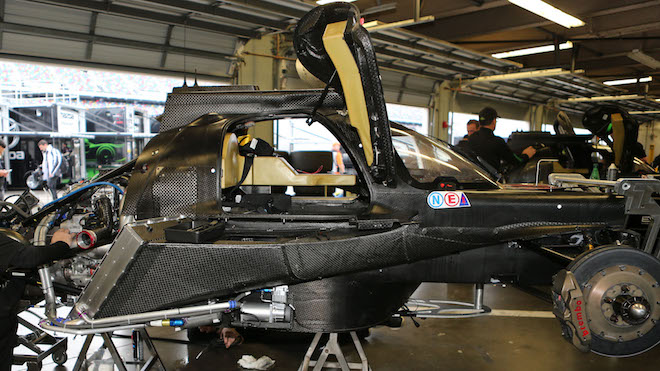
Like every 2017 P2-based chassis, the JS P217-based Nissan Onroak DPi was constructed using a raised forward section of the tub (red) to flow air in from the nose section through the keel and out through the sidepods. The car’s floor (yellow) is a considerable distance from the elevated tub section.
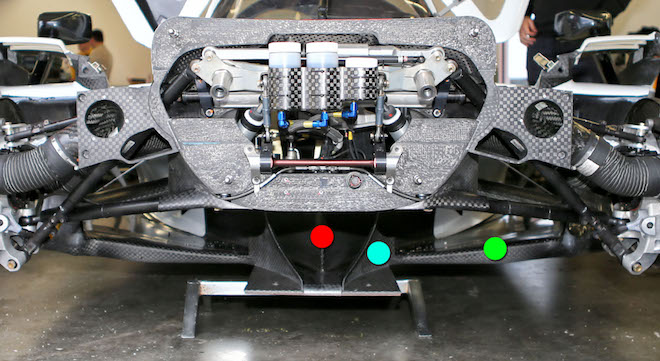
Minus the nose, the keel (red), turning vanes (cyan), and floor (green) can be seen. The Nissan’s JS P217 tub, with the high-flow keel area in mind, is the only one of the six models to use a non-rectangular shape. The rounded, tapered shape at the bottom half of the tub continues back to the cockpit, and creates even more volume to flow air through the front of the car.
On the topside, the front of the Nissan, however, is a vast departure from the JS P217. Compare the WEC model in white to the carbon DPi Nissan below:
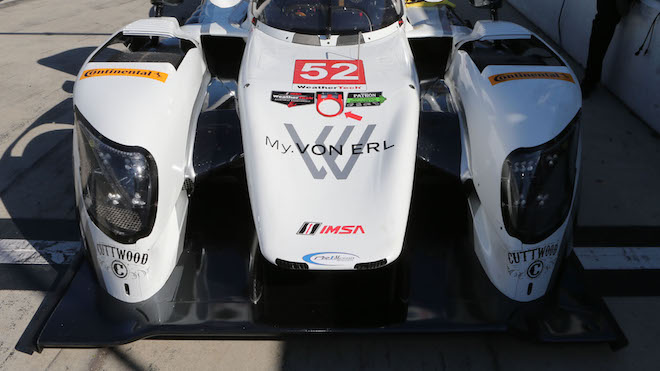
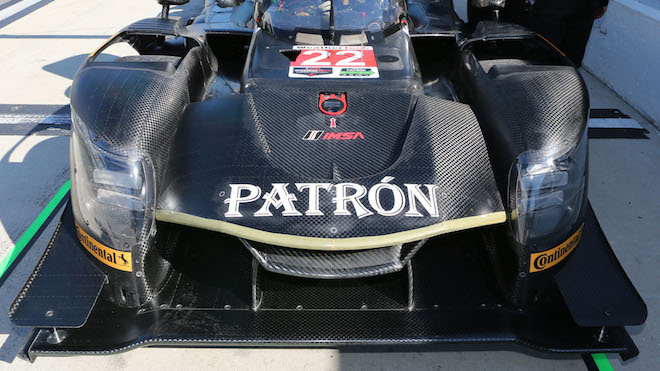
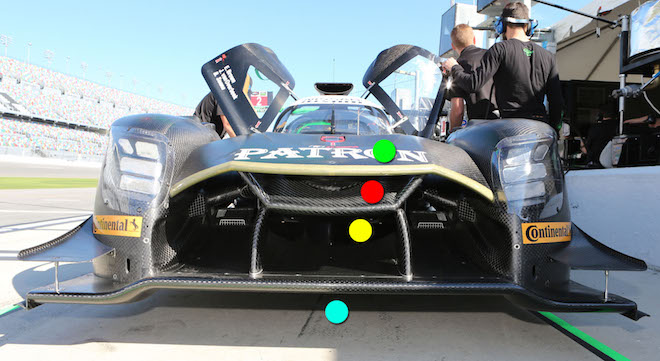
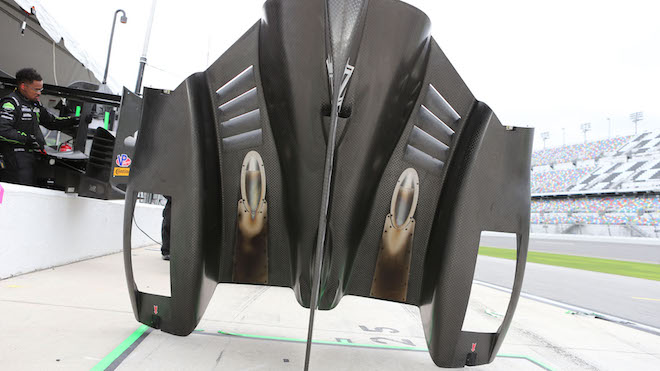
The Nissan has received more than a simple cover over the stock Ligier nose; the fender-to-fender beam shadows a revised nose which uses a wide V-like profile that matches some of the current Nissan road car grilles. Down low, complex interactions with the air take place above the cover (green), between the cover and the nose (red), below the nose and over the diffuser’s wing profile on the way to the keel (yellow) and below the splitter (cyan).
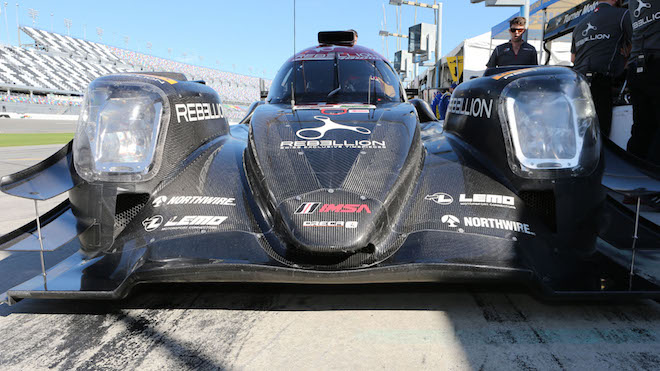
Compare that to the relatively simple nose treatment on the ORECA 07 that sends air above or below the diffuser’s leading edge.
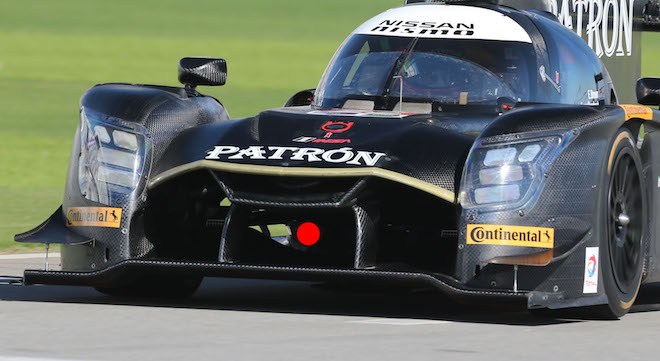
The big air channel beneath the Nissan’s JS P217 tub is seen in action (red).
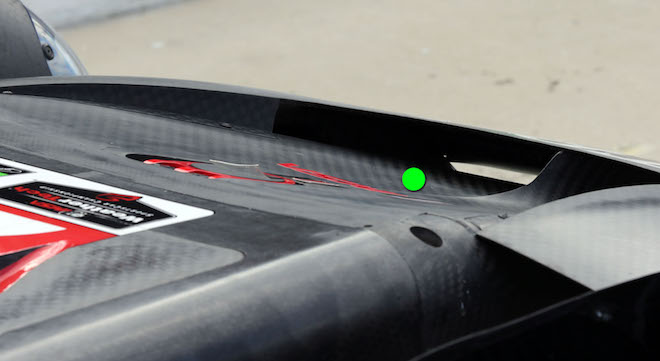
Although most of it is obscured by the cover, the Nissan retains some of the dished nose profile found on the JS P217 (green).
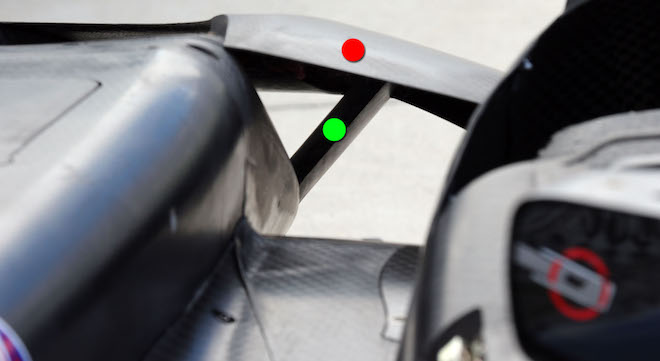
The cover (red) has additional supports (green) that provide a rigid connection to the nose.
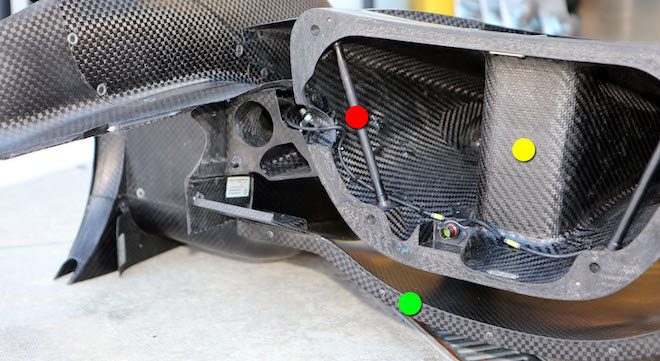
From behind, the Nissan’s nose has a fortified crash structure (yellow), standard quick-disconnect mounting mechanisms (red), and the trailing edge of the splitter’s wing profile can be seen (green).
The front fender treatment on the Ligier was carried over to the Nissan.
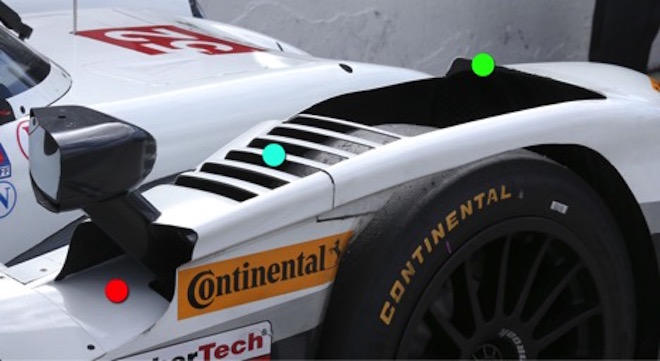
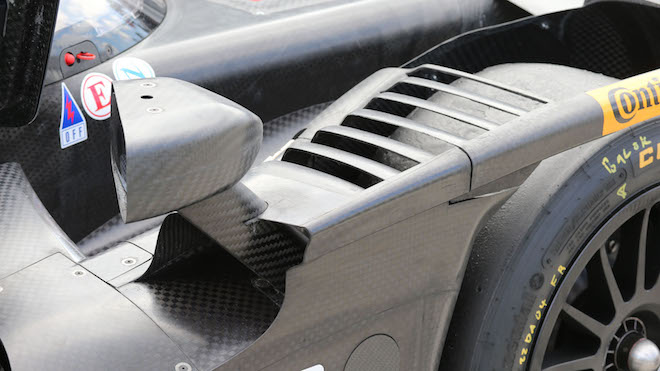
Another significant departure between the JS P217 and the Nissan is found with the sidepods and rear fenders. Using the WEC-spec Gibson V8, the Ligier carries standard water and oil radiators in the middle of the sidepods. The extra available space allowed Onroak to incorporate the rear brake ducts (cyan) and covers of varying sizes to use as needed (green) into the outer surface of the sidepods. With the brake ducts on the side, the leading section on the JS P217’s rear fenders slope downward to shape the direction of the air moving over the middle of the car.
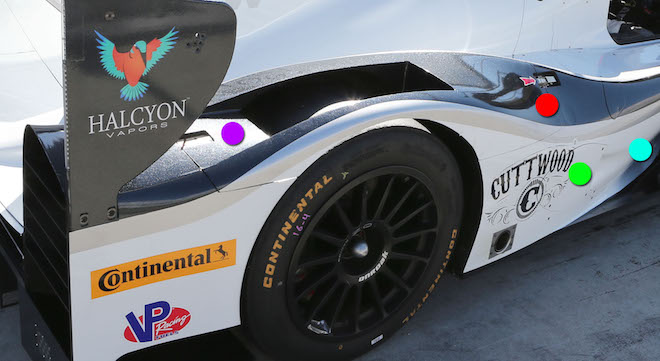
Thanks to its twin-turbo engine, the Nissan’s sidepods have a need to carry a second radiator on each side – the intercoolers to reduce the temperature of the compressed air from the turbos before it enters the engine. With two big items to cram into the sidepods, the Nissan’s designers made use of the space where the JS P217’s brake ducting would sit, and built large external ducts (green) to feed the turbo intercoolers (orange). Larger turning vanes (red) and larger flow conditioners (yellow) are also unique to the Nissan.
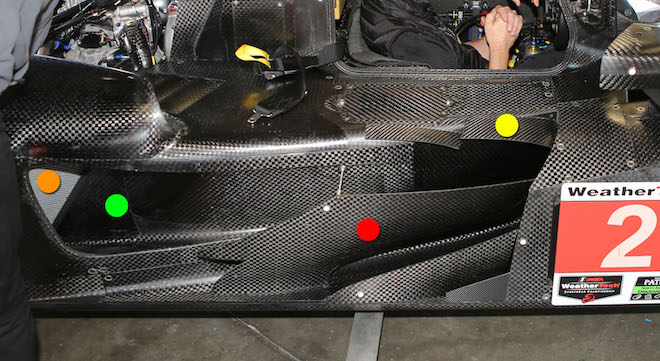
The leading edge of the Nissan’s rear fenders were opened up to relocate the rear brake ducts, and the intercoolers are definitely prone to oncoming debris (green).
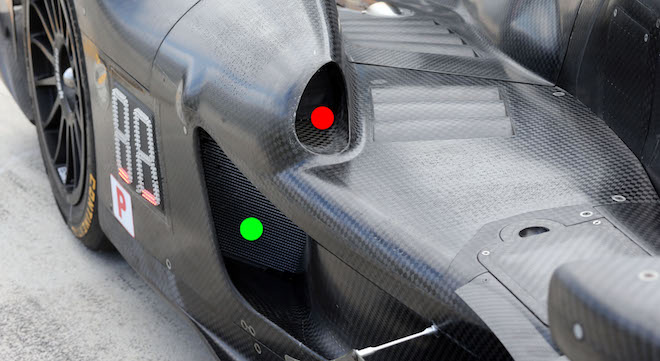
The intercoolers tried at the Roar proved to be troublesome as they became easily clogged with dirt and tire marbles. Owing to the newness of the Nissans, the team conducted an experiment with a flexible orange hose that took clean air entering the keel to feed the intercoolers; a secondary scoop was also tried (green) to determine whether the high turbo air charge temps were due to a lack of fresh air making it to the intercoolers, or if the intercoolers were simply clogging from debris. The latter proved to be the problem and the hose/scoop was removed. Revised intercoolers that allow fine debris to flow through without clogging are expected to be used going forward.
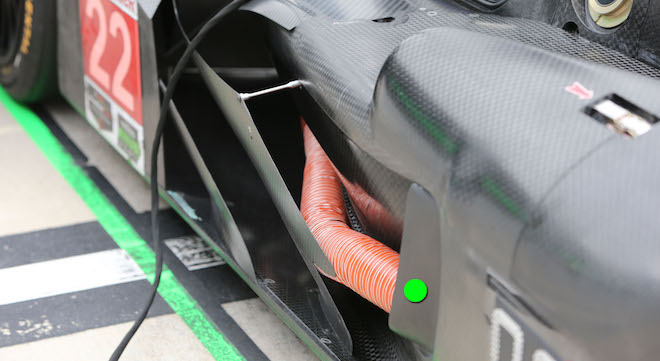
A look at some of the Nissan’s DPi bodywork.
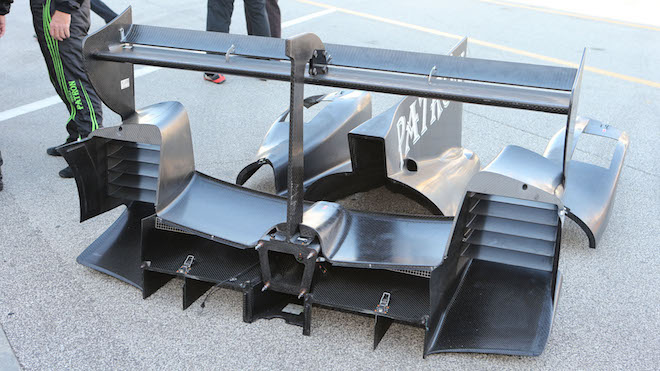
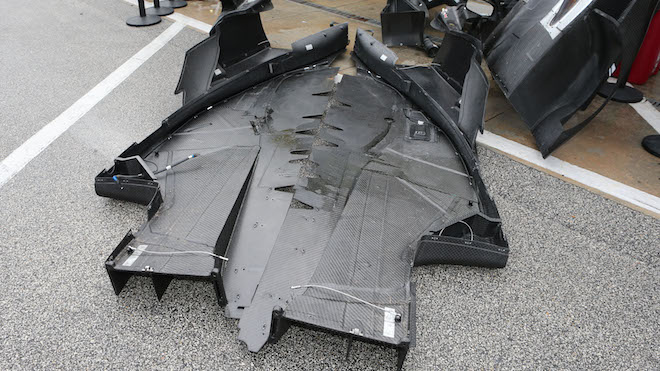
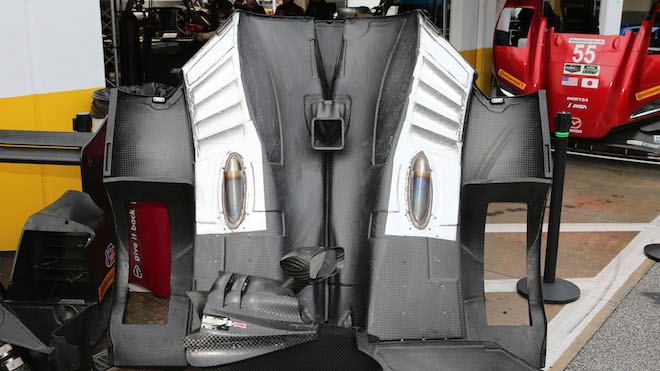
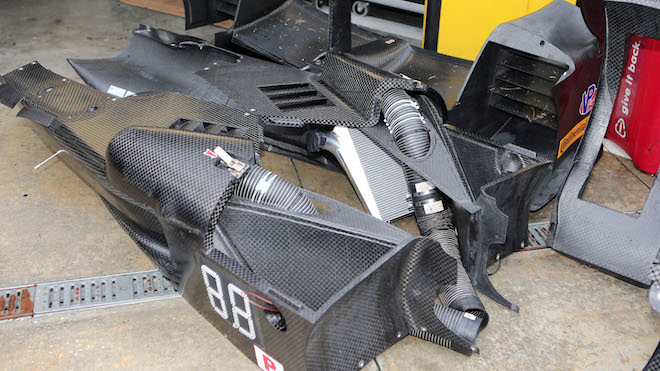
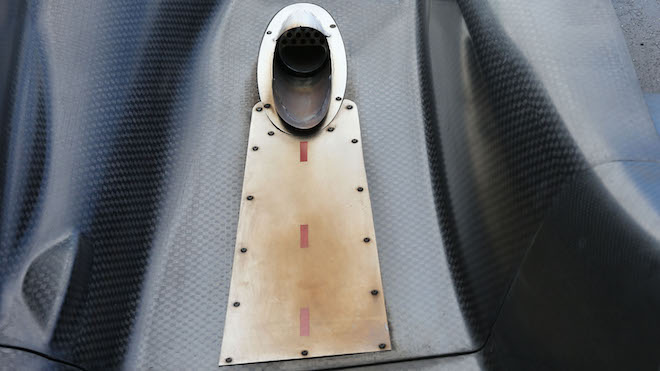
Pictures of the Nissan Onroak DPi with downforce-generating dive planes were shown above; the car was also tried without them in place in low-downforce runs.
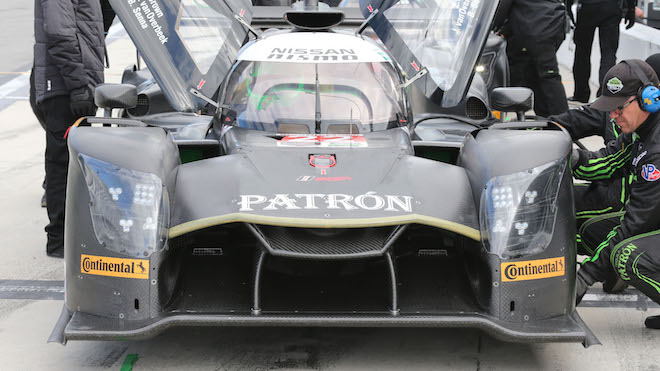
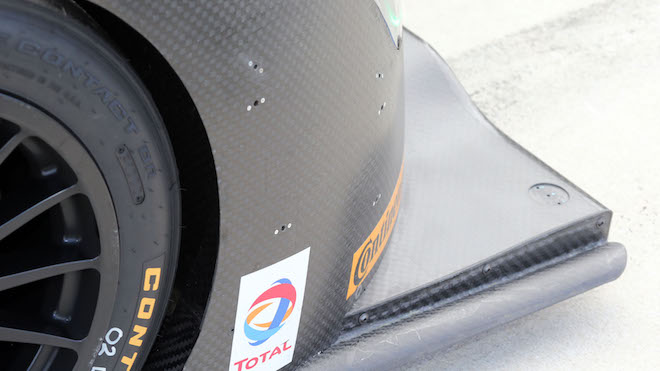
Despite the ultra-busy aero at the front of the Nissan, the rear is quite smooth and flowing. The plunging, low trailing edge to the engine cover and tail is shared with the ORECA 07 and Cadillac DPi-V.R.
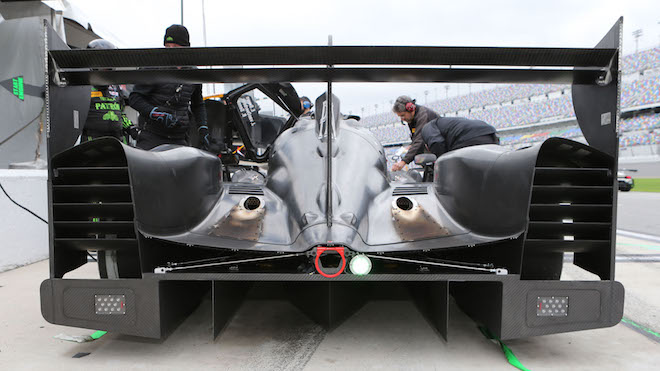
And here’s the flat, rectangular trailing edge preferred by others like the Riley/Multimatic Mk 30:
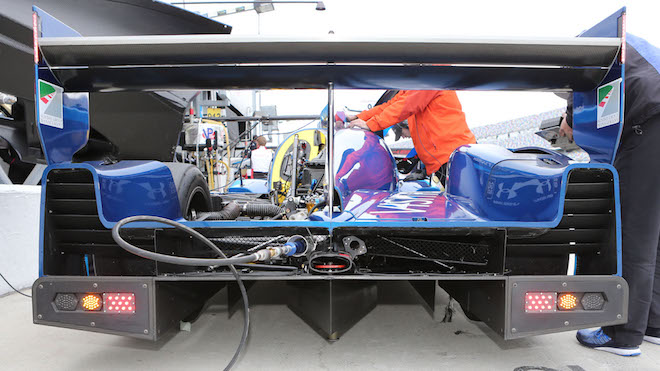
Another look at the Nissan’s tail treatment:
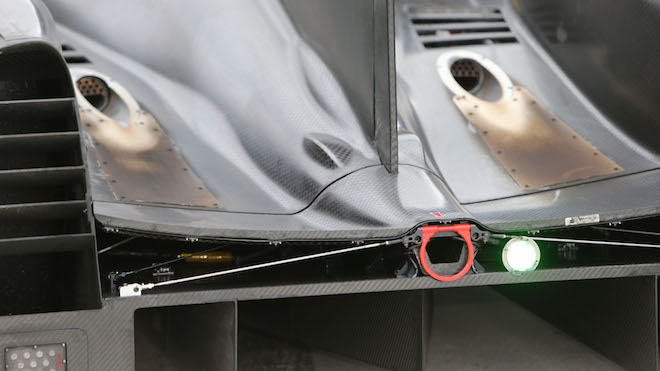
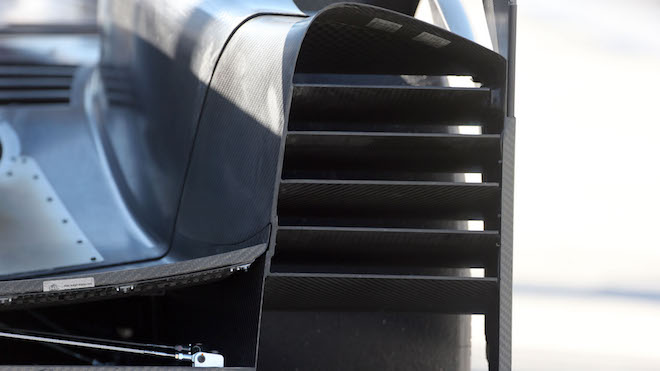
A different look at the rear fenders and the cooling louvers placed above the Gibson V8 engine’s exhausts on the Ligier and the Nissan’s periscope exhausts and bigger louvers to vent the engine and turbo intercoolers.
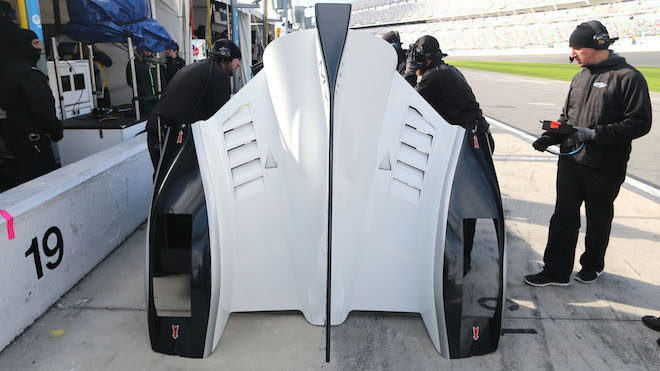
ENGINE
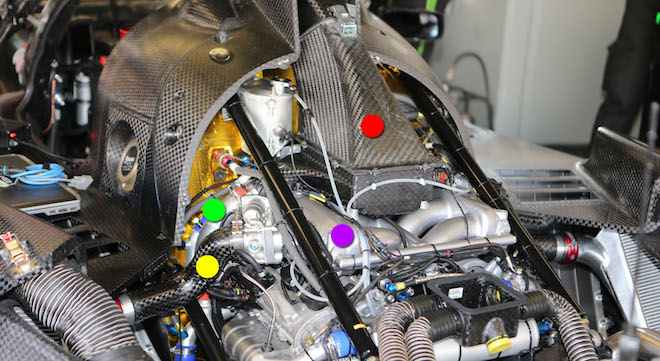
It’s a tight fit in the engine bay. The Nissan’s intake plenums (purple) might have a millimeter to spare between the bellhousing support rods. Air is taken in through the overhead box (red), piped down to the turbos (green), that compressed air is then sent into the bottom of the intercoolers (out of sight) and pumped into the plenums (yellow) in a short and tidy loop that minimizes turbo lag.
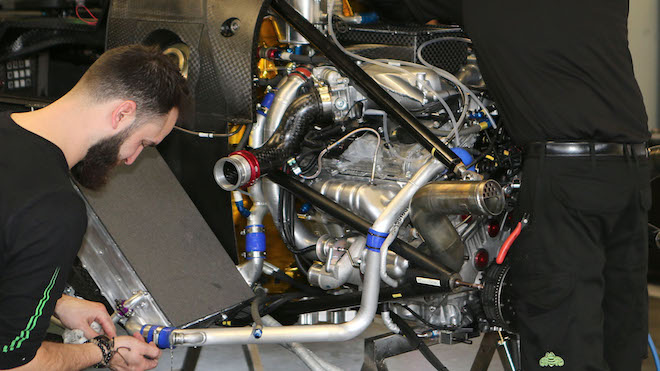
A view of the engine from the left side and its water radiator; the intercooler is off and contained in the sidepod.
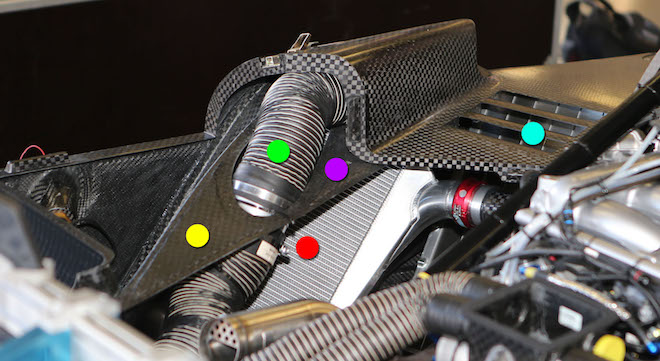
Some amazing work has been done to fit so many extra ancillary pieces into the engine bay, but one problem that presented itself was the blockage to the intercoolers by relocating the brake ducts to the rear fender inlets. With the ducts (green) and the bodywork flange (yellow and purple) that holds the duct, the intercooler (red) has some obstructions for the air flowing through the core. And with the intercoolers sitting behind the engine’s oil/water radiators and creating a bit of blockage on their own, an extra set of louvers (cyan) were added to the top of the bodywork to help hot air escape.
For the sake of comparison, here’s the JS P217’s engine bay with its unobstructed radiators.
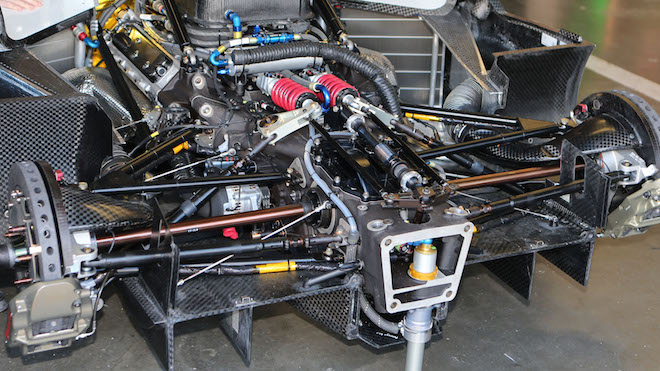
Another look at the installation of the 3.8-liter TTV6 Nissan engine.
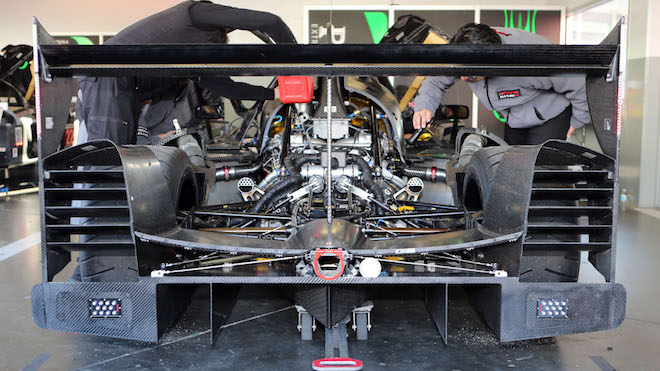
The Nissan’s 6-speed Hewland transmission is built to a different specification than the stock JS P217 (and has a chassis setup jig attached to the rear).
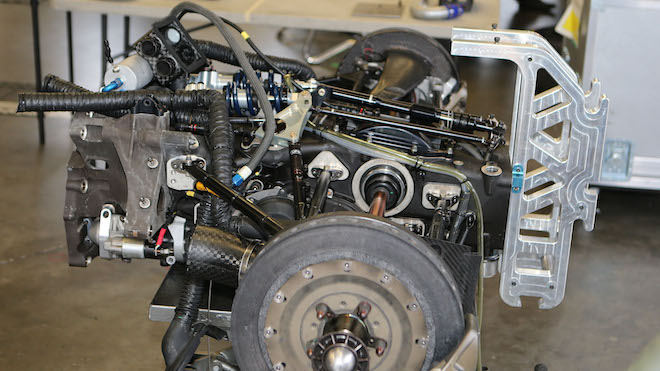
MISCELLANEOUS
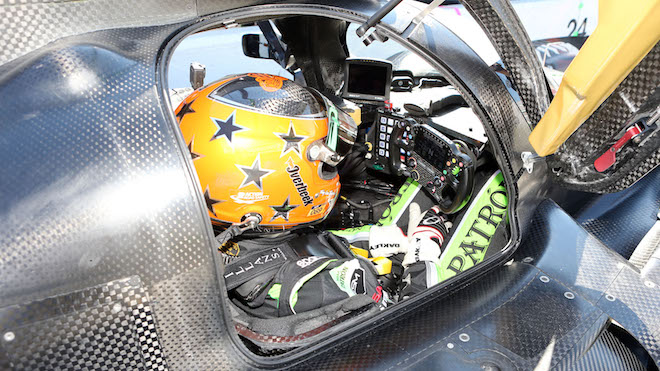
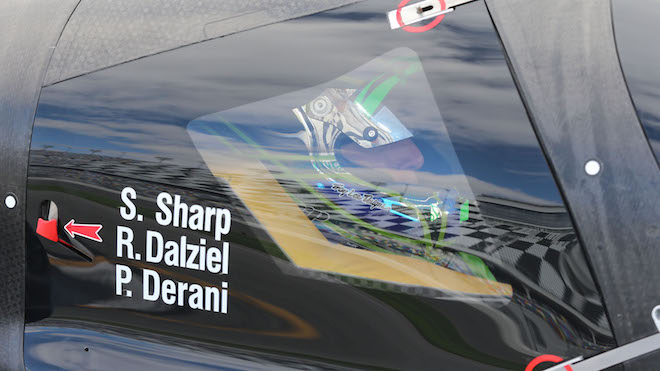
A look inside the car and the head support/impact structure built into the Nissan’s door.
We’ll close on one more of the Nissan’s unmistakable swoops and curves:

Latest News

Comments
Comments are disabled until you accept Social Networking Cookies. Update cookie preferences
If the dialog doesn't appear, ad-blockers are often the cause; try disabling yours or see our Social Features Support.