IMSA 2017 Prototype Tech Profile: Mazda RT24-P
• Tech Profile #1: ORECA 07
• Tech Profile #2: Ligier JS P217
• Tech Profile #3: Riley/Multimatic Mk 30
• Tech Profile #4: Cadillac DPi-V.R
• Tech Profile #5: Nissan Onroak DPi
ORIGINS AND PERFORMANCE:
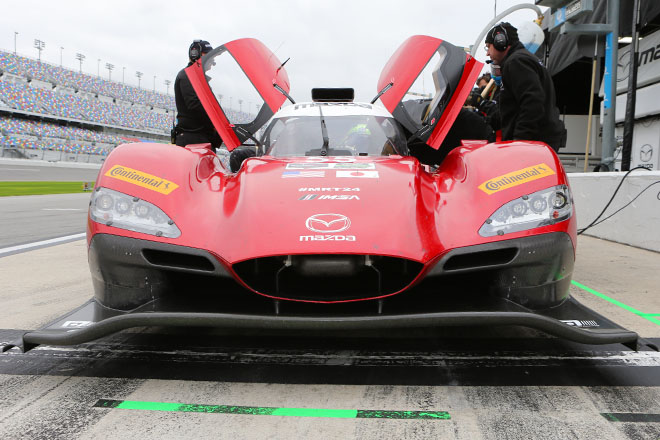
Mazda continued its relationship with Canada’s Multimatic and resumed an old partnership with Riley Technologies to produce its Daytona Prototype international. Mazda’s RT24-P (Road to 24-Prototype), the first DPi unveiled to the public, was built upon the WEC P2-spec Riley/Multimatic Mk 30 and represents a significant and inspired departure from that base model.
With IMSA’s mandate for auto manufacturers to make notable styling changes to the bodywork of their respective WEC-based DPis, Mazda mobilized a group from its North American and Japanese design departments to work with Mk 30 aerodynamicist Mark Handford while penning the RT24-P’s aerodynamics.
The result, according to many fans, is a shape that ranks atop the list of beauty and functionality in IMSA’s WeatherTech SportsCar Championship Prototype class. Handford’s utilitarian approach to the Mk 30, with its blunt nose and traditional lines from nose to tail, has been altered in every imaginable way with the RT24-P.
Soft, rounded front fenders are wholly unique among the six P2-based models in the Prototype category, and in almost every area where the Mk 30 has sharp, angular bodywork, the RT24-P sports curves and appealing contours. And as the speed traps revealed during the three-day Roar Before the 24 test, the Mazda’s flowing lines aren’t just for show: The No. 55 RT24-P set the fastest top speed of the event (while the Mk 30 was the slowest in class) and delivered the second-fastest lap of the Roar.
More speed is expected to come from the Cadillac DPis and the WEC Ligier JS P217 in the season-opening race, so the Mazda’s pace will likely have some company toward the top of the field, but as a whole, the performance gap between the RT24-P and the WEC Mk 30 has been remarkable.
Beyond the fundamental aerodynamic differences to the Mk 30, the Mazdas are also powered by something different than the spec Gibson V8 carried in every WEC P2 – a new version of its venerable 2.0-liter four-cylinder turbo engine.
The RT24-P made its public debut on-track during IMSA’s mid-December test at Daytona with a single car using an exhaust outlet in the left-rear portion of the sidepod. Noting the use of periscope-style exhausts on other prototypes at the test, and unaware it was an option, Mazda returned for the Roar with two cars and two exhaust configurations – one in the same sidepod location and the other with a periscope atop the left side of the engine cover.
From the Roar exhaust evaluation and further dyno testing, the simplified periscope layout, which features fewer power-robbing twists and bends than the sidepod-exiting configuration, freed more grunt from the engine. A slight decrease in radiator temperatures due to the exhaust being directed to the rear was also found. The periscope, as one would expect, has been chosen for both cars starting at the Rolex 24.
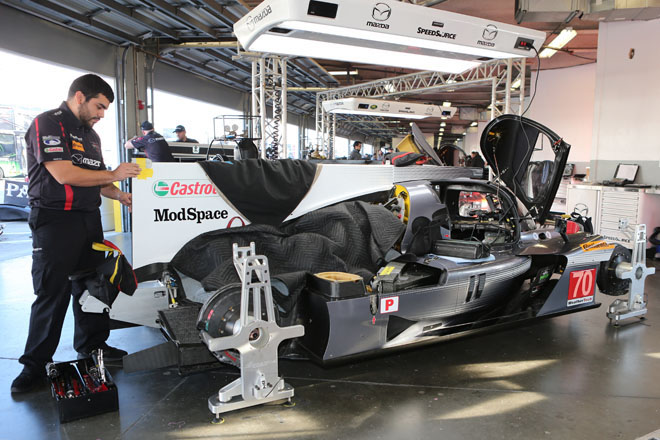
As noted with the Mk 30, one development issue – gearbox cooling – plagued the RT24-Ps in testing, but those issues were reported to be resolved before the end of the Roar. High ambient heat is still a cause for concern when it comes to gearbox cooling, and the SpeedSource-led Mazda team has options to move some of its cooling options in the sidepod and engine cover to direct more or less air to the gearbox cooler.
Inside and out, the RT24-P has the potential to make Mazda a serious player in 2017 and for many years to come. The development race against Cadillac (and Nissan at some point) will ensure the DPis are a source of intrigue and drama, and with reliability issues expected to plague every prototype model at the Rolex 24, it’s impossible to predict which brand will land in Victory Lane. As the only model without Cosworth electronics on board, the RT24-P should have fewer concerns about software or hardware failures than its competition.
Looking to the full championship on the horizon, and coming off a season where Mazda came incredibly close to earning its first Prototype win, it’s safe to assume that problem will be solved in the days and months ahead.
DAYTONA TEST PERFORMANCE NUMBERS
The aforementioned six prototype models were represented by 12 cars entered at the Roar (3 x ORECA 03, 3 x Cadillac DPi.V-R, 2x Mazda RT24-P, 2 x Nissan Onroak DPi, 1 x Ligier JS P217 and 1 x Riley/Multimatic Mk30).
RT24-P’s Fastest Roar Lap: 1m38. 363s (P2 among the six models, P2 of the 12 cars, -0.020s to the fastest lap set by the ORECA 07)
RT24-P’s Best Roar Top Speed: P1, 197.1 mph (+2.8 mph to P2, Ligier JS P217)
NAMES AND SPECIFIC VEHICLE DATA
Lead Chassis Designer(s): Bob and Bill Riley
Lead Aerodynamicist(s): Mark Handford, Julien Montousse, Ikuo Maeda, Jacques Flynn, Ken Saward
Transmission Vendor: Xtrac
Brake Package Vendor: Brembo Calipers with carbon Hitco discs and pads
Data and ECU Electronics Package Vendor: Motec Data, Life Racing engine management
Engine displacement and cylinder count: 2.0-liter four-cylinder
Engine air induction system: Single-turbo
SPEC 2017 P2-BASED DATA FOR EVERY PROTOTYPE MODEL:
Minimum Weight: All WEC P2s and DPis have a minimum of 930 kilos (2050 pounds) with no fuel or driver for the Rolex 24. 930 kg is also the minimum in the WEC.
Maximum Length: 4750 mm (187 in.), which is 100 mm/4 in. longer than the previous LMP2 max length.
Maximum/Minimum Width: 1900 mm max (approx. 75 in.) to 1800 mm min (approx. 71 in.), which is narrower than the previous maximum of 2000 mm/75-3/4 in.
Maximum Height: 1050 mm (approx. 41.5 in.), slightly up from the previous 1030 mm (40.5 in.) standard.
Wheel Size: 18x12.5 in. fronts and 18x13 in. rears.
Tires: All supplied by Continental. Unique use of DP-derived Daytona specification for the Rolex 24, only. Brand-new 2017-spec Continental tires will be used from Round 2 at Sebring onward.
Transmissions: Six-speeds are required for every car. In the WEC, P2 teams are severely limited on the number of gear ratios that may be used (three sets), which will compromise the ability to perfect power and torque curves at some tracks. IMSA has removed the restriction for WEC P2s running in the WeatherTech Championship, and there are no limitations for DPis.
FRONT SUSPENSION
(As the suspension systems are identical, this passage is identical to our breakdown of the Mk 30.)
Riley’s front and rear suspension is unlike anything in sports car racing. While every other constructor went with a torsion bar arrangement, the Rileys reached back to a successful concept employed with its World Sports Car and Indy Racing League designs in the 1990s.
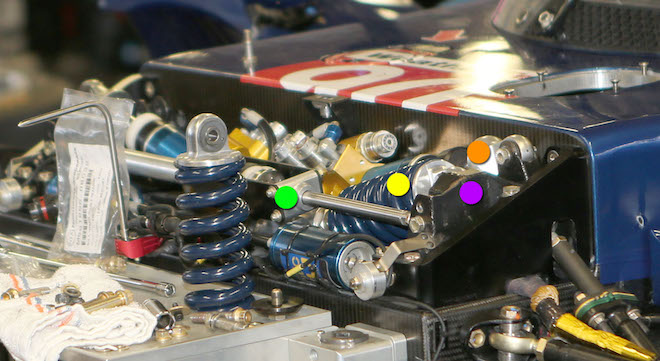
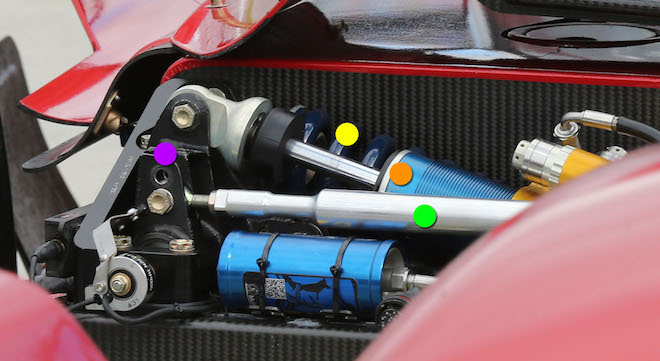
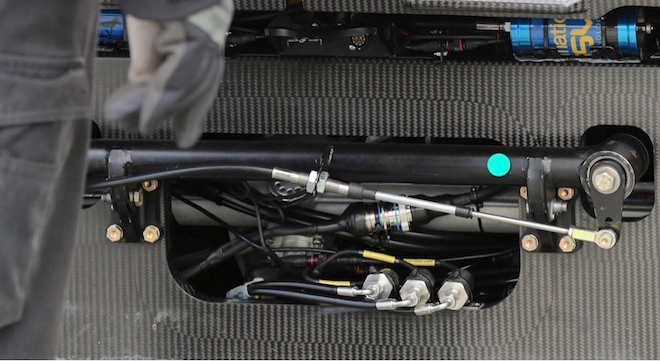
The front suspension system, which sits nicely atop the front of the chassis on a shelf designed into the tub, uses pushrods and massive rocker arms to compress individual dampers, springs, third springs/dampers, and interacts with an anti-roll bar affixed to the front of the bulkhead. The separation of the primary springs from the dampers provides a wider range of suspension adjustments, motion ratios, and increases the speed of spring changes which decreases chassis setup time.
Below: Rocker arms (purple), dampers (orange), springs (yellow), anti-roll bar (cyan), third spring/damper (green).
REAR SUSPENSION
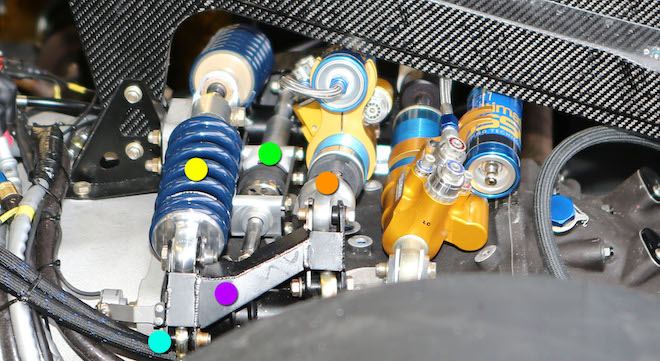
The Mk 30 and RT24-P use the same split spring/damper-with-giant rocker arrangement at the rear. Hidden from sight is the anti-roll bar that sits low in the chassis and is mounted through the bellhousing.
Below: Rocker arms (purple), dampers (orange), rocker-to-anti-roll bar links (cyan), third spring/damper (green).
Shown on the RT24-P below, the narrow suspension control arm aspect ratio (cyan, green) is done to move the system upwards to provide ample space for the diffuser to climb towards the tail of the RT24-P which increases downforce production. The low brake caliper mounting (red) position is done to move mass towards the bottom of the car to improve chassis balance and responsiveness.
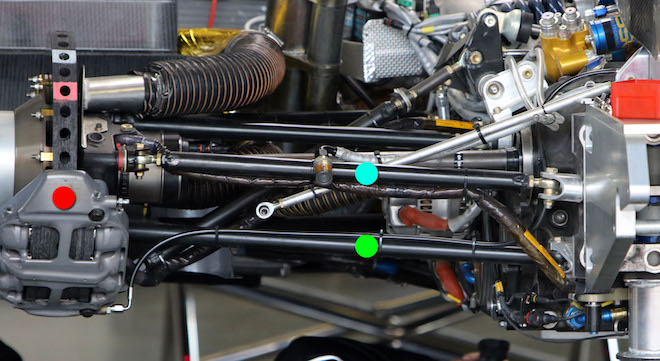
Another item unique to the RT24-P/Mk 30: its front brake calipers sit at the bottom of the suspension upright (below, at 6-o’clock), placing the weight as low in the car as possible. Most cars have the calipers placed at the back of the upright (at the 3-o’clock position) to have the weight closest to the center of the chassis.
AERODYNAMICS
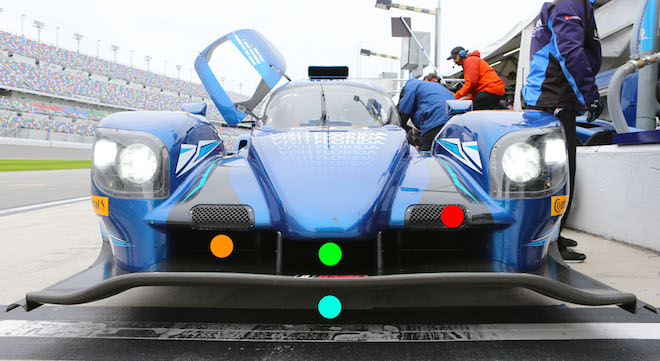
Like every 2017 P2-based chassis, the RT24-P/MK 30 was constructed using a raised forward section of the tub to flow air through the keel. The elevated section allows air to come in from the front below the tip of the nose (green) and on both sides (orange) in the space above the splitter. Air also flows into the keel beneath the splitter (cyan), and with wing profiles on the underside of the splitter, there’s plenty of activity taking place while shoveling air in and past the splitter and onto the keel and out to the sidepods.
The front brakes are fed by ducts (red) at the leading edge of the beam, and the RT24-P, as a standout from the other five models, is the only prototype to use the aforementioned soft, curved front fenders (purple) in place of the long, upright, protruding units seen on the sister Mk 30 (below).
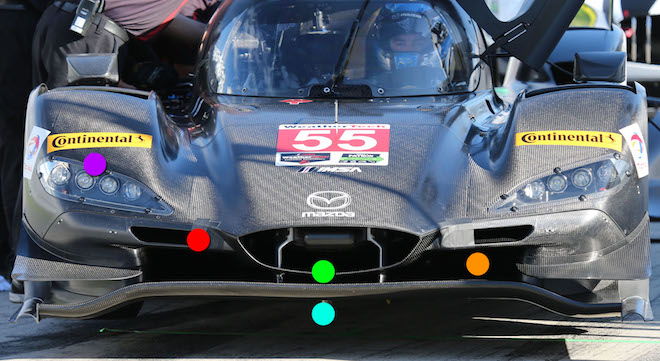
The RT24-P makes another interesting departure from the Mk 30 due to its DPi-driven shape change at the nose. The road car-themed grille, nicknamed the “catcher’s mitt,” gives the Mazda its unique look up front and also serves a few aerodynamic purposes.
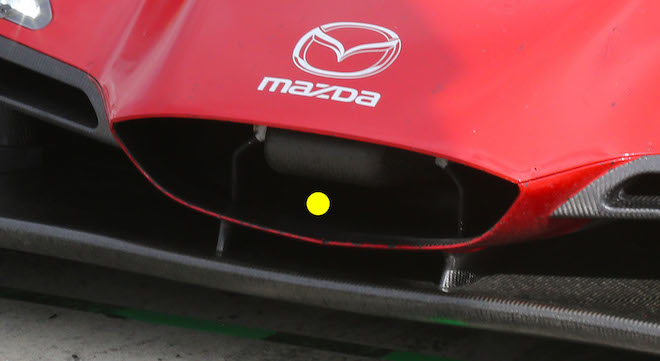
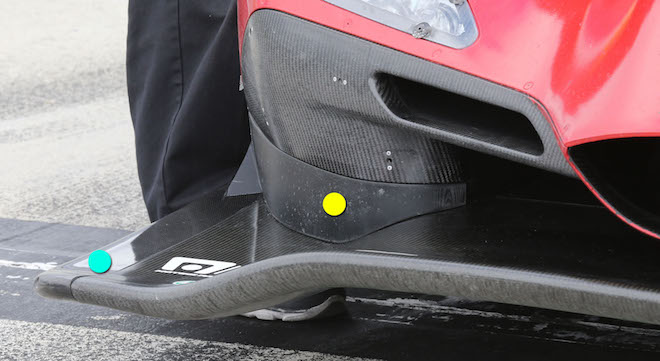
Behind the Mazda’s grille opening, the RT24-P (and Mk 30) make use of the only floor extension found among the six prototype models. Where the other five constructors use a “landing strip” that extends forward from the keel, the RT24-P features a full-width forward floor that fills the void mostly left open on the other models. The bottom portion inside the Mazda’s grille (above, yellow) feeds air directly to that floor extension leading to the keel (red).
The contoured (cyan), elevated portion of the floor extension (green) adds a further degree of control over how the oncoming air is directed out through the vanes to exit around the sidepods, and beneath the car to feed the floor and diffuser.
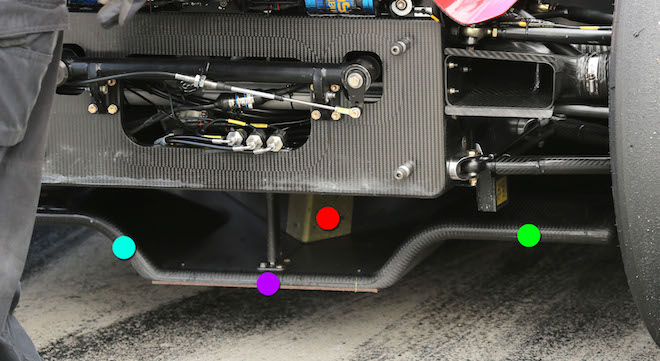
The “landing strip” keel extension (yellow) found on the Cadillac DPi-V.R and other P2-based models is rather simple compared to the RT24-P/Mk 30 device.
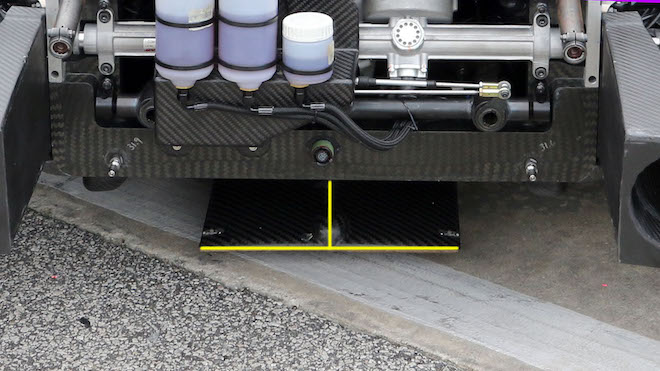
Looking at the rear of the nose section, the flowpath from inside and below the grille to the top of the floor extension can be seen (cyan).
A Daytona-specific modification with in-fills to the splitter’s wing profile to reduce front downforce is also shown (green). Those pieces, which help improve top speed, also improve chassis balance in low-downforce configuration by moving the aerodynamic center of pressure rearward.
After Daytona, where high-downforce packages will be the norm for the remainder of the tracks, the in-fills are not expected to be seen.
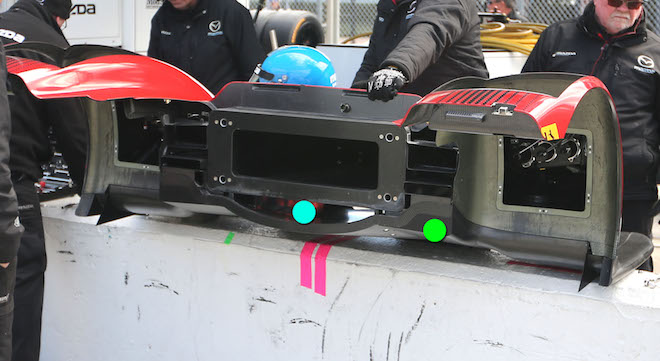
Testing front downforce options was a standard practice for Mazda during the December test and again at the Roar.
Big, road course-style dive planes were tried last month (below), and as the Roar progressed, shorter dive planes were tried until running without them proved to be the fastest package of all.
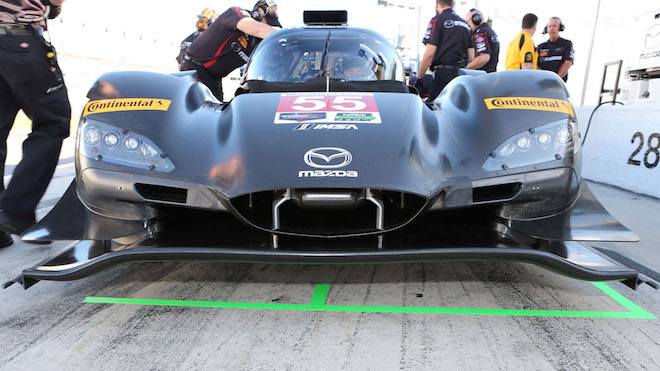
Shorter dive planes followed at the Roar with the half-moon “feet” attached to the ends of the splitter.
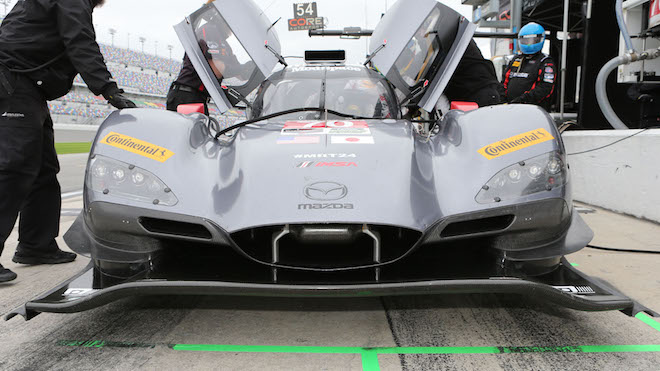
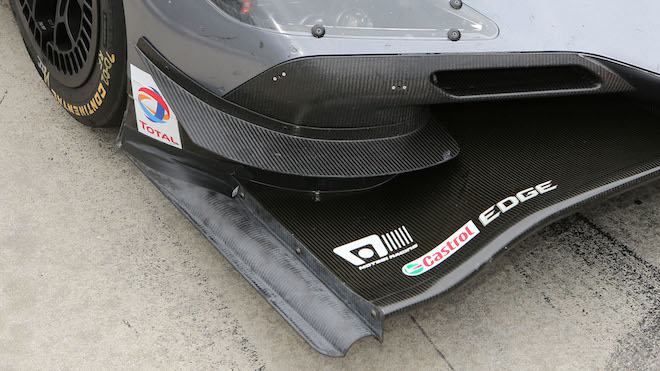
Next, running without dive planes, albeit with the same “feet” and with an in-fill panel at the base of where the fenders meet the splitter, was tested.
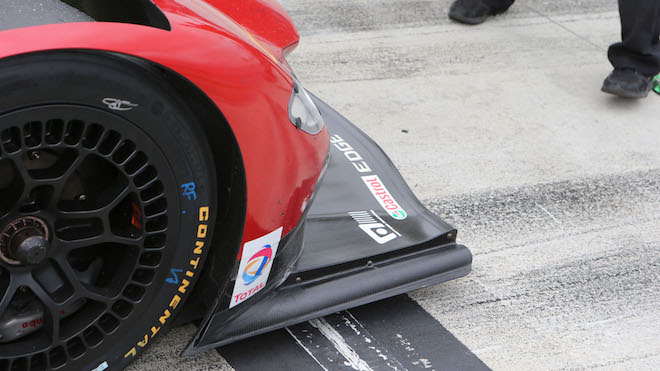
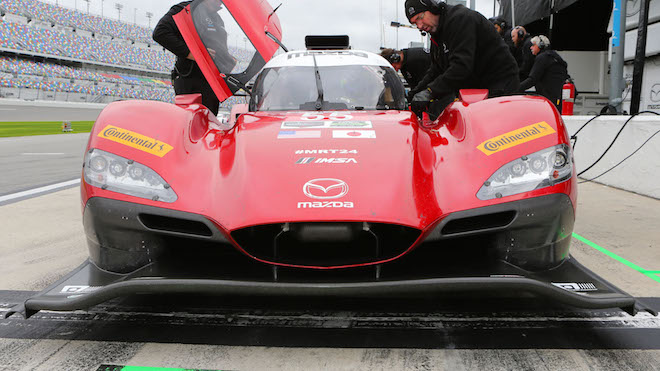
The magic front aero combination, at least according to the top speed figures and lap times, came with the in-fill pieces (yellow) and flat “feet” (cyan) extensions installed.
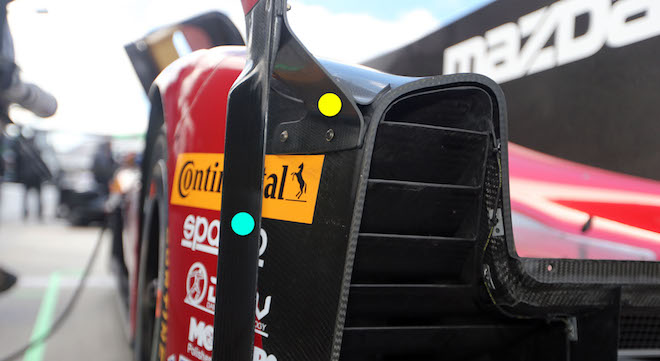
Here’s a look at the extremely different sidepod and vane treatments on the Mk 30 and RT24-P. The rounded Mazda sidepods also have a different rear fender profile. The NACA duct at the rear of the Mazda’s sidepod (below the “P”) and the inlet atop the fender (below) can be used to feed the brakes or gearbox cooler.
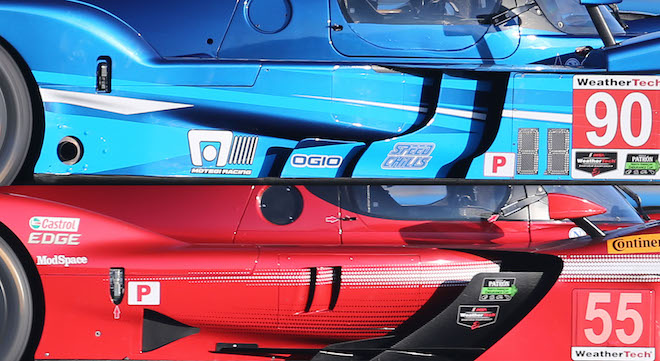
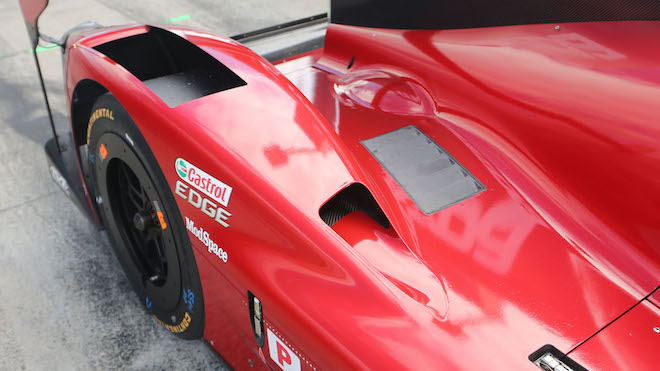
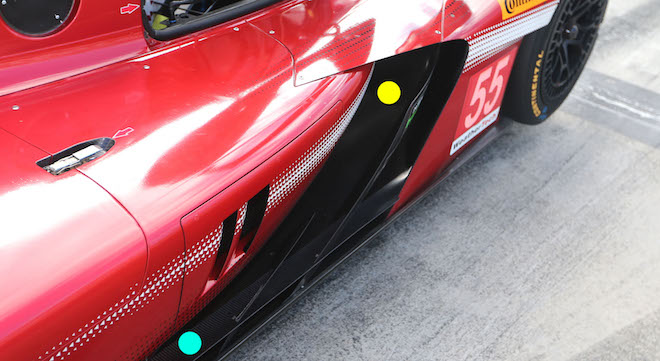
A horizontal piece connecting to the vanes that runs the length of the sidepod (cyan) was seen on the Mk 30 and RT24-P at times. It curves some of the exiting keel air (yellow) upward.
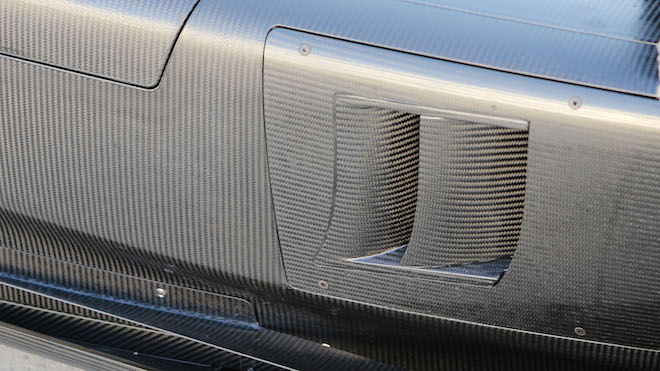
The vents on the RT24-P’s right sidepod are used to cool the cockpit air conditoning condensor.
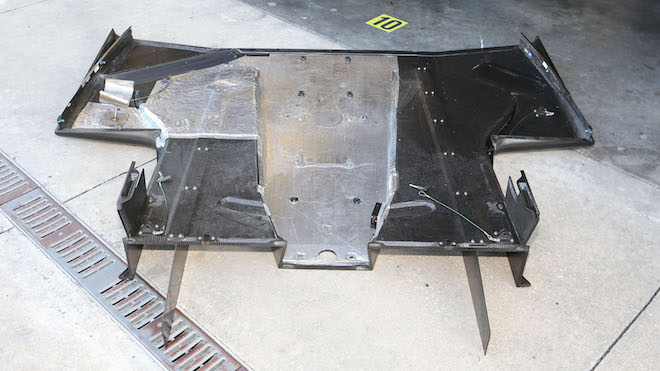
The RT24-P’s removable floor/diffuser section that mounts below the engine bay.
The tapered gap used to accelerate air into and past the RT24-P’s engine.
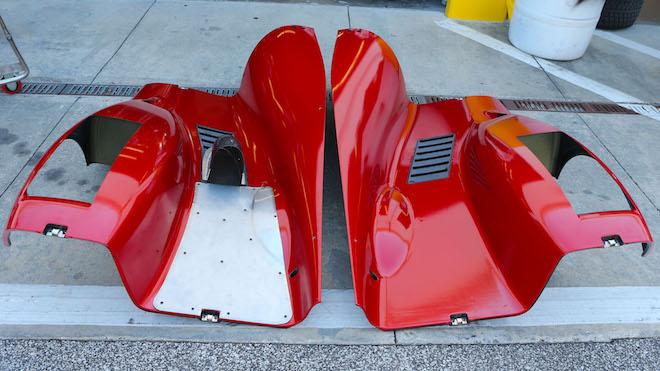
The rear of the RT24-P also differs from the Mk 30 (below) in the sloping, rounded fender and shutter profiles behind the wheels. The rear wing profiles, endplates, and endplate extensions that run down to the “cheese” wedges are also unique to the Mazdas.
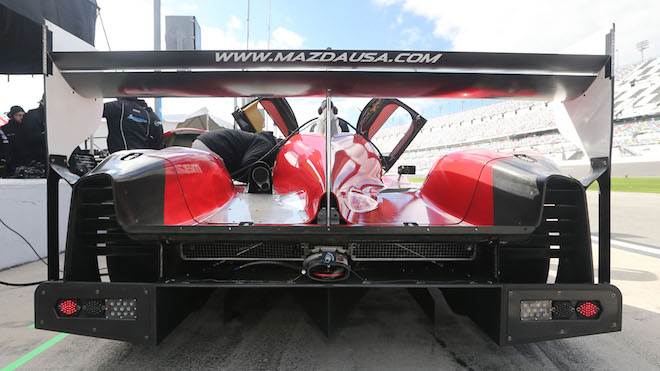
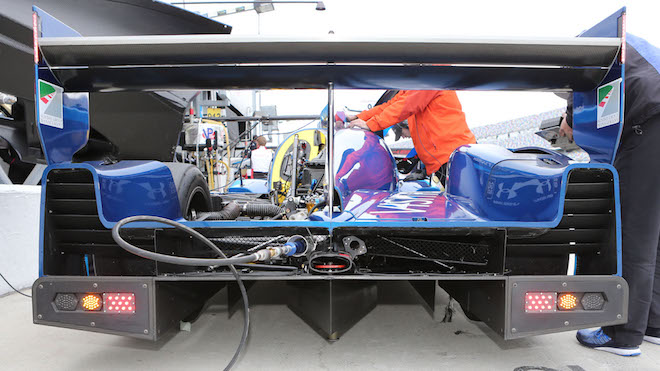
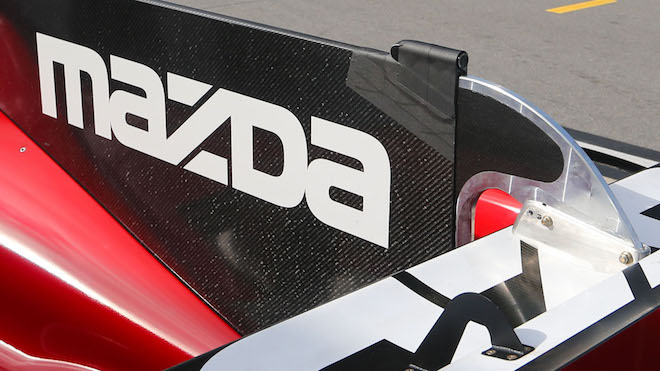
Initially created as a styling alteration, the endplate extensions (cyan), with a slight outward twist, also help to direct and diffuse airflow from the sides as it prepares to leave the back of the car. An additional mounting point to the body is used (yellow) to secure the endplate and rear wing if it’s broken.
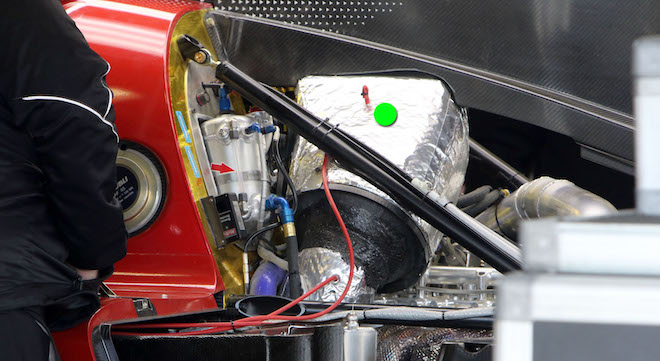
ENGINE
Mazda’s tiny-but-powerful MZ 2.0T engine takes its air from a short inlet (above, green) that feeds its turbo which sits directly below the inlet and exhaust.
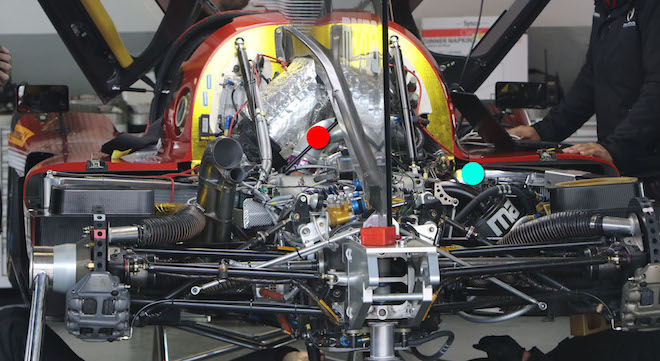
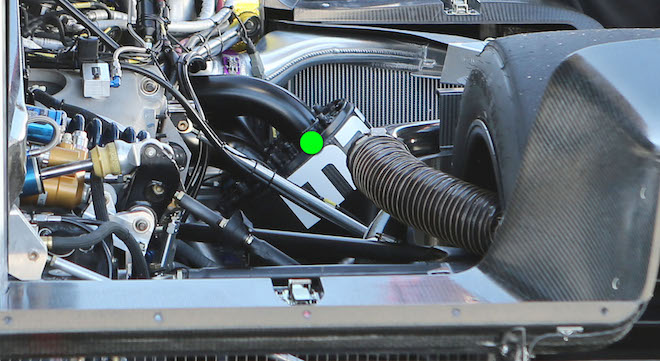
From the turbo, compressed air is sent across the engine bay to an intercooler on the right and directed into the motor through a carbon-fiber plenum (green).
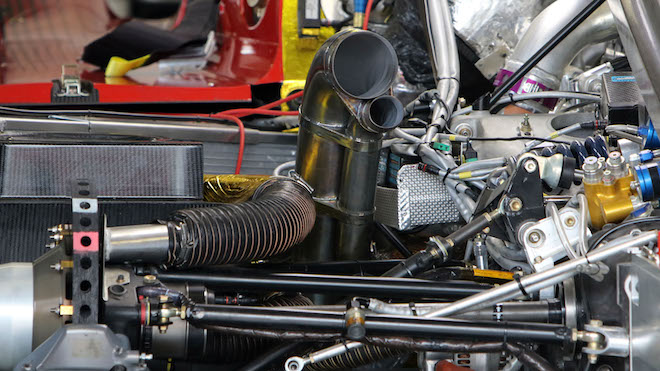
The RT24-P’s power-making periscope exhaust.
MISCELLANEOUS
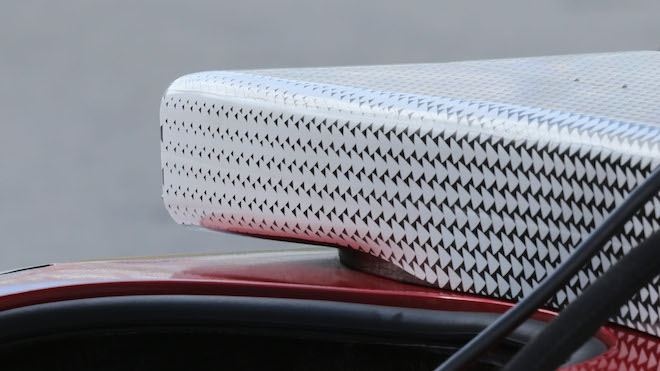
The RT24-P and Mk 30 are the only 2017 cars to use a split engine cover. Both sides attach to the mandatory tail fin, which is hard mounted to the chassis. The Mazda uses heat shielding on the left in light of the exhaust outlet, and louvered vents on both sides to provide additional cooling, when needed.
Thanks to the fin being a fixture that stays in place, the Mk 30 and RT24-Ps have rear cameras build into the fin that feed the cockpit traffic monitor.
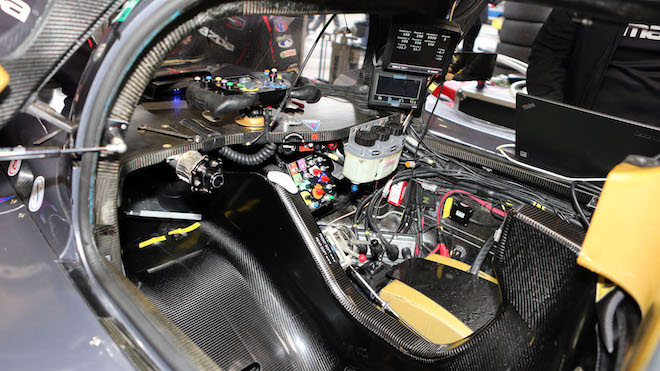
The RT24-P/Mk 30 incorporates the new and standard swinging center head support (green) that is hinged to allow rapid access to the driver from the passenger side of the cockpit, if necessary. The brake and clutch fluid reservoirs can also be seen in the cockpit; most of the 2017 cars have those reservoirs affixed at the front of the tub.
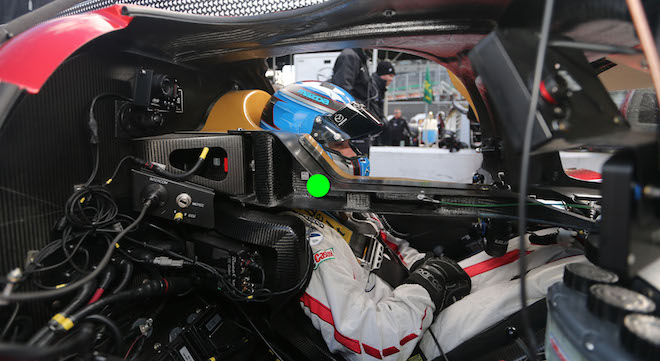
A look inside the RT24-P’s office.
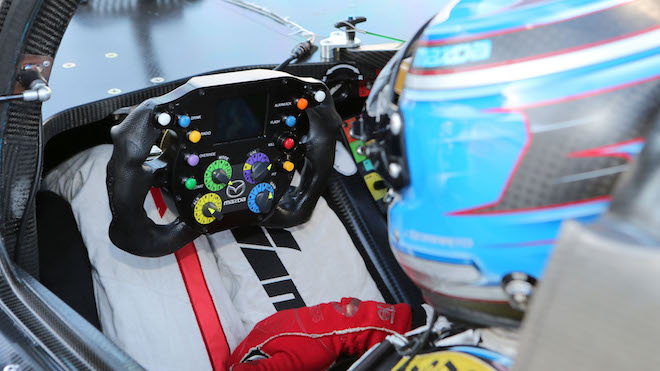
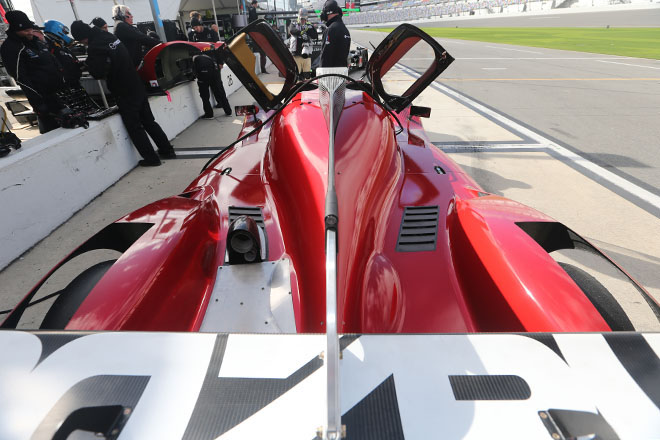
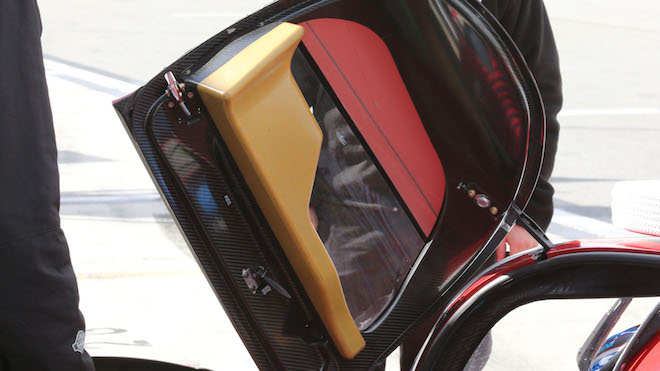
The Mazda has another standard feature among P2-based cars with driver head protection built into the door.
Another shot of the interior of the RT24-P and the maze of IMSA’s mandatory electronics and monitoring equipment in the passenger side.
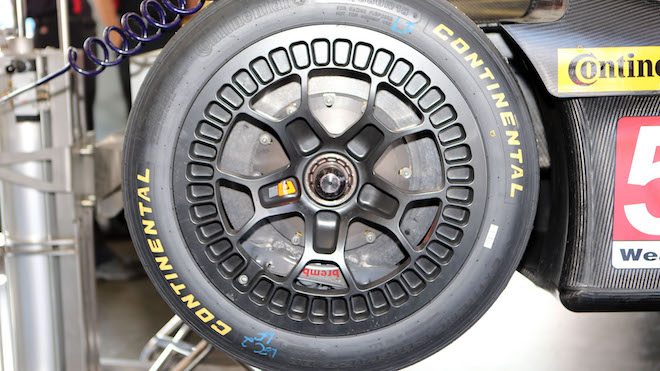
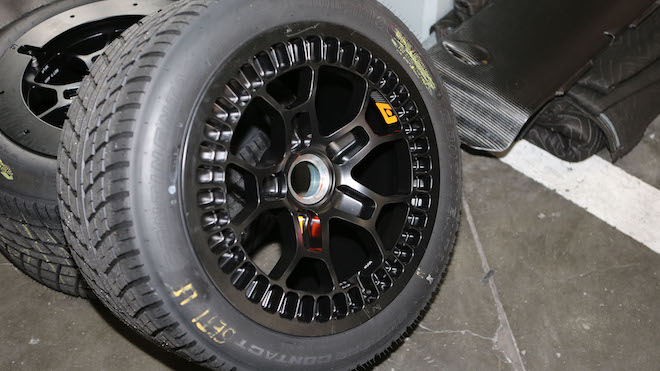
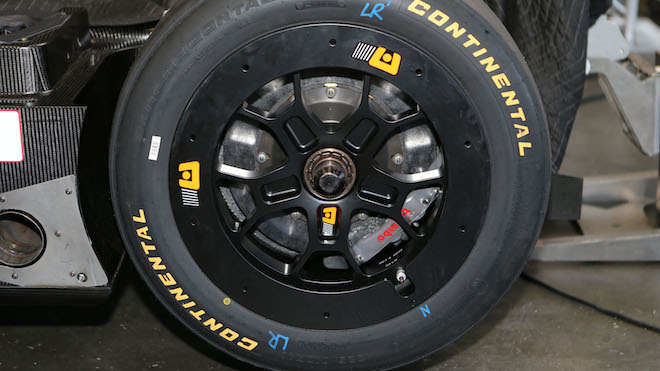
And finally, the RT24-P and Mk 30 use wheels supplied by Motegi. The fronts are notable for the countless lightening pockets machined into the outer lip. The rears stand out with the aero fairings attached to the lip.

Latest News

Comments
Comments are disabled until you accept Social Networking Cookies. Update cookie preferences
If the dialog doesn't appear, ad-blockers are often the cause; try disabling yours or see our Social Features Support.