WEAVER: Two-race downforce test yields little
felt like a monumental turning point
in the history of NASCAR, then Saturday night felt like an obscure blip on an otherwise forgettable weekend.This was supposed to be the weekend the NASCAR front office reached a near-conclusion on the 2017 Sprint Cup competition package, as this was the second of a two-race experiment called the low low-downforce package.
But after the weekend, there are more questions than answers thanks to the freshly repaved and reconfigured Kentucky racing surface. In hindsight, the case could be made that NASCAR probably didn't select the best two races to collect data in advance of taking its next step.
The first occurred last month at the two-mile Michigan International Speedway and the second (and final) was on Saturday. Neither event was a true representation of the Sprint Cup schedule according to veteran Jamie McMurray.
"I think here and Michigan were the two worst places to possibly try this at," McMurray told RACER Saturday on pit road. "This is a repave and it wasn't going to matter what package we brought. It was going to be a challenging race. But I think there is a compromise between taking some downforce off and taking some side force away.
"It's just really hard to get under somebody with this package."
Even Dale Earnhardt Jr. suggested that neither NASCAR nor the teams learned enough to make a full decision on how much downforce to reduce next season. Having blistered a slightly softer tire during a June test at Kentucky, Goodyear was forced to bring its toughest compound of the season.
Earnhardt understood the need for a rock-hard right side tire, but wished it had softened up the lefts a little bit.
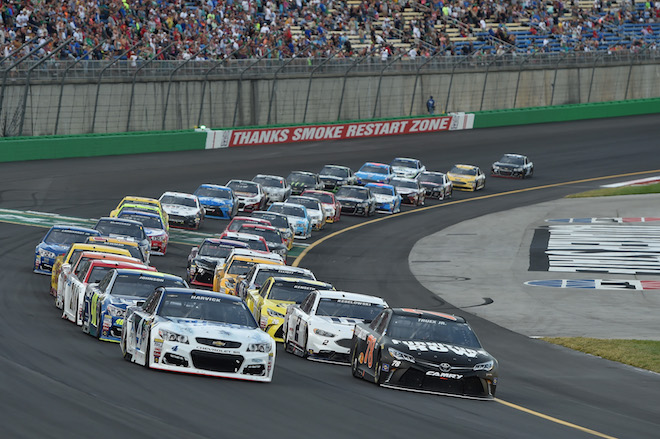
"It's just a bad combination for the new surface and how conservative that tire is," Earnhardt said. "I mean you couldn't hustle the car at all. You are just on pins and needles all the time on restarts ... I don't want to lose any ground and boy, if I have a big slip I'm going to lose all kinds of track position, which happened over and over to a bunch of guys myself included.
"It sucks to race that way. You want to drive and hustle and try to get in there and beat guys but you can't even run side by side. Guys who run side by side were a second slower. What the hell? That is awful; we have a problem man, that is no good."
While much of the problem on Saturday can be attributed to the repave and the one-groove racing surface, there was a degree of speculation that NASCAR had taken too much downforce off for Michigan and Kentucky.
in the six-car crash
near the halfway point of the race and cited the package as a reason for overly loose racecars."Everybody keeps begging for less and less downforce, and we keep seeing more and more incidents because of it," Buescher said. "I think it has made better racing at a lot of racetracks, but it's not easy to get into Turn 3 here side by side."
But still, the consensus amongst the garage is that less downforce and side force is better; Michigan and Kentucky just weren't the best indicators of the planned future direction of the sport. NASCAR vice president of competition Scott Miller says there was a strategy behind selecting these two events and not doing a package test at a more abrasive race like the Southern 500 at Darlington next month.
With that said, Miller also said it's not out of the question that NASCAR will try one more low low-downforce experiment – just not during the Chase for the Championship.
"After tonight we'll go back and we'll sort of reconvene with the drivers and the owners and the OEMs and decide where we're going," Miller said. "We're open to a lot of different options and if [running this package at another track] bubbles up, and we have industry support for it, nothing right now is out of the question.
"But the one thing that I think we won't do is change the Chase around."
Give credit to NASCAR.
Even with a popular direction that has fans generally satisfied through the first half of the season, those in the glass offices at Daytona and Charlotte are still working feverishly to zero in on something even better. And more importantly, they are meeting with the garage like never before to figure it out.
Even if Michigan and Kentucky weren't the most ideal places to run these test at least NASCAR is staying proactive rather than reactive.

Latest News
Comments
Comments are disabled until you accept Social Networking Cookies. Update cookie preferences
If the dialog doesn't appear, ad-blockers are often the cause; try disabling yours or see our Social Features Support.