WEAVER: Don't dump Sprint All-Star format yet
At least on paper, the format for the Sprint All-Star Race made a great deal of sense. With a few minor adjustments, it also deserves a second chance.
The idea of placing the fastest drivers in the back of the pack on new tires and pitting them against slower ones with track position isn't entirely new. It was a strategic variant of the short-track invert and it looked deserving of the all-star mantle.
Combined with a tweaked aerodynamic package, the event promised excitement, and the procedure came much closer to delivering than anyone wants to give it credit for.
While NASCAR and format architect Brad Keselowski deserve some of the blame for the chaos that unfolded on Saturday night, only Matt Kenseth and the No. 20 team failed to adhere to the rules in the first segment – failing to make at least one green flag pit stop before lap 50 – unfurling a chain of events that soured the rest of the evening.
Honestly, if it wasn't for Jamie McMurray's spin with three laps remaining in the first period, Kenseth would have completed his required green flag pit stop, and the result would have been much smoother. But Kenseth didn't pit before the spin, and that indecision trapped several cars a lap down when they were unable to take the waive-around because laps were no longer counted during the break between segments. Again, it was the execution, rather than the concept, that doomed the all-star race.
This is where NASCAR officials deserved some of the blame, and in a rare instance of humility, they shouldered it. Vice president of competition Scott Miller told reporters not long after the race that NASCAR simply didn't predict a driver not pitting before the end of the segment.
But the most baffling part of Miller's statement was that he said NASCAR had no procedure for legally placing those cars back on the lead lap.
Excuse me?
This is the same sanctioning body that added Jeff Gordon as the 13th driver in a 12-team playoff in 2013 because Brian France wanted to right a perceived wrong after the race-fixing scandal that took place in the regular-season finale at Richmond that season.
"I have the authority to do that, and we are going to do that," France said at the time. "It is an unprecedented and extraordinary thing, but it is also an unprecedented and extraordinary set of circumstances that unfolded in multiple different ways on Saturday night."
Couldn't the same reasoning be used this past Saturday night, for something that required a lot less red tape given the exhibition nature of the event?
It wouldn't be the first time NASCAR has made a special exception for the all-star race.
In 2001, rain fell just as the green flag waved and several drivers crashed in Turn 1. Citing special circumstances, NASCAR allowed those with crashed cars to restart the race in the back of the field with their backup cars. One of those drivers, Gordon, went on to win the race in one of the more memorable all-star moments.
If ever there was a justifiable use of "except in rare instances" – a popular phrase in the NASCAR rule book – this was it. NASCAR officials should have declared Kenseth one lap down and everyone he trapped with him back on the lead lap, because it's the Sprint All-Star Race and because it was the right thing to do.
Had that happened, the race would have seen more cars on the lead lap after the conclusion of the second segment and the intrigue-filled finale likely would have played out as intended.
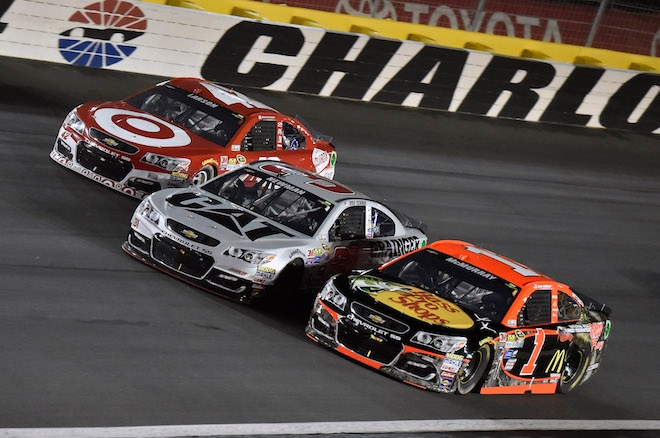
But even with the comic absurdity of the first half, the third segment was still compelling television. Even with only two cars restarting up front on older tires, fans were still treated to a late pass for the win and a frantic battle between Kyle Larson and eventual winner Joey Logano.
At the end of the day, this procedure is worth fine-tuning. The debut race with the format could serve as a lesson for drivers to pit much sooner than what Kenseth tried, and NASCAR should apply logic in instances where the rule book creates a situation where drivers are unjustly placed a lap down.
This version of the all-star race still has potential and the basic tenets should be preserved for next May.

Latest News
Comments
Comments are disabled until you accept Social Networking Cookies. Update cookie preferences
If the dialog doesn't appear, ad-blockers are often the cause; try disabling yours or see our Social Features Support.