Pre-War cars are stars at Amelia Island Gran Prix
The vibe at Fernandina Municipal Airport, the site of the SportsCar Vintage Racing Association's inaugural Amelia Island Gran Prix is a spirit of revival. While the era of airport course racing is probably most romantically linked with the period immediately following World War II, the pre-war racers are capturing a lot of attention and genuinely fit the mood. These machines emerged as stars for curious fans that ventured out to Friday practice to witness the first auto racing here in 42 years.
Related Stories
A field of 14 pre-World War II entries has gathered and while they are primarily open-wheel machines there are a few MG sports cars thrown into the mix. Most are American-built cars, with a handful of British marques and a French Talbot-Lago of tremendous distinction.
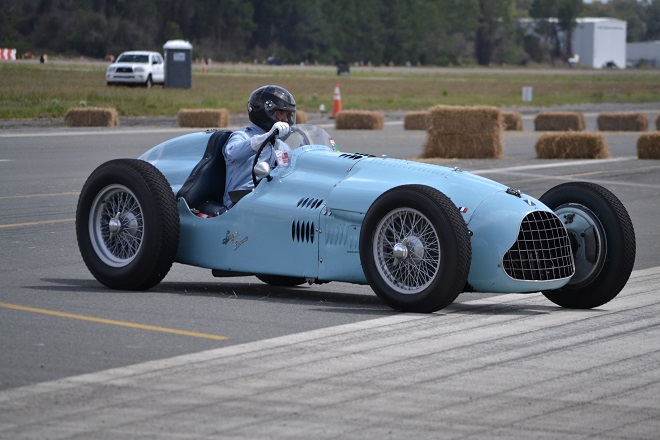
The pale blue 1948 (OK, so the SVRA fudged just a tad on the pre-war thing) Talbot-Lago T26C is not only a striking race car, but also has the distinction of having been owned and driven by the late Pierre Levegh, an outstanding race driver with a particular talent for endurance sports car racing. Unfortunately he is best known as the central figure in the greatest loss of life at an auto racing event, the 1955 Le Mans tragedy when Levegh's Mercedes disintegrated and flew into the grandstands.
The current owner of the car is a Canadian gentleman who asked not to be named. His reasoning?
"The cars are the stars here," he said. "I want to celebrate the cars, not me."
The man has a good handle on the history of his 4500 cc Talbot-Lago. Levegh campaigned it in various French races starting in 1948 and even entered in the earliest Formula 1 contests when the sport was organized under that brand in 1950. Up close the car is obviously well maintained but just as obviously retains all its original parts. Some time after Levegh's passing the car transferred into museum ownership, initially with Costa Mesa, Calif.'s Cunningham Museum. Later Miles Collier acquired it and then finally, 19 years ago, the current owner added it to their family's collection.
{igallery id=6633|cid=481|pid=5|type=category|children=0|addlinks=0|tags=|limit=0}
Among the most interesting American entries is a purpose-built 1939 "Big Car" built by none other than Midwestern icon Floyd "Pop" Dreyer. The story goes that Dreyer welded the frame together on a pair of sawhorses in his driveway. Current owner and driver Scott Ebert reports that Dreyer built the frame, nose, cowling and tail.
"The 'Big Car' designation meant the cars had 90-inch wheelbases," Ebert says. "These were the precursors to what eventually became known as sprint cars. The Indianapolis 500 cars were a few inches longer. Some of the Big Cars were torn down and the frame was stretched out to allow them to go to Indy."
According to Ebert his racer has a 1939 flathead Ford engine as well as a Ford transmission, wishbones and springs. No surprise, Dreyer built the car to be raced on short oval dirt tracks. He probably never could have dreamed Ebert would compete with it exclusively on paved road courses today. To do so he has made a few modifications allowed by SVRA rules – such as the addition of four-wheel disc brakes, a starter, alternator and battery. As with the other cars, safety upgrades such as current-standard roll bars and five-point safety harness have been added. Safety trumps authenticity in vintage racing.
Another "Big Car" is Sam Blanton's 1936 Winfield Ford SP. This is a creation tracing its roots back to the Winfield brothers, best known as the original designers of the iconic NOVI engine of Indianapolis 500 lore. Ed Winfield in particular was regarded as a wizard with Ford engines of the era and has sometimes been called the father of hot rodding.
Blanton bought the car as his ticket to the Monterey Historics, or the Monterey Reunion as it is known today. The car, which flashes an eye-catching Gilmore Oil Company logo complete with their trademark lion silhouette on its cowling, has been in the grand Monterey event over a dozen times. Blanton ticked his trip to the legendary event off his bucket list in 2013.
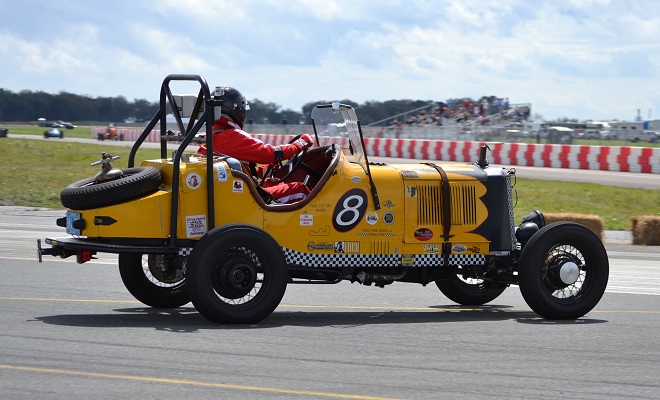
Rick Sanders of Sarasota, Florida has a 1931 Model A Speedster with a 208 cubic inch flat head engine. Ten years ago it was in the possession of someone who could have been a candidate for the TV show, "Hoarders." It was stashed in a barn buried under piles of miscellaneous stuff – papers, broken furniture and the like. It was a regular barn find. Much of the car was missing, but the frame and the engine were in place. Even so, the owner put a condition on letting go of the car. Rick had to promise to bring the old dirt track racer back to life.
"I had to build my own body, but that's very similar to what the owners and drivers did back in those days," Sanders reports. "They were modified racers. People just shaped metal to fit whatever configuration they needed. They worked with what they had, bending, shaping, cutting, riveting and welding sheet or scrap metal together. How it ended up looking depended on their creativity and the materials they had available."
Sanders campaigns his Speedster on both road courses and circle tracks, mostly in Florida. Among the paved ovals he has raced are Desoto Speedway, Auburndale Speedway and Citrus Speedway. He also tackles dirt, such as East Bay Speedway. Standing trackside it is apparent Sanders gets on the gas as his tires squeal and the stiff chassis rolls to the point of tipping in the turns.
Sanders' good friend and racing colleague is Bill Stelcher, who also drives a Model A Speedster. Stelcher's machine is listed as 1929 vintage, but that's misleading because what's under the hood is a later generation of engine performance technology.
"The engine is a 1932 Ford flathead, but the head is from 1935," says Stelcher. "What's really special, though, is this is a George Riley engine with a Riley four-port head. It's rare speed equipment, the first to have overhead valves, and there were two per cylinder. George Riley built engines for boats, Bonneville and track racing."
Comparing his car to that of Sanders, Stelcher points out that at 2,200 pounds, his racer is nearly twice as heavy. He also says his 1932 vintage engine has a pressurized oiling system whereas Sanders' older engine uses the very early "splash" oiling system that relied on troughs built into its push rods to dip into the oil pan supply and then scatter the lubricant inside the engine on the upstroke. Regardless of the type of Speedster an owner acquires, documentation can be tough.
"The history on most of these cars is hard to come by," Stelcher says. "They were driven on county fair tracks in races presented by local organizers, not true sanctioning organizations. The bodies were custom-built jobs and a lot of them were created by young guys coming back from World War I who needed the level of excitement in a sport like racing after being in combat."
{igallery id=4565|cid=481|pid=5|type=category|children=0|addlinks=0|tags=|limit=0}
Switching gears from custom-built racers to American factory entries, a great example is the 322 cubic inch 1929 "Safety" Stutz Blackhawk owned and driven by Richard Mitchell out of Montgomery, Texas. The car reflects a marketing campaign of the Indianapolis-based Stutz car company to stress the safety features of their cars. They touted, among other things, "safety glass" designed not to scatter glass shards onto drivers or passengers in the event of an accident. Thin wires were assembled within the glass to hold pieces in place even in the event of fracture.
Mitchell, the owner of 20 Stutz cars, believes this particular machine is especially rare. He did some research after discovering his car's wheelbase is one inch shorter than the standard Blackhawk.
"What we found out was that an automobile dealer in England during 1929 requested three Blackhawks with the shorter wheelbase," Mitchell explains. "We have every reason to believe this is one of those cars."
Mitchell completed restoration of his Safety Stutz in June 2015. Since then he has raced it at the Brickyard Invitational, Lime Rock Historics and the Coronado Speed Festival near San Diego.
One of the closed-wheel entries is Michael Bartell's 1934 MG Model PA. The 847cc engine car was referred to as a "midget" in its era. During the 1930s it was raced in England in rallies and speed trials. Bartell acquired the car three years ago and has raced it at Lime Rock, Thompson Speedway, the Pittsburgh Grand Prix and Watkins Glen where it won the National MG Triple-M race. The car had been fully restored when Bartell purchased it and he has maintained it since.
Another UK product is the attention-grabbing 1928 Riley Brooklands Special of Ray Morgan. The Riley Company produced a variety of body designs including models that were covered in "fabric." Morgan's blue racer is wrapped in leather-like vinyl with padding underneath. Part of the appeal of this 1330cc engine entry is that it was designed for the Brooklands Speedway, the world's first purpose-built, paved, closed-circuit course. Constructed in 1907, this concrete, high-banked track delivered blazingly fast speeds and even pre-dated the Indianapolis Motor Speedway.
"Honestly, I just don't know much about what my car did at Brooklands, or if it was even there," says Morgan about his Riley. "It was welcomed at Goodwood, I can tell you that. It did well there but its original history from decades further back isn't as clear."
Whether it is vinyl covered "fabric" bodies, custom sheet metal contours or splash lubrication systems, the unique qualities of these, the oldest machines on the grounds, are a big part of their appeal. They are all survivors. Some have rich stories to tell. Others come to us shrouded in mystery and can only offer clues for those determined to piece together the puzzle of auto racing's past.

Latest News

Comments
Comments are disabled until you accept Social Networking Cookies. Update cookie preferences
If the dialog doesn't appear, ad-blockers are often the cause; try disabling yours or see our Social Features Support.