INDYCAR: Miles aims "to leverage the absolutely unique, important, pivotal 100th” Indy 500"
Mark Miles, CEO of Hulman & Company, expressed confidence at the Verizon IndyCar Series Media Day that the series was poised for growth on TV and promotional fronts this season.
Related Stories
"In broad strokes, I would say we are all about as excited as we could be about the 2016 season," Miles said. "We met with all the promoters in Scottsdale last week. The drivers are all here and will be meeting with them (and) the team owners at the test in Phoenix at the end of the month. We get to go through everything.
"One of the things I think is very cool is to show them the plans for how we view the year from a communications perspective, which basically is to design, to leverage the absolutely unique, important, pivotal 100th running of the Indianapolis 500, and to draw the connections to that legend and to that history, to that epic moment to all our races.
"The drivers that are here will be driving at the races, they'll be competing for wins and titles and the like throughout the whole series. I think we intend to use that historic moment for the benefit of the promotion of our drivers and our promoters and events throughout the year. Sooner or later I'm sure you'll get to see some of the creative that has gone into that."
Miles said that some tweaks to the event schedule should help raise the series' TV profile.
"We expect to continue to increase the television audience. We have the same broadcast partners. As you probably know, we increased ratings and viewership on average over the last two years by 25% and another 13%. I think we'll get over 50% in total increase over the three years by the end of this year. That was done through some very careful scheduling, which took some time.
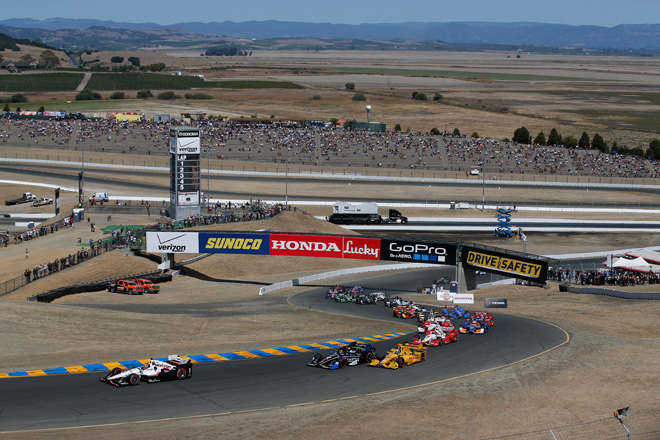
"You'll see things like, for example, Sonoma is going to run a little later. If I'm a Sonoma fan, I might say, 'I'd like to be headed home to Sacramento a little earlier.' In this case, Sonoma will run a little later because it allowed us from a television perspective. There are several like that where we continue each year to have fewer overlaps in the broadcast with NASCAR. For Pocono, our broadcaster is covering the Olympics (so) Pocono will run after the last sport competition of the Olympic Games this summer and before the closing ceremonies, which is a nice window – good opportunity to capture a broad audience.
"I think there are half a dozen surgical scheduling moves like that that I think will help us get over 50% in television audience over the three years, including at the end of the 2016."
Miles acknowledged that changes to start times could have a negative impact on fans at the track, saying that a balance needed to be struck with benefits for TV.
"We'll see if it affects the gate. It is difficult for a sport to balance the gate, local fan attendee consideration with television," he said. "I think what our sport, where we've had the greatest opportunity to make up is on the television side. We don't ever want to be reckless with the affinity and loyalty of fans who buy tickets to make the events work. We have to find a good balance.
If you pick a time when you can't even get on TV because your broadcaster is covering the Olympics in every part of their platform, that's a real problem. If alternatively you can pick a time when you have a great window, coming out of a NASCAR race or what have you, then there's a big upside.
"It isn't perfect, but I think we're getting a good balance. I think it's showing up with increases in the biggest numbers, which are television.
"We are still – maybe more than ever as we get closer – really excited about the prospects for being back at or for the first time in Phoenix and Road America and Boston. All of them are making great progress. As I said, we were just in Phoenix. Brian Sperber and his team are doing a fantastic job of reintroducing IndyCar in that marketplace. We're looking forward to increasing the number of fans in those cities and making new fans."
Miles went on to address technical issues and safety upgrades planned for the new year.
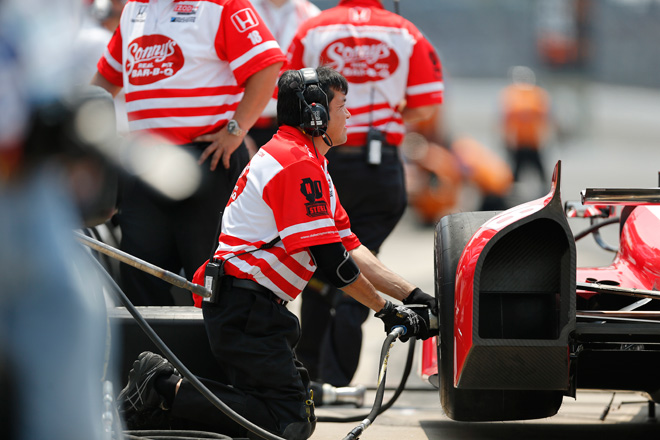
"At superspeedways, there will be tethers to the nose and front wing main plate. We think that will be helpful from reducing debris and a safety perspective.
"We're adding dome skids to the bottom of the car, the floor of the car at superspeedways. As you all know, that means increased stability, which I think is really important for the superspeedways.
"There are new rear beam wing flaps that are a little 'NASCAResque'. They are meant to kick into and have effect at 15 to 20 miles per hour if the car is going backwards, basically to keep it on the ground. This was developed with the cooperation of all of our manufacturing partners and some of the teams. It was tested at the Texas A&M wind tunnel up to 230 miles per hour in the tunnel. There was no mechanical failure. I'd love to see the wind tunnel testing at 230, but they did it and it seems that it works.
"It adds 500 pounds of downforce to a car going backwards, which we think will help prevent cars getting in the air in that condition.
'"Push to pass' has been increased by 20 horsepower, so it would go from 40 to 60 horsepower, which makes a big difference. Things like the fuel probe sensor, which was part of the controversy, I'd say, for I think it was Fontana in the 15 car, it will now work much better and basically will have more effect more quickly on an engine in gear when the fuel probe is detected."
Miles acknowledged that financial issues facing the teams remain an obstacle to introducing new elements to the series, but emphasized that he was confident in the progress being made.
"In one of my first opportunities to talk to fans three years ago, I sort of felt like IndyCar maybe needed to apologize because we put our fans through a lot," he noted. "We're not perfect today. But I think the fan metrics are improving.
"We have to worry about costs up until such time we can infuse more financial resources into the paddock. We have to be very careful about adding costs. I think the aero kits contributed a little bit of angst in that regard last year. I think they're getting a handle on that.
"What matters most is more fans paying more attention. I think that's happening. We can talk about the metrics, whether they're digital, dot-com, social, broadcast.
"It's very hard to get a handle on attendance. We learned about some new technology that will give us a better ability to have a better understanding by day at each event how that works. But my sense is if you can sort of normalize for crummy weather and rain last season, the vast majority of our races have bigger crowds.
"Three years ago we sort of put flags in the ground for some things we thought were really important and say, 'Where do we aspire to be in three years?' One of them, for example, was to get a total paid increase in attendance at the Indianapolis Motor Speedway of 200,000 people, which is a 50% increase.
"Another one was to double the amount of money that the series pays to Leader Circle teams. Basically to go from $1 million to $2 million. We have increased that by 25%, $1,250,000. We hope over the next two years to get that somewhat higher.
"Frankly, as we look out today, I'm not sure we'll be able to get it up to $2 million per team by '18. We've had some very interesting conversations with team owners, one in particular with Michael Andretti.
"He said there's two ways to accomplish the point of your goals. One is to pay more and the other is to reduce our costs. What if we combined an effort with our technical people at the series and our manufacturers and team representatives to think through where can there be savings. That doesn't necessarily mean the cost of a part, although it will mean the cost of a part. It can also mean the rationale and the rules for testing, the way they use tires.
"We've got an owners' meeting, as I mentioned, in late February. By then we will have constituted this group. It won't be every owner. There will be a focused initiative to say that without affecting the popularity of this sport, are there ways that we can reduce costs, which is the same as writing a check, to make the economics better for teams?
This is something I'm excited about. The team owners believe there are ways, again, that you won't see, that won't affect our appeal to fans, but can be sensible initiatives to reduce costs."
Turning to the matter of ongoing objections being raised by local civic groups and media in the Boston area about this year's new street race there, Miles remained bullish about the event.
"We fully expect the race is going to go on and is going to be a great success," he declared. "We were with the representative of the promoter last week in Arizona and went over where we are on suite sales, sponsors. I'm not a political analyst that can give you all the real truth about what's going on on the ground except I know our promoter working with the mayor's office there has worked very hard to make every accommodation to people who live right there who might be inconvenienced to any extent and to speak to the concerns of anybody who might fear the worst, if you will, with a new event they've never experienced.
"I think it's true there are five different owners of parts of that track or the facilities adjacent to the track. The city owns a piece, they're one of the five. You have Massport, Mass Highway, you have the Convention Center. Just the task of getting them all onboard conceptually, which had happened we thought when we made the announcement last May, but every nit documented is a lot of work.
"I think the show is going on. I think it's going to be a stupendous location in a great city. We're really excited about the chance to capture the attention of more college students who descend on that city just before we race. It's important that it works.
"There are certainly challenges. I believe it will be a situation where in 2017 for year two, the people of Boston couldn't imagine not having it."

Latest News

Comments
Comments are disabled until you accept Social Networking Cookies. Update cookie preferences
If the dialog doesn't appear, ad-blockers are often the cause; try disabling yours or see our Social Features Support.