The Arrow SAM Project: Sam Schmidt's fast-track to self-reliance
The IndyCar rulebook is a land of tight technical restraints. Paradoxically though, the paddock is developing into a wellspring of potentially game-changing technical and engineering innovations. In this first in a series of features, RACER takes a look at some of the groundbreaking STEM (Science, Technology, Engineering and Math) programs being developed within IndyCar's orbit.
Ever since he woke up in hospital as a quadriplegic after a testing crash at Walt Disney World Speedway in early 2000, Sam Schmidt has had to learn new ways to perform even the most menial tasks. There are also some things that he still knows how to do, but for obvious reasons needs assistance with; everyday things ranging from picking up a glass of water to driving to the Speedway.
But if Colorado-based Arrows Electronics has its way, a solution to the driving part might not be too far off. And depending on how the technology develops, it might be able to do something about that glass of water, too.
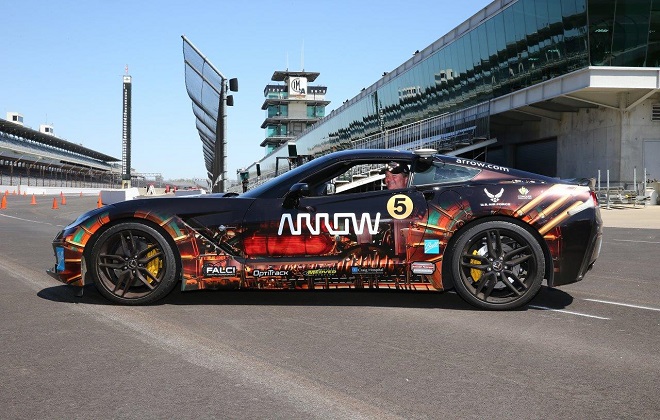
The Arrow SAM Project is an illustration of the sorts of things that can happen if a bunch of mad geniuses are allowed to spend too much time with a 2014 Corvette C7 Stingray. It first came into the orbit of IndyCar fans when Schmidt used the car to tip-toe around Indianapolis Motor Speedway last year, with subsequent public demos highlighting the project's development, and leading to a crescendo in the form of a fairly rapid run around the hilly turns of Sonoma in September.
Plenty of companies are working on autonomous vehicles, but Arrow is not among them. The Corvette is deliberately semi-autonomous; Arrow having recognized the empowering value of being in control to someone who has been largely reliant on others for more than a decade. (The SAM in the project's name is an acronym of semi-autonomous motorcar).
"We really are committed to helping Sam drive, both as an individual and as an example for the wider disabled community," says Joe Verrengia. Global Director, Corporate Social Responsibility at Arrow. "Our focus, and the principle behind the whole project, is to put more of the car into his control. He's already a passenger in his wheelchair, so automatic driving is just a big, fast wheelchair. And that's not our purpose."
Despite the complexity of the project, it all came together very quickly. At the time that Schmidt directed the Corvette out of pitlane at IMS in May of 2014, the whole thing had only been cooking for a few months.
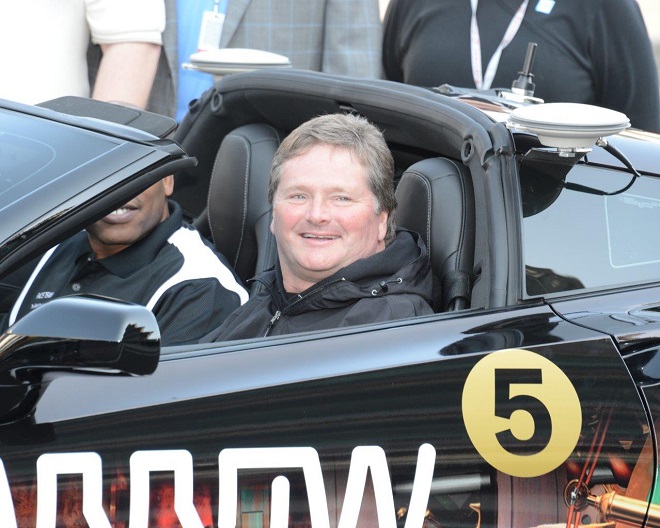
"And then a project like this comes along, and it's privately-funded, and they say, 'Hey, this is a forever problem; a guy like you, or somebody with limited mobility, can't drive, so we want to do a car', So they bought a car, they applied the engineering, and boom, from start to finish it was, like, seven months and we get a car that goes around Indy."
If getting Sam to roll the car into Turn 1 at the Speedway was a big step, Arrow's Corvette has come a long way since. The team is at the end of year two with the project, and virtually all of the main control systems have evolved substantially over the past 18 months. That progress has been validated in the incremental road-course steps that were taken toward Schmidt's appearance on the track at Sonoma in late August, more than a year after he first drove the car on Bosch's half-mile proving ground track in Germany in 2014.
That initial run was short, and slow: Schmidt covered about 12 miles over the space of two hours, and barely pushed the needle past 25mph. But it was enough to give Arrow a direction in which to pursue further development, and with the arrival of Freescale Semiconductor as a technical partner at the start of 2015, progress stepped up quickly. When Schmidt tested the car again, this time on a 17-turn go-kart track in Denver in March, he was able to push it up to 70mph.
"We knew then that if he could do 17 turns, including a hairpin, in half a mile, then he could do a road course that had 17 or 20 course in two miles," says Verrengia. "So then we demonstrated at Long Beach for the first time."
Among the refinements were improvements to the infra-red cameras that track Schmidt's head movements to enable steering. By the time he performed that first public road/street course run at Long Beach, the cameras' field of view had been widened to the point that Schmidt could achieve full lock-to-lock steering capability.
The other big change was centered on throttle control.
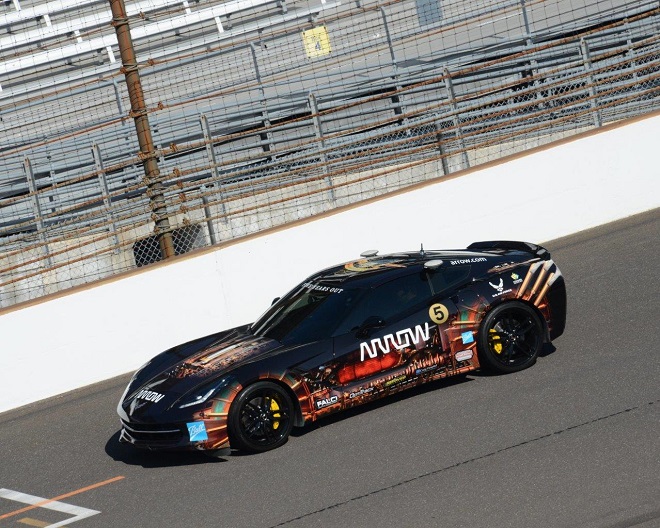
"At Indy [in 2014, ABOVE] Sam would tilt his head backwards in order to gain acceleration in 10mph increments," says Verrengia. "So when he did four demo laps at Indy, he would have to use the first lap just to get up to speed. It would take him the entire lap to go over 100mph. And then to slow down he would bite on a pressure sensor in his mouth. The harder he bit down on it, the harder the car would stop. So it was effective for an oval because we had time to gather speed, and he was only turning left four times, and it's pretty wide, and the turns are very banked. So it was OK for that environment.
"But for the road courses, you have to react much more quickly – you're going left or right, and those turns can happen going uphill or downhill. It's a much more dynamic situation, so he needed a system that would throttle and brake in a much more dynamic way. So what we ended up with was sip and puff technology, which is widely-used in the disabled community already, although it had never been used in this way before.
"So he has a headset with a tube in his mouth. He almost looks like a telemarketer. And when he's got the tube in his mouth he blows into the tube, which registers with the pressure sensor, and that mimics the foot pressure on the accelerator pedal. So the harder he blows into the tube, the faster he is accelerating. If he is really blowing into the tube hard, he's revving the engine and it's like he's flooring it. "And it was very exciting for him, because he was able to drive in a much more dynamic way. And for us, it was the first time we'd been able to hear him revving the engine. In the past, when the car had to gather speed gradually ... it was running, but we never heard it sound like a Corvette. And he could never peel out. And now he can. He's very happy with that."
"It just feels like driving," he says. "I turn my head to the left and it goes; to the right and it goes, the way the system is now I blow into a straw and it goes. Everything just felt right; there was an immediate translation. Which is pretty strange, when you think about it – you blow into a straw and that goes to a sensor, which talks to a computer, which makes it accelerate, and all of that happens in a nanosecond."
Equally surprising to him was the sophistication of modern road cars, which Schmidt had only been able to sense vicariously since his accident. But even that was dwarfed by the sense of independence instilled through the simple act of being in full control of a car for the first time in over a decade.
"Road cars now are much more technically-advanced than what I last drove," Schmidt says. "The performance on a roughly $55,000 off-the-shelf car is unbelievable.
"But probably the most shocking thing was just how amazingly normal it felt. Somebody like me, who has been requiring other people to assist me for the past 15 years, there has not really been a lot done in that timeframe where you feel in control and it feels just like it did 15 years ago. But this was one of those circumstances where, I'm sitting there in the drivers' seat, and I tell the car to go, to turn left, turn right, stop ... I'm in total control. It just felt normal, and that's really cool."
It's precisely this that has prompted Arrows to go down the road of developing a car that someone with limited mobility can actually drive, rather than throwing its engineering weight behind the burgeoning field of fully-autonomous vehicles.
"We don't have any current plans to go toward full autonomy, and there are a couple of reasons for that," says Verrengia.
"One is that we really are committed to helping Sam drive, both as an individual and as an example for the wider disabled community. Our focus, and the principle behind the whole project, is to put more of the car into his control. He's already a passenger in his wheelchair, so automatic driving is just a big, fast wheelchair. And that's not our purpose.
"On a broader basis – there are the vehicles we drive now, which are not smart, and then there are the fully-automated cars, which Google is developing along with others, and then there is the sort of grey area in the middle that is still yet to be established. And how we get from where we are today to a world of fully-automated vehicles ... there are a lot of steps. And I think with this car, aside from it benefiting people like Sam, it is a sort of platform for that evolutionary period. You're still driving, you still have a driver, but the car can do many different things with you along the way.
"Volvo has what they call a semi-automatic car, where you're driving the car, and when you get onto the designated smart roadway in Sweden, the steering wheel collapses into the dashboard and your chair pushes back, and you're riding, and you can read the paper or text or do whatever you want to do. And then when you reach your exit the steering wheel comes back, and you're driving again. So their definition of semi-autonomous is that you're driving, and then you're not, and then you're driving again. Our version of semi-autonomous is that you are always driving, but you're driving in a different way."
For all of the progress that has been made, the car remains a work in progress. For starters, the infrared cameras that monitor Schmidt's head movements are extremely sensitive to light, which accounts for the Corvette's heavily-tinted windows. Even that only goes part-way toward addressing the problem, and the system remains especially vulnerable to interference from stray sunlight coming in through the rear window when the sun is low on the horizon. Arrow is working on a variety of other technologies with the eventual aim of replacing the cameras altogether. In the meantime, the team will use other methods to further darken the car's interior for year three.
There are also limitations to the sip-and-puff system. The first is that the mouthpiece does not have a trumpet-style spit valve, so some sort of drainage system will be needed as Schmidt begins to spend longer stints in the car. Another problem as the drives become longer is rather more fundamental.
"He needs to breathe," says Verrengia. "At some point, after a long, demanding drive, he'll get tired. We haven't pushed him to that point yet, but there will come a point where he won't have as much breath control to drive. That doesn't happen on a two-and-a-half mile road course, but as we look out into the future ..."
The other major development for the third year of the project had already been introduced just before the demo at Sonoma: data recording. That in turn will help to further inform the project's overall development direction. Arrow hopes to take the car around more challenging road courses in 2016 and also, potentially, a first foray onto a public street.
And the end goal? For now, that's an open question. Arrow does not have the capacity to scale the technology for production itself, but it hopes that the potential shown by Schmidt's outings in the Corvette will lure other technology companies that might have their own possible applications for the system.
"We've not protected the IP because we want the technology community to take a hard look at this and bring us their ideas about how it can be scaled, how it can be applied in different ways," says Verrengia.
"There are opportunities in cars, not just on the street, but also in industry, or the military, or other kinds of vehicles.
"Or even controlling technologies. For instance, last summer our interns took the same steering system approach and applied it to a robotic arm. That could eventually find uses in Sam's house or his office, whether it's picking up a glass and drinking out of it.
"Or ... he can drive himself on and off the elevator using head paddles, but he can't press the elevator button. He can't scratch his nose. And he, like many people in his situation, complains that he always needs an attendant or a family member or a friend when he wants a mouthful of water, or he needs to open a door. So I think these technologies can be applied in boarder ways, and we're open to proposals by innovators if they think they can do that."
These broader ideas tie in with Schmidt's own sense of how the car will develop over the coming years.
"When you get to SAM 4.0 or SAM 5.0, the idea is that it is completely connected to the Cloud," he says.
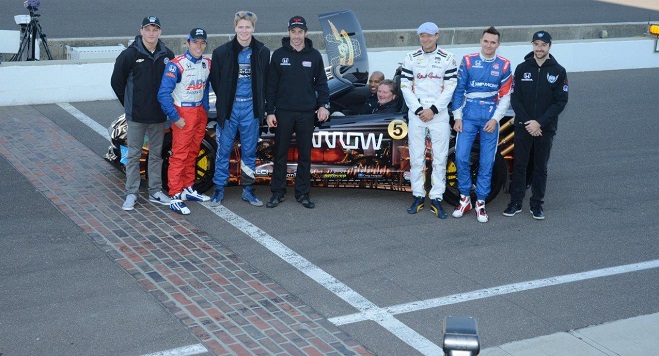
"So the ultimate goal for them is that when I get up in the morning, I get into my wheelchair (RIGHT, LAT photo), and the system automatically recognizes that, OK, I'm in my chair, turns on the coffee pot, turns on the news or whatever, then I roll out into the garage and the doors open and I drive into a vehicle and it's semi-autonomous. But I don't use assistance to do it, or engineers, or anything.
"That's kind of the way it's headed, but you're not going to do this stuff overnight. You've got to take baby steps. But the whole thing restores your faith in what can be done efficiently with private funding. Did I think something like this was possible five years ago? Absolutely not. It's kind of rejuvenated my thought process regarding what our foundation [Conquer Paralysis Now] is capable of and hopefully crossing over from relying entirely on public funds to getting more companies involved in this process."

Latest News
Comments
Comments are disabled until you accept Social Networking Cookies. Update cookie preferences
If the dialog doesn't appear, ad-blockers are often the cause; try disabling yours or see our Social Features Support.