INSIGHT: Someone's always buying IndyCar, Pt 2
click here to read Part 1
). To recap: IndyCar and its teams need money. The X1 Group has proposed a partnership that would bring in money through the flourishing world of online gaming. IndyCar needs to lower its demographic to appeal to more advertisers, and to establish new and younger fans as its core followers edge closer to retirement. The X1 Group believes its virtual-to-reality gaming concept would draw a new generation of fans into the sport.Having drilled into the economic and demographic angles of X1's concept, the next major topics to broach include the commissioning of a new car, a desire to change television partners and, above everything else, whether the X1 Group has the actual funding to support their proposed initiatives.
If there's one area of an alliance with IndyCar that excites Earle more than others, it's the creation of a new car.
"We'd like to move back to an engine that is a little more representative of the sport, a little more ground-pounding, higher-revving, louder, more exciting than what we have today," Earle said. "Depending upon how it goes, maybe have multiple manufacturers, maybe one. It's yet to be determined; there's a lot of politics that has to be played out there for sure."
LEFT: Reynard vs Lola in CART in 2000.
IndyCar partners and engine suppliers Chevy and Honda would likely raise a brow at Earle's dismissive approach to their involvement in the series, but his comments were not aimed at either manufacturer directly. From input received from the series, it's clear the topic of IndyCar and its manufacturer alliances are far removed from any vision an external group like X1 might have.
Earle's raw enthusiasm for commissioning a new car has also been met with some resistance by at least one team owner who, after hearing X1's proposal, suggested Earle follow IndyCar's lead on the new-car topic, rather than dictate to the series in an area that's well outside X1's expertise.
Accelerating the move toward a new chassis is vital for X1's gaming model to take root, and the group is willing to bankroll the DW12's replacement, according to Earle.
"The initial use of funds from the initial capital raised that we have in front of us would fund the development of a rolling prototype, so get the first car built and all the R&D expenses related to that," he said. "Get that on the track.
"Then, do enough testing that we are comfortable that this will be a safe vehicle, a vehicle that will be a lower cost to operate than the current cars. And a lower cost to produce and make things fair. The goal is to come in at a very similar price point from a capital purchase standpoint for the current car. Most of the team owners are not as concerned about the upfront price capital-wise to buy the car; it's the operating cost that they are concerned about."
Earle then moved on to his ideas on the cost and production of spare parts – a hot button item during the first few years of use with the DW12.
"We have some scenarios that could reduce the cost of spares and parts for the team to lower their operating cost," he said. "Particularly around a set of design criteria that will be available for licensing third parties to actually build and be approved to build those spares, introduce some competition into the spares and the running costs so that we can keep the prices down and teams can go buy from whoever they wish from the approved list, and control the cost from that standpoint. That is the initial premise."
Earle also outlined the number of cars X1 would be willing to subsidize for IndyCar team owners who are plugged into the series' Leader Circle program.
"The plan ... the initial use of capital is to build a pool of cars," he said. "One car per team, so if you're a team with two cars, four cars, they will be able to sign up a Leader Circle contract, get a free car for each of their drivers. Just one. Spares, extra chassis, extra engines; it's up to them. But they will get the transitional first car capital-wise at no cost. And that comes from our initial capital outlay.
"And for the initial development of the car, it would be a creation of a pool of 40 vehicles. The goal is to have 24 cars given to the teams that are currently participating, [if they] sign up for a period of time to participate in the series. And the remaining pool of cars will go into a leasing pool to be able to have enough chassis and combinations to be able to field a full 33-car grid at Indianapolis, including the one-off entries for the 500."
its most impressive season of television ratings to date on NBC Sports Network, and also generated strong ratings on ABC
. One of the X1 Group's ideas is to shift IndyCar to FOX, and while having the series presented on network television on a full-time basis would be worth considering, appearing on FOX's cable outlets FOX Sports 1 and FOX Sports 2 would have limited appeal. Like many things associated with the group's proposals, television is an area that requires more thought and consideration."Tie everything we've covered to an international TV package which is in already well over 350 million homes today, then you start to solve a lot of problems," Earle said.
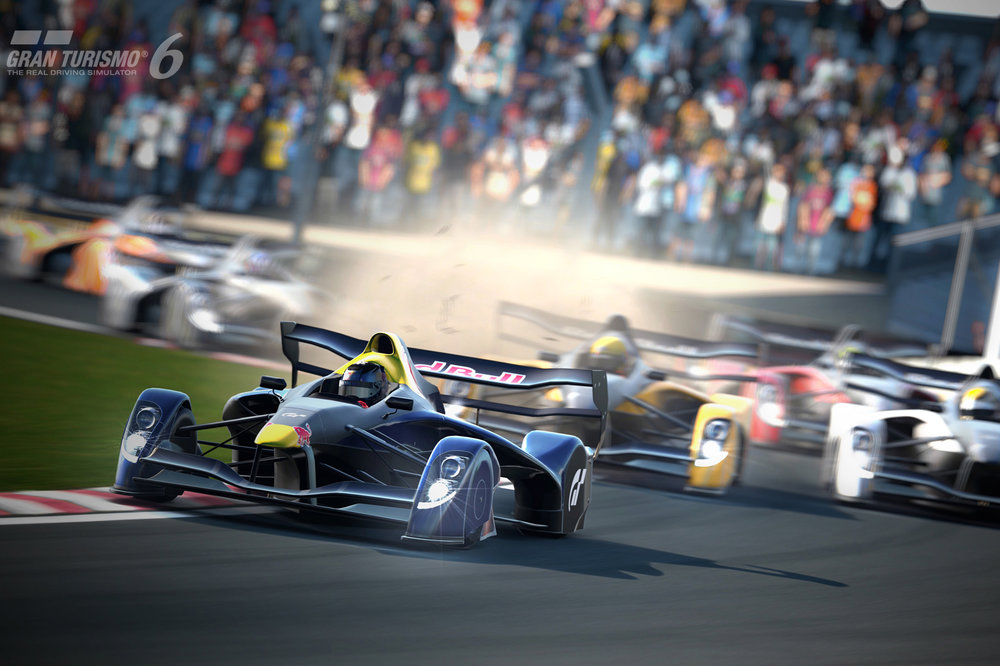
envisioned for the GranTurismo 6 game.
So where does all the money come from to design, build, and supply a full field of Red Bull X1-esque IndyCars? And who'll cover the costs to develop the virtual-to-reality IndyCar racing game that X1 believes could replace traditional sponsorship and sanctioning fees? And how would a costly time-buy on FOX be underwritten?
"All that we can really say is that we have the project well-funded," Earle responded. "There's a couple of scenarios, like I said, and nothing has been discussed as far as a final structure. We do have a lot of ideas out between the two of us, everywhere between a marketing alliance to a joint venture.
"I think it is good for our group and our group of investors and the team, and it is good for IndyCar. We've got to get into the needs and understand what the structure looks like and how it best serves the needs of all parties. That is yet to be determined."
Could the X1 Group actually be a Trojan Horse? Is it an assembly of IndyCar's wealthiest team owners looking to take control of the series by pooling their vast financial resources? Or is it a legitimate effort headed by Earle – an ardent fan who admittedly lacks the chops of a war-torn insider – along with an unnamed group of investment heavyweights?
It's believed billionaire media mogul John Malone, through his Liberty Media Corporation, could provide the financial horsepower to bring the X1 Group's goals to market in concert with IndyCar. IndyCar team owner Chip Ganassi has also had his name mentioned as part of the group, although he denies any involvement.
Malone, through Liberty, has been an investor in the new FIA Formula E series (RIGHT), which makes an alignment with IndyCar less of a far-fetched concept ... provided he's actually behind Earle and the X1 Group. It has also been suggested Malone's core interest is IndyCar's international TV rights, which become available after ABC's rights expire after the 2018 season. Despite multiple requests for confirmation regarding Malone, Liberty, and X1, those asked were unwilling to respond with a definite answer.
"We haven't announced who the media or financial partners are; that's something we want to keep private for now," Earle said. "Until IndyCar tells us how they want to do things, we're keeping that part quiet."
If the X1 Group wants instant success, F1 or NASCAR would represent a clearer path to a wider fan base, although both would come with a much higher price tag to form a partnership. Targeting IndyCar, however, with its current value in mind, would come at a more affordable cost.
"I would characterize it like this: You start with a property that is somewhat stranded at the moment compared to one of the thriving series like NASCAR," Earle said.
"Certainly, from a revenue generation standpoint, it's better to start with a bigger pool [of funds]. However if you look at marketing potential where you can start at a lower investment now in IndyCar because of where the series sits, the upside that is certainly much higher when you look at what could be done if you can execute well on this.
"Starting from the others series where they're already operating at 90 percent or above, new opportunity for growth with a concept like we have is a lot more stunted. From a market valuation of the overall company, you've got a big opportunity to start low and grow high [with IndyCar]."
Of all the tasks facing Miles and the rest of the team that met with the X1 Group at Sonoma, sorting through the ambitions and goals to find a solid answer on their financial support is critical. It's easy to get lost in the myriad possibilities, but without the funding to fuel X1's ideas, IndyCar would be wasting its time. Miles has said his team is digging into the group's backing – just as they should. And as Earle confirms, another meeting is on the horizon that could lead to taking the next step with IndyCar.
"All I can tell you at this point is the proposal has been shared with IndyCar," he said. "I can tell you that it was well received. No commitments, no agreements, nothing in place at this point, except a commitment and an agreement to meet again within the next two weeks to explore further how we could potentially put a structure together that works for all parties involved."
By mid-September, we could have an answer to whether the X1 Group is IndyCar's new and favorite Santa Claus, or if they're another set of dreamers who lack the means to turn their ideas into reality. For those who've stuck with IndyCar through some of its rougher patches in recent years, hoping for X1 to be real is only natural. And knowing how many frauds have passed through IndyCar's paddock, it's also hard to keep every ounce of skepticism at bay.
"I would characterize it kind of like this: there's interest, there is intrigue, there is a desire," Earle said. "There's still a lot of work to do around putting the structure together, and formal agreements to move to the next step."
It's too early to say whether X1 will move past the second round of meetings with IndyCar, but it is clear that IndyCar needs to embrace some of the basic ideas X1 is championing. Expanding IndyCar's funding models for its paddock and the series itself is a worthwhile endeavor. Sponsorship levels – and the number of sponsors coming into the series – are far from impressive, and event promoters are in a constant struggle to turn a profit.
Could gaming serve as a new model to bolster sponsorships and sanction fees? Yes, absolutely. And could gaming serve as the bridge for younger generations to learn about IndyCar and increase its fan base? Once again, absolutely. Whether it's the X1 Group's promise of money and salvation, or Miles leading the Hulman George family to invest in IndyCar's future without Earle and company, action needs to take place.
Stay tuned, IndyCar fans – interesting days are ahead.

Latest News
Comments
Comments are disabled until you accept Social Networking Cookies. Update cookie preferences
If the dialog doesn't appear, ad-blockers are often the cause; try disabling yours or see our Social Features Support.