Five things racers need to know about the 2016 Mazda Miata
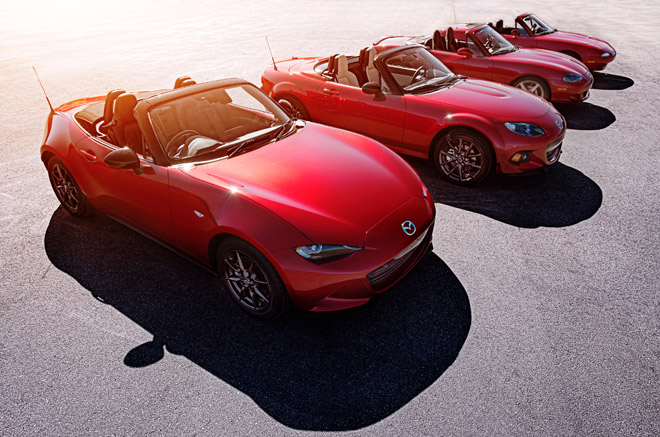
Yes, it's true – every last word. Everything you've read about the completely redesigned 2016 Mazda MX-5, otherwise called the Miata or ND (denoting it as the fourth generation of the car), is correct. Ultimately, this car is fantastic, and if you owned a first generation (1990-'97, the NA) or second generation (1999-'05, the NB) Miata, you'll feel right at home in the 2016. It does everything perfectly while still maintaining enough quirks to remind you that it is, indeed, a Miata.
What quirks? The seats, for instance, weigh next to nothing, but the flipside is they offer zero lumbar support (although lateral support is superb). Also, storage in the 2016 Miata is Mission: Impossible. The rearward center console is chintzy at best, and the trunk opening is ridiculously tiny. But it's a Miata, and if you're shopping for one of these, chances are you simply don't care about the car's quirks – in fact, they're probably endearing. To you, the Miata is about the experience of owning an open-top car, or you desire the driving thrill that comes with an expertly balanced performance car – a car that stand above the competition because, frankly, there is no competition when it comes to the MX-5.
Over the years, other companies have tried to step into Miata waters, but they've failed for many reasons. One of the biggest reasons has to do with weight. The Miata is light. When it hit the market, the NA Miata weighed in around 2,100lbs. Over the years it bulked to over 2,300lbs with the NB, and the third generation Miata (2006-'15, the NC) tipped the scales at a comparatively beefy 2,500lbs. The ND, meanwhile, moves the weight needle down again, coming to rest in the 2,300lb range. This is fairly impressive considering modern airbag and crash requirements, plus items like the ND's standard seven-inch touch screen display.
So if all the good things you've already read about the ND Miata are true, what can we possibly have to add? Well, nobody else out there is looking at it from a racer's point of view. So there are some things you need to know:
 15-inch wheels are not an option
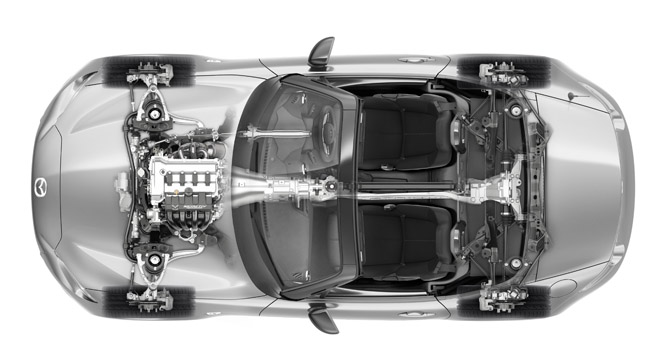
The 2015 Miata utilizes 11-inch rotors front and rear. While it's reasonable to assume a 15-inch wheel would fit over the brakes, caliper clearance dictates at least a 16-inch diameter wheel be used. Interestingly, caliper clearance isn't just an issue in the front; the rear caliper will also not allow the fitment of 15-inch wheels. Should you really want to fit 15-inch wheels, smaller motor versions of the MX-5 released elsewhere in the world offer a tighter brake package, and 15-inch wheels will clear those brakes. Also, aftermarket companies like Wilwood have already started to offer brakes that will clear smaller wheels.
Why is fitting smaller wheels important? In a number of racing classes, from SCCA club racing to autocross, changing wheel diameter is key to not only finding the right width tire, but also dialing in gear ratios. Since there are few 16-inch competition tires available, a stock-brake-wearing ND Miata is limited to 17-inch wheels. And from what we hear, tire width at that diameter might be limited. But more on that in a moment.
 New gear ratios
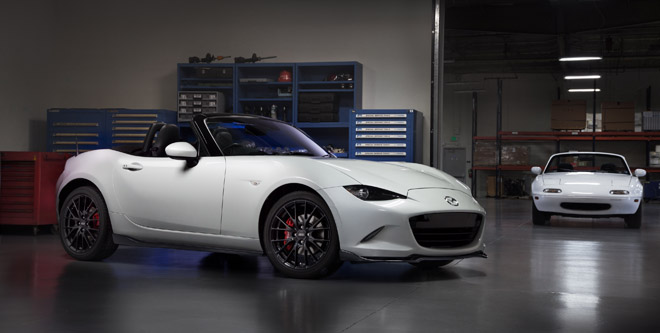
The transmission in the 2016 MX-5 is a new design and is also a very different take on the Miata transmission. It might be a six speed, but unlike other Mazda six speed manuals, its ratios are unique, as is its final drive ratio.
6-SPEED MANUAL
GEAR RATIO
1st 5.087
2nd 2.991
3rd 2.035
4th 1.594
5th 1.286
6th 1.000
Reverse 4.696
Final Drive 2.866
That's a lot of numbers, but what you want to note is that the manual transmission's sixth gear is 1:1; the NC's sixth gear was 0.79:1. According to Mazda's Vehicle Development Engineer Dave Coleman, Mazda swapped to a 1:1 gear because it's the most efficient due to the way gears in transmissions are selected. Since this is the most efficient gear, it's the most likely to improve fuel economy.
One secret to speed on the racetrack for the previous MX-5s is swapping the final drive to a shorter gear, as many Mazdas (and vehicles sharing similar manufacturers or parts bins) utilized ring and pinion gears that bolted in (the exception being the original 1.6L Miata, which housed a six-inch ring gear vs. the interchangeable seven-inch gear). When you combine the final drive ratios that will fit everything from a 1994 Miata through the final NC, the options included 3.63, 3.90, 4.10, 4.30, and a 4.77, and that's not to mention the 4.88 and 5.12 Mazda Motorsports made available.
But because the ND Miata is a new design, there are currently only two final drive ratios to choose from, and both are from the ND: the manual transmission final drive (2.866) and automatic transmission's taller final drive (3.454).
An autocross setup
Speaking of transmissions and final drive ratios, part of what makes the 2016 MX-5 so peppy with only 155hp is short gearing. However, that same short gearing means the car will not hit 60mph in second gear. That might not seem like a big deal, as many cars with six-speed transmissions suffer the same problem, but in autocross competition, not being able to hit 60mph in second gear can be troublesome. The NB Miata with the six-speed manual suffered the same problem and, ultimately, didn't do well in autocross competition where gearing and tires couldn't be altered to compensate. Meanwhile, almost all Miatas from the 1.6L NA through the NC with a second gear capable of 60mph have had some level of autocross success.
Initial reports from The Tire Rack are that even with a larger tire package sitting on the stock wheels, the ND's top speed is limited to the sub-55mph range. There are also initial reports that going too much beyond a 225mm width tire can result in fender liner rub, and since the packaging on this car is so tight, that rub comes dangerously close to brake lines and wiring harnesses.
This isn't to say the ND Miata won't thrive in autocross competition where the rules are somewhat limiting; it just means that some level of development might be in order before the car sees success at something like the Tire Rack SCCA Solo National Championships.
There's no removable hard top...or is there?
The official line from Mazda is that there is no hard top for the ND Miata – which is true, right now. Since Mazda has produced an optional removable hardtop for every generation of the MX-5 thus far, it's not hard to believe one will be produced, we just don't know when. Ahh, but we kind of do.
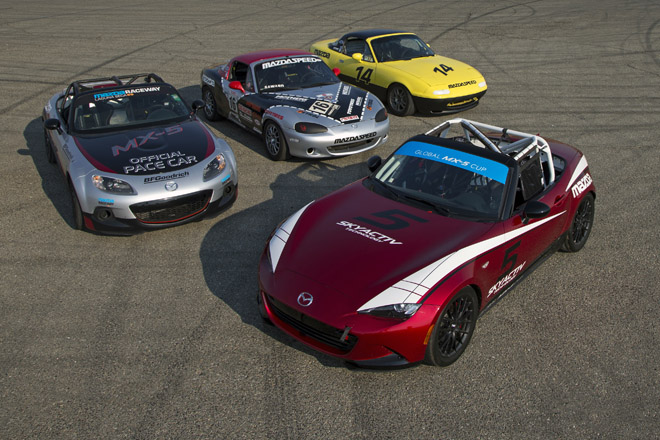
We have received confirmation from Mazda's Motorsports division that the Global MX-5 Cup racecar, which will race in a worldwide professional racing series starting in 2016, is also targeted to race in amateur motorsports, specifically SCCA's Touring 3. For that class, Mazda's Business Development Manager David Cook confirmed a hardtop is, indeed, in development. Undoubtedly, this hardtop will not house street-worthy features like sound deadening, rear defroster, and possibly weather stripping, but it is a hardtop option racers can use. When will you be able to buy one? Don't know.
 The ND's global racing series
As alluded to in the previous section, Mazda is replacing the NC Miata in the Battery Tender Mazda MX-5 Cup Presented by BFGoodrich Tires with the ND starting in 2016. Unlike in the past where competitors would buy an NC street car and convert it to a road race car for the spec series, Mazda will sell complete ND racecars direct to the competitor.
Mazda, however, will not be building these racecars – dubbed Global MX-5 Cup cars – themselves. Rather, Long Road Racing will produce the racecars. Long Road Racing and its lead driver Tom Long have developed the ND MX-5 from street car to racecar, so not only are they producing the cars, they know why each part is the way it is.
Something else unique to the Global MX-5 Cup series is that this will, as the name implies, be a global series, with racers competing in almost identical cars worldwide. We say "almost identical" because it's our understanding based on the roll cage design that there will be left- and right-hand drive versions. All racecars, however, are slated to compete using the 2.0L SKYACTIV motor.

Crandon International Raceway announces first-ever vintage revival & reunion for 2026 Brush Run Speed Festival

Comments
Comments are disabled until you accept Social Networking Cookies. Update cookie preferences
If the dialog doesn't appear, ad-blockers are often the cause; try disabling yours or see our Social Features Support.
.jpg?environment=live)