WEC: "Summit" on Le Mans and the automotive industry
Prior to last week's press conference in Paris presenting the 2015 Le Mans 24 Hours field, the Automobile Club de l'Ouest invited media and auto industry representatives to a conference/debate about the industrial impact of the endurance classic for the major manufacturers.
Meeting with the 20-some representatives of the press who accepted the invitation Pierre Fillon, the ACO President, Vincent Beaumesnil, ACO Sport Manager in charge of regulations, Pascal Couasnon, Michelin Competitions Manager, Darren Cox, Nissan Motorsport Global Manager, Wolfgang Ullrich, the Audi Sport Manager and Pascal Vasselon, the Toyota Motor Sport Group's Technical Director, answered questions from the journalists. Also present was Frederic Lenart, the ACO General Manager.
Fillon opened the proceedings reminding those present of the many innovations for the automobile that were tested and proved in the long history of the Le Mans 24 Hours, such as the detachable wheel, disc brakes, windscreen wipers and quartz halogen headlights. He reminded them of the important technological links forged with the introduction of the new Le Mans 24 Hours regulations in 2014 aimed at encouraging the manufacturers to reduce their cars' fuel consumption by up to 30 percent, while racing on increasingly narrow tires, in phase with current road-going requirements. This aspect is fully in keeping with the challenges that the car industry will have to face, in particular when they're linked to problems of sustainable development.
Vasselon, Ullrich and Cox listed the many advantages – over and above the purely sporting aspect – which the motor car manufacturers draw from their presence at Le Mans in terms of the car market, technology, marketing and image.
Obviously, the image that Audi has forged for itself through its involvement in endurance racing at the Le Mans 24 Hours since 1999, was at the heart of Ullrich's speech, which emphasized the slogan dear to the Ingolstadt make: namely, progress through technology (translated from the German "Vorsprung Durch Technic)." He mentioned the innovative work done on direct injection in 2001, now a technology common to all the gasoline engines in the Volkswagen range, the low fuel consumption of the diesel engines made by this giant in the car industry since the arrival of the TDI engine, victorious in 2006 for the first time, and the arrival of hybrid technologies.
One piece of data made a big impression on those present: in 2014 the winning Audi used 25 percent less fuel compared to 2013 while achieving the same performance, mind-boggling progress in just a year. Another revealing figure was that between 2006 and 2014 the Audis used 62 percent less fuel and continued to rack up victories. He also said that the German manufacturer uses the event to communicate on a worldwide basis with its different importers and asks them to use the strong persuasive powers of the race on all the world markets.
Vasselon pointed out that the engineers working on the TS040 hybrid's powerplant are the same as those working on road-going cars, and they go back to Japan on a regular basis to the Toyota Motor Corporation's Research and Development departments armed with the information gained from racing. At present the competitions branch of the Japanese manufacturer is working on 64 research and development projects, one of which is the Le Mans 24 Hours, which has an effect on all the others. For example, the work done on the inertial balance of the dampers in endurance racing directly benefits the cars sold on the market. It is the same story for the aerodynamic methodology and the simulation tools used to help the LM P1 prototypes achieve top-level performance.
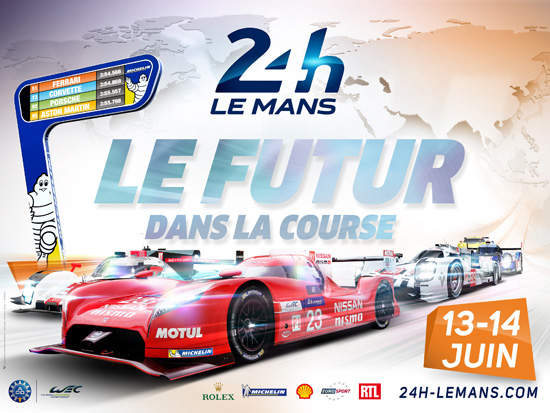
Cox, the Nissan Motorsport Global Manager, insisted on the fact that the arrival of Nissan in the top category to take on such renowned manufacturers in the Le Mans 24 Hours, a worldwide showcase for motorsport and cutting-edge technologies, is the apex of their marketing strategy. Nissan, which is making its Le Mans 24 Hours comeback this year, particularly appreciates the scope and the open-ended spirit of the regulations, which enable manufacturers to enter very different types of racing cars. He noted that the debut of the new Nissan LM GTR in Nissan's Super Bowl commercial demonstrates this. In terms of marketing Nissan also has a very different approach and takes full advantage of the platform provided by Le Mans 24 Hours.
Michelin's Couasnon underlined the fact that the tire technology used in the Le Mans 24 Hours was transferred to the tires on sale to private motorists in under three years and that the physical fitness training program of the drivers and tire technicians in collaboration with the Clermont-Ferrand rugby team were being gradually introduced to the Group's employees, so that they could take advantage of them too. The Michelin Competitions Manager criticized the current anti-car ambiance, and pointed out quite rightly that motorsport is the best possible accelerator for progress.
Summing up, Beaumesnil, the ACO Sport Manager also in charge of the regulations, gave some examples of the future orientation of progress like optimizing driver comfort whose benefits could then be passed on to the everyday motorist, and the development of connected cars:
"Innovation and technological development in the context of capped costs are the keys to future mobility," he said, noting that in addition to the exciting battles on the track in the different categories, it was one of the reasons that united the 263,000 spectators who attended the 2014 Le Mans 24 Hours.

Latest News
Comments
Comments are disabled until you accept Social Networking Cookies. Update cookie preferences
If the dialog doesn't appear, ad-blockers are often the cause; try disabling yours or see our Social Features Support.