.jpg?environment=live)
IndyCar 2014 Review: P3 – Scott Dixon
Marshall Pruett says…
IndyCar fans, meet the master of the comeback season. Take Scott Dixon’s second half of 2013 and add it to the second half of 2014, and you might have the most impressive “year” of IndyCar performances combined.
From the final eight rounds in 2014 that ran from Pocono through Fontana, Dixie’s worst finish was a seventh. Those eight races contained two wins, a second, two fourths and two fifths, along with the lone seventh. Look back to the final nine races of 2013, also from Pocono to Fontana, and the Kiwi put together four wins, a second, a fifth, a seventh, and had two races to forget – a penalty at Sonoma and a hit from Power that ended his day at Baltimore.
Sonoma and Baltimore 2013 aside, those are gaudy numbers for Dixon spanning the close of two consecutive seasons. Unfortunately, IndyCar keeps score in the first half of the season as well, and once again, Ganassi’s opening championship salvo was a misfiring mess. At least by the standard we’ve come to expect from the zillion-time champions.
Even with the huge lead the No. 9 Chevy entry spotted the rest of the field leading up to Pocono, the red team, including Dixon’s new Target teammate Tony Kanaan, mashed the throttle and wreaked havoc on the championship contenders as the title race heated up. The Target drivers were friendly to each other throughout their long careers, yet had no real relationship entering 2014, and by the end of the championship, Dixie and TK formed a powerful duo that catalyzed the program.
The tandem’s performances, and Dixon’s efforts to capture the form he used to win the IndyCar championship in 2013, was shown in his rise through the standings. Ninth heading into Pocono, he left the tri-oval in eighth, moved up to seventh after Iowa, was sixth departing Toronto, propelled himself to fifth after Sonoma, and motored his way to third by the end of Fontana. The entire process took from July 6 to August 30.
Imagine what might have happened if Ganassi got their act together in June…
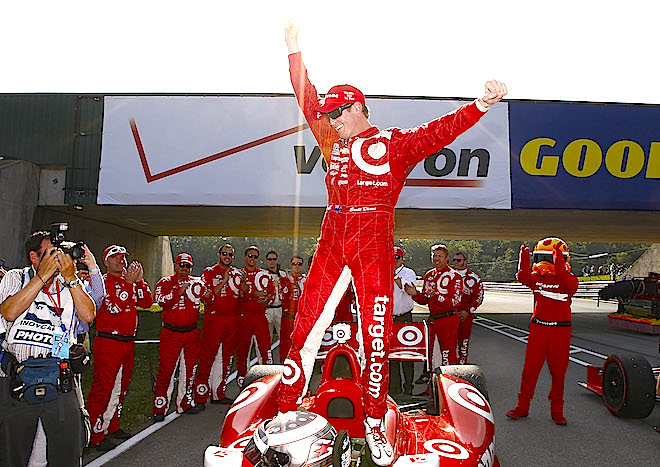
Dixie authored possibly the greatest drive of the season at Mid-Ohio, turning a 22nd starting position into his first win of the year. That race took place on August 3, we've just entered December, and I’m still not sure I’ve processed the Mid-Ohio Miracle. Did Ganassi have a miniature refueling drone follow Dixon around the track and top up the car? I’m still mystified by how fast Dixie coasted through the corners to save fuel while pulling away from the rest of the field.
We celebrate Will Power on his first championship, hail Helio Castroneves for fighting his Team Penske teammate down to the wire, and praise Penske man Juan Montoya for shocking many people with his run to fourth. But for my money, and looking at the true performance capabilities between the dominant Penske cars and the slow starting Ganassi entries, Dixon’s drives in the second half of 2014 might have been the most impressive body of work recorded by any IndyCar driver this year.
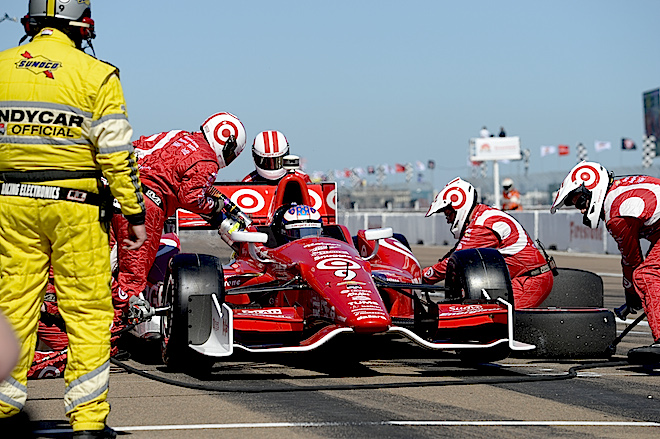
Two wins, a couple podiums and seven Top 5s is a pretty damn good season. Unless you’re Scott Dixon. And while his 13th season driving for Target/Chip Ganassi ended strong, a sluggish start proved too much to overcome in his bid to defend his third IndyCar championship.
Dixon’s annual prowess leads to high expectations and finishing third in the championship behind Will Power and Helio Castroneves was good considering where he’d come from halfway through the season. However, it was too little, too late and mostly disappointing for a driver and team who are used to success.
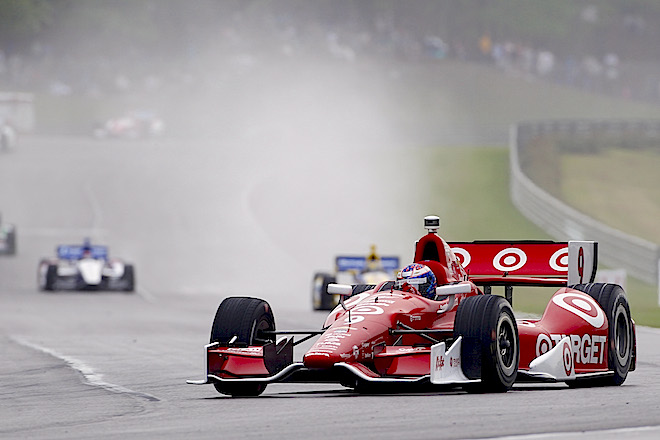
Following a third at Barber (RIGHT), it was 11 races before he returned to the podium at Mid-Ohio. Starting 22nd after sliding off course in wet qualifying conditions, it took alternate strategy, a fortunate caution and all of Dixie’s magic making fuel mileage to end up in victory lane. He led 45 laps in taking his 34th career win and then followed it up with another command performance of racing while saving at Sonoma. When leader Grahal Rahal had to pit for fuel with three laps to go, Dixon was there to snap up the win.
It tied him with Bobby Unser (35) for fifth on the all-time win list and he’s even got a good shot at catching Mario Andretti (52) considering his age, his team and his considerable talents.
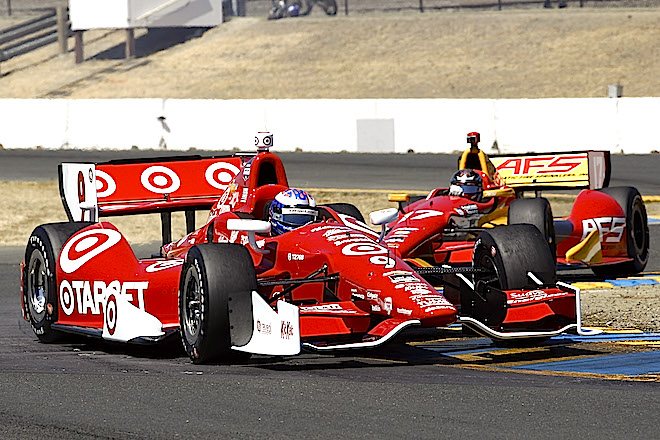
Barber Motorsports Park has been on the IndyCar calendar for five years now, and every year, the race has ended with Scott Dixon in the top three. But in 2014, like last year, that was the sole podium finish in the first half of reigning champ’s season.
Even Scott himself can’t put his finger on why he and/or his team appear to start slow, so often. You have to look back to 2009 to find a year in which the No. 9 Target car entered victory lane more than once in the season’s first half. Sometimes the problem has been bad luck – collisions, mechanical failures, etc. – but this year, as last, it was down to the team missing that last edge of pace.
“The problem is that those last [missing] couple of tenths [of a second] are filled with other teams these days,” remarked Dixon back in June. “Six or seven years ago, if we were at a track where we weren’t quite on Penske’s pace or Andretti’s, we’d still be run top-five or top-six, maybe grab a podium if strategy fell our way. And a couple of races later, we’d be back on the pace and we’d be fighting for the win. Now, if you’re missing a couple of tenths on race day, you’re going to be fighting to stay in the top 10. The pack’s become tighter and tighter.”
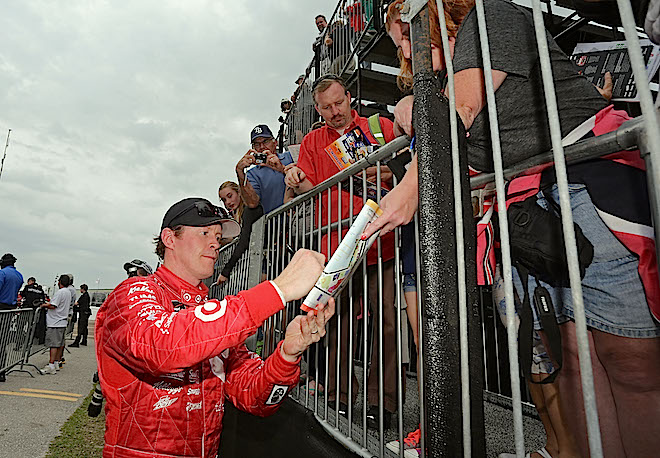
What was the issue? Depends who you asked. Piecing together what little information I could extract from five team members, I came to this conclusion: simply evolving last year’s setups was not quite enough for road and street courses in 2014 (due to tire compound changes, according to some drivers) and the new-to-Ganassi Chevrolet engines have a power delivery that slightly exaggerated the consequent issues with the team’s shock/damper setup philosophy. To explain further, Ilmor, unlike HPD, allows very little driver-specific tailoring of power delivery; that continues to pay dividends in reliability, as we’ve all seen, but is a bit of a culture shock to drivers who like to meddle with engine mapping). Our man Marshall Pruett has also mentioned in the past that there’s a subtle but notable shift in c-of-g and weight distribution between a Honda and a Chevrolet.
The result was the Ganassi cars struggled for traction out of corners, so the drivers had to relearn to be more delicate with the throttle, and the engineers had to rethink the car’s setup to maximize power-down. We’re only talking about being fractions out, but as Scott mentioned above, it only takes fractions to split the good from the average.
So, Dixon was in a dilemma. Should he push on as hard as ever with a car not to his taste? That would increase the likelihood of mistakes. Should he back off from the edge just a little, rely on his race smarts to bank good points? Throttling back is not in the three-time champ’s nature. Plus, there are so many strong teams and drivers, driving at 99 percent is going to cost you.
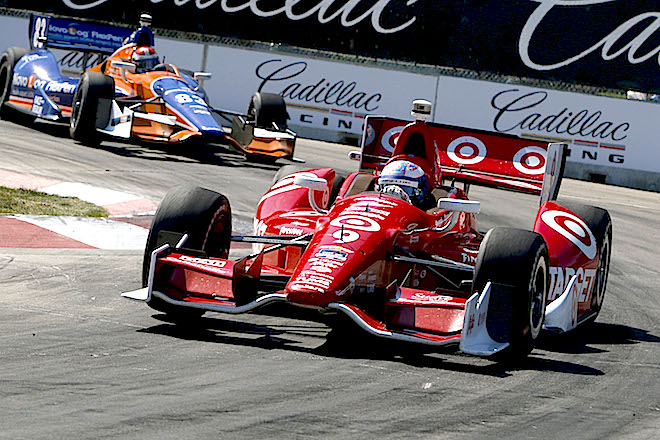
Ovals were a mixed bag for Dixon. At Texas, he and Target teammate Tony Kanaan could run at the same pace as Power and Carpenter, but only at the expense of their tires; each stint, they’d be fast for 25 laps and then fall back, and so they finished fifth and sixth. Yet at Fontana, the season finale, making their tires last for the duration of a stint was what gave the red cars the 1-2 finish. Clearly good progress had been made on the big speedways, and until they got jumped by the new-tired Ryan Hunter-Reay and Josef Newgarden, this pair was the class of the field at Iowa, too. But interestingly, aside from Texas, it was Kanaan ahead each time on the ovals. At Milwaukee, both complained of tire issues, but it was TK who made the podium.
So clearly even a driver who has been an ace in the sport for 15 years still has things he can learn. Those victories in Mid-Ohio and Sonoma, by contrast, were merely examples of what he’s learned already. Pretty amazing, yes, but also a blatant reminder of why this guy has finished in the top three in points for eight consecutive seasons.

Latest News
Comments
Comments are disabled until you accept Social Networking Cookies. Update cookie preferences
If the dialog doesn't appear, ad-blockers are often the cause; try disabling yours or see our Social Features Support.