.jpg?environment=live)
IndyCar: Revised, more powerful engines on tap in 2014
With two years of strong competition between Chevy and Honda under IndyCar's 2.2-liter turbocharged engine formula, planned upgrades for the 2014 season have given both manufacturers some leeway to make more horsepower and torque.
The 2.2-liter displacement remains unchanged, but many items have either been opened for re-homologation or redefined.
Changed from the original set of engine rules produced in 2011, manufacturers are now required to build V6 engines, which is altered from the previous language that simply restricted the number of cylinders to six. The option to use single- or twin-turbo systems has also been revised, deleting the single solution altogether.
Of the open areas for Chevy and engine partner Ilmor Engineering, and Honda through its Honda Performance Development arm, almost everything that attaches to the block was available for a complete redesign or major modifications.
"The whole top end, basically from the fire face up is what Chevrolet took a look at and improved on or went away and redesigned and hopefully came up with a gain," Ilmor IndyCar program director Wayne Bennett told RACER. "That's what we did. Basically from the fire face up, the heads are different based on the same casting, the plenum is different, induction system, fuel system. All of things we're allowed to change we did."
The move to a larger spec turbo
allowed Chevy and Honda to start from scratch with new exhausts, turbo piping, a larger plenum, and to position the turbos within the chassis as they desired. New heads, provided they fit within the existing casting, and new camshafts are permitted. High-pressure direct-injection fueling has been the norm since they began racing in 2012, and both manufacturers took the opportunity to combine what they've learned with fresh ideas as new DI systems were developed during the off-season."The homologation table gave us many items to look at," added former HPD technical director Roger Griffiths, who spoke with RACER before leaving the firm. Cylinder heads, camshafts, induction system – it's all new because of the twin-turbocharger layout rather than the single for us. We looked hard in every area. I don't think there was any part that was not looked at, that didn't go untouched. Some areas gave a good opportunity for improvement. You have that list in front of you. Everybody in the past year or so you've been looking at what the 2014 engine could be to look at all of things that you would've done differently if you had the time again.
"You can't just take one item in isolation, everything works together. So if you come up with a new port shape for a new valve size, or whatever, there's an interaction with what's going on with the piston crown and what's going on with the camshaft, the lift or the duration or both, the timing. Everything works together. With direct injection the whole system is a lot more sensitive to what's going on. So you can gain power and you can lose power if you don't get that recipe right. So you've got to pay a lot of attention, you can't just assume that everything that you think is going to be better will be better because if you don't get that combination right, you'll be off the pace."
The rule limiting new heads to fit within the previous casting was done to reduce costs, according to Griffiths.
"It does limit the scope of what you can do but it was done with cost as one of the driving forces when we laid out the regulation," he explained. "Between IndyCar, Honda and Chevy, we looked at what's the sensible way to go. Was it all new cylinder heads where you could have completely free reign over everything? That would involve new castings – which means new tooling, which is pretty expensive. You're talking about hundreds of thousands of dollars for the tooling. What we tried to do was give ourselves the flexibility to work within what we had.
"When you designed the original casting, you left that amount of material in there for future improvement, you have to get the balance right between not creating a cylinder head that's monstrously large so you can change the port shape, you've got a water jacket in there so you have to respect that, that kind of thing. You give yourself a little bit of latitude but you also have to remember that you don't make something that's bigger than necessary. So it was trying to find the right balance between giving yourselves opportunity to play around with the combustion chamber and things like that versus trying to keep the development cost under control."
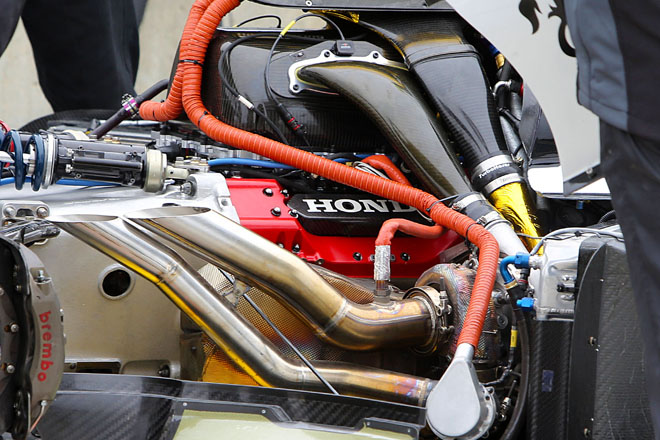
"Weight is always a concern of race teams," said Bennett. "When the race team is so heavily focused on weight we have to do our part and spend time looking at areas where we can reduce weight, especially ancillaries. Obviously, the engine has to be a set weight. So if you're at minimum weight in the engine, then really the only improvement you can make is either the distribution – put them in slightly different spots to help the team move weight around, or you reduce the weight of the components, allowing the team then to put weight wherever they want within the car. That's always a big focus. And probably more so this year I think than the last couple of years."
Observing the respective Chevy and Honda engine installations, the Japanese brand has gone to great lengths to move its turbos as far forward in the DW12 as possible. By comparison, Chevy's 2014 exhaust/turbo system looks very similar to what was used in 2013. With both manufacturers required to use the same turbos, the ability to move them closer to the front of the car only helps to improve the rear weight bias that plagued the Dallara upon its introduction.
{igallery id=4315|cid=80|pid=5|type=category|children=0|addlinks=0|tags=|limit=0}
"As I've said many times before, a good engine always helps but the engine is just one part of the equation and everything needs to work in harmony," Griffiths noted. "You probably recall from when we first had the DW12, a lot of people complained about the excessive weight percentage at the back. We listen to what the drivers want, what the teams want. And what can we do to help with the center of gravity? We look at heat management, we look at turbo location, the exhaust system. You kind of keep everything, the hot parts in one area and the cool parts in another area and separate the two.
"You don't ever run out of ideas on where to find more horsepower but you start looking at other areas and say, well, there are other means. Ultimately, it's about how fast can you go around the racetrack. And you can achieve that in many ways. You can achieve that with more horsepower, you can achieve that through center of gravity, you can achieve it through the overall mass of the car. So it's finding the right combination, which we've tried to do by moving our turbo packaging as far forward as we could."
Honda's move from a single turbo mounted in the bellhousing behind the engine to two turbos bundled into the exhausts – behind the radiators – has also given HPD a first crack at optimizing airflow over both turbos within the sidepods. And with the new turbo layout, a matching plenum design was done in tandem.
"A lot of simulation work went into coming off of the plenum solution that we had, and it was a case of how did you package it or where did you want to put your turbos?" Griffiths continued. "If you put the turbos here that means the way to get air to the plenum is there. If you put your turbo here... Perhaps you can exploit a different entrance into the plenum, what would fill the best, what would be easiest to work? Many things went into the shape of the plenum, the location of the entry to the plenum, what the transition from the pipes look like. It wasn't just the case of how we're going to figure out how to package it. Any part, any design is a long list of compromises and it's just making the right choices."
IndyCar's engine manufacturers have also seen the minimum mileage threshold between rebuilds increase from 2000 miles to 2500.
"The other challenge is not just trying to find more performance but it was the durability aspect, which that's a huge challenge to go up effectively 25 percent," said Bennett. "That's been a huge focus, durability. Our focus, we've been very focused on the durability side anyway but even for the engines that were at 2000 miles, this was a big step to try and get the engines to 2500 miles reliably and squeeze more power out of it. And even now continually running durability work in other areas to see if there's ways we can squeeze a bit more here and there. More power, more reliability; it's a tough puzzle to solve, but that's what we're always after."
Chevy and Honda are unwilling to quantify accurate power figures in road racing trim for 2014, but with the number said to be "between 700 and 750" by a senior staff member from manufacturer, all of the hard work from both marques should result in more speed and excitement this season.

Latest News
Comments
Comments are disabled until you accept Social Networking Cookies. Update cookie preferences
If the dialog doesn't appear, ad-blockers are often the cause; try disabling yours or see our Social Features Support.